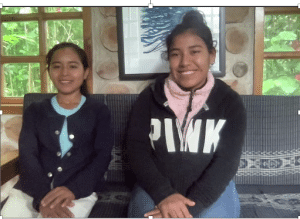
 This oral history interview with Yolanda Regina Cao Mez and Ixchel Melida Poou Beb took place on October 28, 2024, and was conducted by Peg Spitzer and Karina Yager with contextual interpretations and translations from Qʼeqchiʼ Maya into English by Robert Cahill. It lasted 123 minutes.
How has climate change impacted your community? When did you first notice this, and how did it continue? What do you think the future impacts will be?
Yolanda: The impacts of climate change that we are currently witnessing are affecting many people. As we know, there have been droughts and a loss of resources, especially in agriculture. Crops have been affected not only in quantity but also in quality, as in the case of cardamom and coffee.
In some communities, including where my parents work, cardamom is no longer being harvested at the same levels. Over the past two years, we have already seen these changes take hold. People are working every day, yet their efforts often result in little or no yield, which represents a significant loss of resources.
In other areas, rising temperatures have also created serious challenges. For example, when people wanted to plant corn, they had to wait for rain that did not come. Many had planned to plant as early as March but were unable to do so in April or May and only managed to plant something by June.
These changes have especially affected people living in rural areas, particularly small-scale farmers who depend on agriculture for their livelihoods.
From my perspective, this situation will continue to impact people in the coming year. Those who once relied on harvesting cardamom and coffee are now producing only a fraction of what they used to—perhaps 5 to 10 percent of previous yields. Both the quantity and quality have declined. In response, some efforts are now focused on planting and reforestation to restore the land.
To look toward the future and find ways to improve and restore our environment, we have been working with small groups of young women to establish agroforestry plots. This practice helps protect crops by providing shade. In many cases, people clear trees before planting, but when temperatures rise, crops suffer significantly. By contrast, when sustainable practices are used—such as integrating trees into coffee or cardamom cultivation—the crops are better protected from heat and more resilient overall.
Rob’s contextual interpretation (RCI): Agroforestry mitigates the climate extremes. The droughts are more survivable because of the trees. And the big rain events are more insulated because of the trees. Traditionally, what people do is if they’re going to plant something, they just go in and clear, cut everything, and then they plant their crop. Now the new way is to think about the trees first and then the crops.
What are agroforest parcels?
Yolanda: The agroforestry plot means combining agriculture with a variety of trees alongside the crops we plant, such as cardamom. We intersperse the crops among the trees so they can grow under shade.
RCI: For example, Yolanda’s family produces cardamom. Putting cardamom with trees is an agroforest parcel. If you have trees and you have crops together, then you have food forests, which I think is a better term. The idea is that the trees are providing carbon, some trees provide nitrogen, and all the trees provide carbon and insulate against droughts and flooding.
Are the trees native?
Yolanda: We work with both native trees, including fruit and timber species. This approach has many advantages. For example, people can access firewood not by cutting down trees, but by pruning them when needed. This allows us to use resources more sustainably.
Over time, there are additional benefits. After about five years, these trees can begin to produce fruit. What can be planted depends on the climate. In warmer areas, people can grow crops like mangos or sapote. In other regions, like where I live, we can plant grafted varieties such as oranges, lemons, and other fruits.
This diversity is both interesting and important, as it supports livelihoods while also helping to restore and protect the environment.
RCI: The trees can be grown for wood or for fruit, and depending on where you live, different kinds of trees are suited to different climates. People in hot climates can plant certain varieties that thrive there. Yolanda, for example, grows mangos, which do very well in the warm climate where she lives. Our kids used to call mangos “pumpkin pie fruit” because they taste just like pumpkin pie. They’re delicious and full of vitamin A.
There are many kinds of fruit trees you can plant, as well as trees for firewood or timber. Yolanda also pointed out that you do not always have to cut down a tree to get firewood. Some trees, like the Inga tree, can simply be pruned or coppiced. You collect the wood for fuel, and the tree grows back again. In fact, the tree often flourishes when it is regularly pruned.
There are certain kinds of trees that do that. And they make wonderful firewood. There are all kinds of these sort of nature-based solutions that I think Yolanda is particularly high on because her parents are facing a problem with the cardamom harvest.
Cardamom is huge in Alta Verapaz. In fact, sixty percent of the world’s cardamom comes not just from Guatemala, but specifically from Alta Verapaz. If cardamom were considered part of U.S. national security, this region would be seen as a major geopolitical hotspot.
The cardamom plant naturally grows in the understory of cloud forests in India. It evolved to live beneath the forest canopy—that is where the plant is happiest and healthiest. And now, more than one hundred years after cardamom was first introduced to Alta Verapaz, people are finally beginning to understand that cardamom thrives best when it is grown within the forest, not apart from it.
Ixchel, how would you answer the question of how climate change has impacted your community? When did you first notice this? And how did it continue? And what do you think that the future impacts will be?
Ixchel: The impact that climate change has had on our community has been very sad for me because it has created serious challenges for our health, our nutrition, and our overall well-being. For example, this year it has felt like summer almost the entire time. Only now has it started to rain a little, and we are already just two months away from the end of the year. There has been almost no water and so much heat.
RCI: And for example, this summer, it was just it was we had a half a year of summer like we had we had very warm weather. The weather they usually have in April, they had from January to May and it didn’t rain, it was hot and it was breaking records. It was record breaking hot: It exceeded the temperature by a half a degree. It exceeded the temperature four degrees or five degrees.
Ixchel: And with this we have had very low water. The water is drying up in almost all communities. Like us we have had the experience of going to different communities to conduct health surveys and we realized the great need for water.
RCI: While this was going on, they did a health survey in several different villages while we were breaking all these record temperatures. The idea was to do a health survey. She saw the people literally just running out of water.
Ixchel: Some of these are large communities, and they are practically the only source of water for cities and other places. The impact has been very strong. Where there used to be a spring, it has dried up, and now the whole community is without water.
People have tried to save their crops using agrochemicals, because there is no longer enough water, no longer enough resources. So, farmers turned to chemicals to try to rescue what they can. But this also affects our nutrition, and it affects our lives.
With all of this, we have also lost native crops and trees. We have seen trees that were planted years ago dry up because of the drought. This has affected us deeply.
How did I realize the scale of the impact? Through what we are living. Where I live, in Cobán, we used to go and collect water from a spring. Now, it is only rocks—there is not a single drop of water. Our main water sources have dried up. We depend on rain, but with so much pollution, even the rainwater is contaminated, and people no longer trust it to drink.
And now, thinking about the present and the future—we are starting to see the rains come, but very little. And when they do come, the impacts are strong. There are floods, loss of resources. The trees, which are what hold and protect the mountains, have been weakened by the drought. Their roots are damaged. So now, when the rains come, there are landslides and flooding. And with so much pollution and garbage, the water has nowhere to go.
All of this is affecting us. And if we do not act now, our future will be very short.
RCI: I just want Ixchel to talk about their experience because when they came down from this village, they had so much to say. The village is right underneath this enormous cloud forest that should be one of the one of the places where water is the most abundant. It is supposed to be the most the wettest village of all.
Ixchel: Well, when we went there, it was very difficult for me because there is no water. It is assumed that this is where the source of water for most of the communities in the lower part mainly comes.
RCI: They were just living without water. And that was a new experience. She thought that her home village was kind of an extreme situation. But when she realized that, in this village, they’re just literally living without water.
Ixchel: Yes, it is something we never imagined—that we would find families living like this, without access to drinking water. And this is in a place where there is still so much forest! I don’t know if people have not taken care of it, because there is still deforestation happening, and now there is no water source.
People were already suffering from water shortages earlier in the season. And then April came, which is usually a very hot time, but by then people already had no water. They were waiting for rain, even a little, but it did not come.
It has a very strong impact on people, especially in communities that are far away and already have many basic needs, especially when it comes to water. Because if there is no water, we know there cannot be good health or hygiene.
With water, we can care for our families, for our children. But without it, I see how it affects the health of children, and really, of every family.
RCI: It’s eight thousand feet … really high up on the mountain and or seven thousand, five hundred feet. And usually, they’re wearing coats most of the year. And it was hot.
Please describe your work and/or education. How did you become involved?
Yolanda: About the activities I currently carry out… Well, I started participating in 2018, first as a participant and second as a teacher in 2020, but I focused on providing workshops for children, young people and mothers. And there are some groups in institutions that can participate.
RCI: Starting in 2018, Yolanda came to CCFC as a participant in the WALC program and she became a teacher in 2020. She teaches groups of children, of youth, of adults. Many different organizations send groups here, including field technicians for workshops. Yolanda is teaching in all these different capacities.
Yolanda: These activities really catch my attention because they are urgent—not only for young people, but for everyone in rural communities. For me, the importance is in helping to instill values and principles about caring for natural resources and everything around us.
I am especially focused on working with women in rural areas, so that they can learn about how to care for natural resources, but also to become leaders—agents of change in their communities. And it begins in the family. Because it is not always possible to go directly into a community and form groups right away. The first step is change within the family.
From there, little by little, they begin to think differently, to analyze more, and to participate more—in their communities, and even at the municipal level. As women prepare themselves, that preparation opens other opportunities in their lives.
Ixchel: Well, I study social work. When I entered the WALC Program as a participant, I began to understand the importance of everything around us—because it gives us life. After that, I also became a teacher, and I carry a deep sense of gratitude for what exists around us, because we are part of it—we help complete it. I think it is very important for everyone to understand this.
And so, my work now is to reach more people—people who have the desire to continue, to seek change in our world. Because this is the only planet with life, and if we do not take care of it now, we will not have a future, as I mentioned before.
As for my background, I was born in Cobán. I am from Cobán. My mother is from Tucurú, and my father is from Tactic, but I was born and raised in Cobán. Before all of this, I focused only on my studies. As a family, we also had small-scale work—we raised chickens and other domestic animals and then sold them.
At one point, I realized that my thinking was very limited. We focused only on that work, and while we knew it was important, it kept us within a small circle. We were focused on producing, but we were not thinking about how to care for our environment—our land, our soil, our forests.
Through the opportunities that have come to us, I have learned how important it is to take advantage of them, because they open our vision. They help us see that it is not only about ourselves, but about the world—about life in all its forms, including people, plants, and animals.
In my family, we also grew up speaking three languages. It was sometimes complicated—we would mix them when we spoke—but it is a great strength. My parents speak Poqomchi’, when we came to Cobán we adapted to Q’eqchi’, and my father has always spoken Spanish with us. Now, this ability allows us to connect with more people. As we work toward change, being able to communicate in three languages helps us reach others and build support.
Ixchel: My course of study in high school was focused on technology, in particular, computer science. And since I live near the city of Cobán, my world is different.
Yolanda: I also studied computer science in high school. I loved learning something about technology because it was something new and different. For example, in rural areas, those of us who were studying in elementary school had no knowledge in the use of computers or telephones. After graduating from high school, my mom bought me a phone, and she started to learn how to handle a phone.
RCI: She is one of the very few people that got a phone after she graduated from high school and learned how to use it.
Ixchel: In reality, where we are now, we realize that it is not exactly the technology, but instead the most important is what we have, the environment, because technology at any moment ends. But we are ending our world with technology.
Yolanda: I am in my fifth year of social work. I just need to do my practicum and then I’ll become a licensed social worker, with bachelor’s degree.
RCI: To give you a context about their level in school, when they went out and did this this health survey, they found that fifty three percent of the mothers that they talked to had never been to day one of primary school. Over fifty percent of the mothers of the twelve hundred mothers that they surveyed hadn’t gone to school at all. For Yolanda who is from a very remote village, finishing her bachelor’s degree in university is like interplanetary travel.
Yolanda: Well, since I was a child, I studied, but also with my parents we have always worked in agriculture. My dad is a farmer, and my mom also raised chickens and turkeys from domestic fowl.
Because of these agricultural activities, my parents were able to pay for me to go through junior high and high school. The primary school is free with the government, but then for junior high and high school, I went to a private school, and they had to pay for that.
RCI: Both Yolanda and Ixchel are in private universities and must pay for that.
Are you part of the community that you serve?
Yolanda: We are already part of this community, but we can also participate in other groups where we will also talk about the care of our common home, because it is everyone’s responsibility. But I also had thought that if God allows me to live, then maybe in the future, I could form small groups with children or women who can also talk about the care of the spaces we have to have something in the future for the children and for the new generations.
Ixchel: I am part of the community where I serve, as well as the space, or I am part of the watershed where we work in general. So, with this we seek to reach more hearts.
Are there people in your life who have helped you and what challenges did you find in this, in this direction of your life?
Yolanda: Yes—going back to the beginning, when I first started studying, the most important people for me were my parents. They are the ones who have contributed so much to my life. They always told me that to study, I must struggle, to move forward, and to keep learning new knowledge.
Through that, I began to participate in different groups, and I also had the opportunity to meet people in communities like this one—communities focused on conservation. Since I started in the program, I have met people who speak about life projects, about women’s empowerment. These experiences have helped me grow and have strengthened the ideas my parents first gave me.
They helped me see that women who want to keep going, who want to struggle, can achieve their goals. They can find spaces to participate. Maybe our parents did not always have those opportunities, but we do. And if we make the effort, if we keep going and participate, we can reach those spaces too.
At the beginning, I met people like Don Roberto and Doña Tara, and then many others. As I listened to more stories, I came to value the voices and experiences of women. One example that has stayed with me is a woman named Elvira Max. She fought for her dream of studying. She wanted to continue, but she did not have the economic resources. So, she began working from a young age. She saved a little every month, year after year. She even invested those savings, and little by little, she was able to earn more. With that, she was finally able to begin her basic education.
As we know, in many of our communities, continuing school is not easy—you often must leave your village to do so. Stories like hers were shared with us, and they inspired me to continue.
I also always kept in mind that I wanted to study, no matter the limitations. First, I studied in my community. Then, for my next level of education, I had to go to another municipality, San Pedro Carchá. It was difficult to leave my parents, and it made me sad, but I had to go and study in a boarding school. There, I learned to be strong.
And I also learned that by participating, by going to new places, we can find new opportunities. And those opportunities continue to strengthen us, increasingly, every day.
RCI: She mentioned one person. And that’s a person who was our coordinator. She was in the program as a participant and then became a coordinator like they have done. Elvira Max had a really tough childhood. Her parents had to flee during the war and had a very difficult experience trying to go on, to go to junior high, what they call basico, so just to get to junior high, she had to work and save money. Every year she saved back some money until she was able to pay for her first year of junior high school. People like Elvira have taught her to value the opportunities that she has.
Ixchel: Well, in my life—along my journey—I have had people who have supported me. At every step, we look for support. And first are my parents, who have always motivated me.
As I continued studying, my thinking began to grow, and my desire to keep learning grew as well. So, every opportunity that has come to me, I have tried to take advantage of it—every training, every learning space—because it is so important.
Our focus is on the environment. We have had the opportunity to go into communities and carry out health surveys, to really get to know the heart of each family—their homes, and how they live.
Through this, we are trying to raise awareness among more people—those who are already doing this work, and those who truly need and want change around us. We want to continue building that awareness, to help recover our home—our common home—that we are slowly losing.
So that is our focus now. That has been our work – taking advantage of every opportunity, every piece of knowledge, every experience that is shared with us. Now, we see ourselves as agents of change, and we are looking for more people who want to become agents of change as well.
RCI: Ixchel signed up for extracurricular educational opportunities. And that’s why she’s here too, because that came along as an opportunity.
How do people find out about CCFC?
RCI: It’s kind of just more of a word-of-mouth thing when we when we started. We still work with schools, we still let teachers know about their programs, and we still let the village leadership know about our programs and so on. In Ixchel’s case, another institution let her know about it. In fact, other institutions publicize opportunities on the radio or through the schools. These kinds of educational opportunities get around.
What are the challenges that you encountered in doing the work that you do and in developing your passion for the work that you do?
RCI: Elvira’s story is that she couldn’t continue to junior high school in her village. And that is still the reality in both of their communities—the highest grade available is sixth grade. For Yolanda, if you want to continue studying beyond that, you must leave and go somewhere else. She said it was very hard to leave her parents. But at the same time, that experience made her stronger.
Yolanda went to what she called a “solution school,” where she received a very strong kind of personal formation. I’m not sure if you’re familiar with these schools—they are part of a Catholic educational model. But they do important work, especially with very low-income communities, focusing on empowerment and long-term development. They really leave a lasting impact.
Ixchel: Well, personally, one of the biggest challenges in continuing to study is the risk of dropping out. In my family, my brothers and I all had the opportunity to study, but not all of us were able to take advantage of it. In my case, I am the first to reach university and to complete a diversified level of education—while the others stopped after basic school.
Now, in our institutional work, we are facing a similar challenge. Soon, more girls and young women will be joining the program. And our concern is that they might participate for a time but then stop studying.
Our biggest challenge now is to encourage them to continue—to help them make a change within themselves, and in that way, to support them. Because our goal is not only to reach the individual who enters the program, but also her family and the wider community she comes from.
But is there a high rate of teenage pregnancies? Is that one of the challenges or one of the things that are that really prevent young women from being able to achieve what they might want to do?
RCI: That’s our number one problem.
Yolanda: The indices that have been published – and that we’ve seen with our own eyes – is that we have a very high incidence of teenage pregnancies from twelve to nineteen years of age. About two or three weeks ago, a colleague told us that there are more than 67,000 pregnancies nationwide [in Guatemala] and it is a problem that is really going to affect the family, the future of those children who are going to be born and us as professionals.
Institutions give us more work, but we also must be a little more strategic or we must look for more strategies to solve these problems, because it implies having more malnutrition, poor health, and fewer opportunities. If there are many children who really will not have enough, they will not have enough nutrition because their mothers are minors.
With that amount of teenage pregnancy is there also embedded in that kind of system a bit of domestic violence that results from this?
Yolanda: Yes.
RCI: Yes, the published indices reported sexual abuse, and many were members of the family itself. I don’t remember the exact figure.
Yolanda: As is well known, there is also a lot of violence against women and that affects children. And, perhaps for that reason, girls look for other men outside of the family as a refuge, perhaps to find something better and leave. But that only perpetuates the problem.
Ixchel: When we were doing our health surveys, some mothers refused to talk to us for fear of abuse from their husbands. We also observed girls who were left at home to take care of their little girls in the family, simply because they were girls and they weren’t allowed to go to school. We saw that firsthand and thought that was not right either. The impact of this is serious.
It is difficult to enter their homes because they fear repercussions from their husbands. Or there are also cases where the young ladies are single mothers but live at home with their parents. In this case, the father’s violence is much greater, much stronger towards the daughter or the wife, because she is a single mother, right? And it’s even worse if the child is a girl. Violence is a perpetual cycle (“chain by chain”). The woman’s obligation is to stay at home. Sometimes they are let outside to farm the land – it depends on how much the family needs food. But they never have an opportunity to study.
How do women and girls learn about family planning and reproductive health?
Ixchel: [Through the WALC program], they learn how to take care of themselves and how their body is evolving. Everyone is different. When one reaches the age of having a partner, they need to know a contraceptive method. Earlier, they had to learn how to take care of themselves when the menstruation process begins, right? So things like that they learn from the doctor or nurse.
RCI: At CCFC, a doctor does a whole reproductive health workshop for several days, like five, six days during the WALC program. She covers from everything from menstruation, all the way to a having a partner and family planning methods and so on. This is a very important component of female empowerment, right?
Ixchel: Each of the girls who enter the WALC program come from different environments, so the subject is taboo – bad to talk about reproductive health. Sometimes because girls don’t have this knowledge they end up being a single mother or when they are very young mothers, right? And then not being able to take care of themselves after becoming a mother or taking care of the baby. In these spaces, WALC teaches how to take care of ourselves as women and at the time one is a mother.
RCI: So, the problem with this being a taboo subject is that for those girls that are not learning about this kind of stuff is that they become a mother at a very young age or they become a single mother and so either of those are good options.
It’s better to inform yourself and get educated about reproductive health. So that you can be empowered to make the right decisions to protect yourself, you know, not just from pregnancy, but from sexually transmitted diseases, for example, you know, just to protect yourself from abuse. And you know, the, the woman that come now, I’m going to just mention something, but in our program, the five, six days that this doctor comes here, she talks about everything from, you know, sexual violence, sexual abuse, you know, and so really the whole thing, you know, so everything that has to do with sexual health. Nothing is taboo here.
Is there anything you would like to add Yolanda?
The focus of the program or the community helps girls to have knowledge of their health, because it is the most important thing for everyone. It also talks about taking responsibility for protecting our resources such as forests. It is a space that we can save, we need to take care of ourselves because it is part of our life. If we are going to pollute, if we are also going to continue deforesting, it is also another problem that can affect us. And it is for that reason that the program or this community helps women understand that our environment is a very beautiful space, important for everyone. There are spaces, for young women from rural areas so that they have knowledge about their life projects, their health and the care of the environment.
How can those outside of your community, maybe even those people who live in the Global North (aka, the developed world) support your work?
Yolanda: Institutional development is very important – to support each other by supporting the development of the institutions. So for example, we have a higher capacity to reach more people that there’s limited space, but we want to have a higher capacity to bring this program to more people, right now, maybe in one village is just a couple of people that can be in the program and we want to extend that to more people. We need to continue to strengthen the institutions that we’re working with, so that we can get this out to more people in a larger area.
Ixchel: Because of the nature of your [oral history] work, you’re listening to our stories and you’re able to spread to share their thoughts with others. We’re very much in this together. And if we’re if we’re trying to become better developed and to take care of our water, and then on the other side of the world, people are not then it’s then it just cancels each other out. If we if we can all pitch in, we can all do this together, and then we can make a difference. What you’re doing is very important because you’re able to amplify and spread the word about what other people are doing in the world.
Yolanda: With this opportunity that I had through the [oral history] interview, I feel that it is also the part that helps us understand that we as human beings are aware of knowing what is happening on our planet and as we well knowing that not all institutions are interested in helping or informing students of how climate this change is affecting our planet. We must take responsibility and let us also be part of [the solution].
It is true that in the majority, such as in our country of Guatemala, not all institutions are interested in this, only NGOs. Until this year, government institutions are not interested in improving. I have heard that there are some that may also have regulations on care, but, but it is not this, they are not their priorities, but rather they are focused on other areas and that is why I have seen that only NGOs that are talking about climate change – what we are going to do, what we should do and what we should not do.