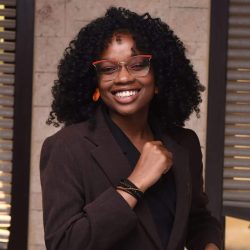
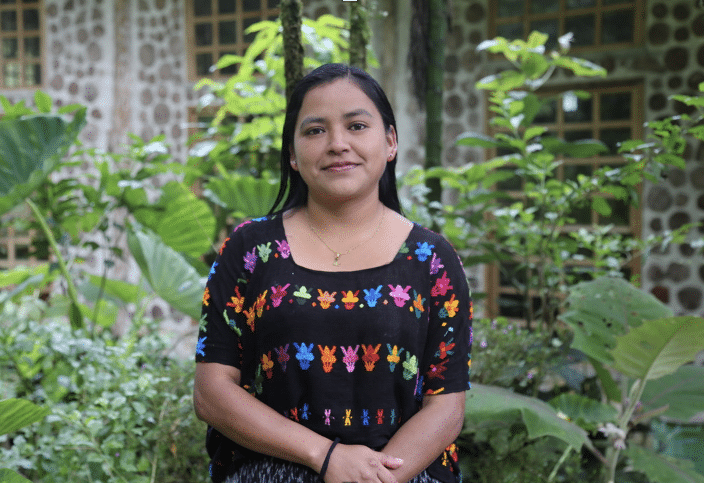
 This oral history interview with Sara Elvira Caz Si and Silvia Leticia Mez Caal took place on September 9, 2024, and was conducted by Peg Spitzer and Karina Yager with contextual interpretations and translations by Robert Cahill. It lasted 93 minutes.
How has climate change impacted your community? When did you first notice this, and how did it continue? What do you think the future impacts will be?
Sara: When I was a young girl, the temperatures were much lower. I’ve seen drastic changes from 8-10 years ago. Now, temperatures are around 35°C (95°F), which for the elevation level where I work – 1500 meters (4900 feet) – is unheard of. My home village’s elevation level is 1800 meters (5900 feet) and the temperature this year of 35°C (95°F) is unprecedented.
This year, there was a drought from January to May, and springs dried up – even the ones right around my house where I normally would get water. People didn’t have water. They were used to getting water but this year, there was a drought. People really didn’t notice exactly when the springs began to dry up but my parents or grandparents might know. Still, it’s a huge change and the cause of the change is burning fossil fuels. We’re burning forests and we’re burning our garbage. This cause is burning of forests, fuel and trash causing contamination and means that there are fewer forest areas. There used to be huge extensions of forests and now we have deforestation. Wherever you go, the forests are burning and it’s all causing too much CO2 in the atmosphere.
Very few people are acting to find solutions to this problem – there are just a few people thinking about what can be done to confront it.
Silvia: When I arrived in the cloud forest area in 2001, it was very cold and foggy. Today, the fog is gone, the cold is gone and it’s hot. And there are big hurricanes. The most recent hurricanes that passed through here devastated the landscape where I live and there were landslides. The principal cause of all of this is humanity… we are continuing to do this, and we can’t blame God for this. It’s us! Very few people connect their actions today with what’s going on in the climate. For example, they see a tree as an obstacle when they really should be planting more trees. Instead of cutting down trees, we should be protecting the forests. The forests are our allies in this climate fight.
It is important to preserve nature for future generations. I worry that kids today (and even ones who are not even born yet) won’t be able to enjoy the natural world – the incredible forests. We live in the green heart of Guatemala, and I am worried that future generations or even the young people today won’t know the nature that I grew up with. And I am only 22 years old.
I realize the effects of climate change in my daily life. In the village where we do health surveys, I used to wear three sweaters and a jacket in high elevation areas of about 2500 meters (8000 feet). Usually, it’s cloudy and wet all the time when we are there in the coldest month of the year in February. In the village of Cesar, most of the families get their water from rain roof water. They have tanks set up under the roof and there’s usually constant rain up there and so there’s more than enough water. But this year, there was no water from the roofs and the springs where they usually go to get water were dry and so they had no water at all. This was in February when the dry season hadn’t started yet!
The dry season typically starts at the end of March and April. To be up there in what is supposed to be the rainy season and for everyone to be without water, is jolting and alarming. Also, the groundwater is so depleted that even the springs weren’t running. After I left that high elevation area and returned to my home village, I worried about what these women were going to do in April (the dry season). There’s still no rain and what in the world are these families going to do?”
Sara: The women must buy water, and the problem is that they have no money for that. The springs were dry, and the roof water was empty. It’s not just one village. To see that, if we’re continuing down this path, where are we headed? This is not a great future when these extremes are becoming frequent. People must resort to buying water. The [Guatemalan] government is not interested in helping — and much less so in faraway villages. If people have money, they can buy water. But if they don’t have money, then they can’t buy water. There’s no help from the government.
Please describe your work. How did you become involved?
Rob’s contextual interpretation (RCI): What happens in the Women in Agroecology Leadership (WALC) program – the program that Sara and Silvia are part of – is that young women come from villages all around northern Guatemala. They come here and then leave to be agents of positive change in their communities. They come from a lot of different communities. Secondly, not just in the WALC program but all throughout the year, boys and girls from primary school and secondary school, youth educators, teachers, school administrators, and women and men from different villages come here, to the Community Cloud Forest Conservation (CCFC) center, to be “extension agents.” Men and women from different villages will come here to receive training and they’ll return to their villages. That process of education and equipping is done by Silvia and Sara and about 15 other people.
When people come here for these training sessions, it’s not just about learning theory but it’s putting theory into practice. They get their hands dirty: they plant and harvest. They work on questions of food security and climate resiliency. Not just in theory, not just on a chalkboard, but out in the field. Every single one of the young women in the WALC program specifically will return to their home village with an agroforest parcel to implement conservation practices. This makes their agriculture more resilient to climate change. It’s through agroforestry and our big push is teaching, equipping, and setting up young women to be agents of positive change.
Sara: My work focuses on merging theory with practice – and working with my hands.
Silvia: Through the WALC program and throughout the year, I work with many different people – even midwife groups who attend training sessions. I work with schoolteachers, children, university students, and even people from the Ministry of Agriculture. We have a real breadth of people that we are trying to reach. In the schools, we’re putting up school gardens. In the communities, we’re putting community gardens. All the young women are learning about adding value: They can take their harvests and make it into something more valuable so that gives them a foot up economically … to get a better price for their goods.
RCI: Silvia was the one who had the idea to create a women’s leadership course. She then designed and taught it.
How did Sara and Silvia learn about the Community Cloud Forest Conservation (CCFC) NGO and the WALC program?
RCI: Sara was 13 (just out of primary school) when she first came into the 25-day WALC program. She had an older sibling in the program. Sara went back to school and then returned for another 25 days the next year. After that, she was out of the program for many years until just this last year, when she was 21 years old. She attended her third 25-day program and then stayed on as a part of the teaching staff. [Rob mentioned that he has a database of the years and photos of all the students that have been in the WALC program.]
Silvia was 21 years old when she first took part in the program. A cousin told her about it. So, in both cases, Sara and Silvia had family members who had been part of the program. In 2016, when Silvia was leaving junior high school, her parents didn’t give her permission to go on in school until she was 21. Because she wanted to be a part of the WALC program, she received a scholarship to continue her formal schooling. That was nine years ago.
Silvia: I noticed more about the environment because of the WALC program. It was a kind of environmental education. It was an “invitation” to open our eyes to what’s around us. Sara has already mentioned the marvels of nature but also, I noticed the changes and challenges of our environment. I think that a lot of times we can go through life just so blind to both those things – the negative and the positive. One thing that I received from the program was to be conscientious and aware of what is going on in my surroundings.
RCI: There are 12 distinct classes. Some of the classes have two teachers and some have three teachers. WALC consists of approximately 18 teachers. The program only happens during vacation (i.e., from October to January). Sometimes there are participants/leaders in each class. There are 12 participants/leaders consisting of young women who previously participated in the program. These women then may go on to become teachers. The bottom rung is the participant/leader, then the next rung is the teacher, and the next rung is the program coordinator.
Before you became involved in this work, what was your educational background? Where did you grow up? Are you part of the community that you serve?
Sara: I returned to the WALC program when I was studying at the university in
my 3rd and 4th years. My major is criminology, and I am also going to start studying to be a teacher in physics and mathematics.
When I was younger, the questions I wanted to answer were ‘What is it that creates a criminal? What are the factors that contribute to people turning to crime?’ In addition, I was interested in understanding how criminals get started as delinquents. I noticed that crime is a huge factor in the society today –and that there has been a dramatic increase. I am looking at the psychological or sociological perspective. I’m not interested in putting yellow tape around a crime scene or taking fingerprints.
There are many victims of sexual misconduct. A lot of times, their cases never get resolved. The cases just sit on someone’s desk, and I think that this lack of response has a tremendous negative impact psychologically, emotionally, and socially. Because sexual crimes (and sexual abuse) affect the whole society, I became interested in studying criminology.
Silvia: I finished junior high and was in a college preparatory program – something called “maturity.” I completed two years of coursework within one year. Because I was a little bit older, I went straight into university in 2018. For the first three years, I majored in social work and then changed my major. Now I’m studying Sociolinguistics. I changed from the Social Work Department to the Education Department to concentrate on bilingual education in Spanish (in the Q’eqchi’ Maya context.)
It was natural for me to study bilingual education. Communication problems are particularly acute in rural villages, and farmers were confronting everything from malnutrition to violence. Initially, I was interested in social work
because it provided analytical tools to understand more about what’s going on in the villages and the problems that people are facing in the villages.
I decided to study Sociolinguistics because I observed that, in the school system, a lot of people were abandoning their native language, which is Q’eqchi’ Maya. I don’t think that this is a good thing. Mayan languages are in danger of extinction, and I want people to be able to be educated in their native language in their mother tongue.
RCI: We have had this conversation many times – that ‘the pages are dropping out of the playbook.’ All around the world, people are trading in traditional knowledge for TikTok, and that it is a bad trade.
Silvia and Sara, where did you grow up and are you part of the community that you serve?
RCI: I need to clarify that a village may just be a set of houses, and that the culture (including language and dress) is part of Pan-American identity even though Silvia and Sara grew up in different places from where they work today. When they enter a
village, they treat the residents as if they were first cousins.
Sara: I was raised in the village of San Marcos Tamil and that’s where I live to this day. I
was born and raised there. That’s where my parents are, too. There is a cultural dynamic when you go from one village to another. You’re seen as an outsider but, because of the Pan-Mayan identity, we are accepted. Just two weeks ago, I did a session for 30 women from a different village who spoke a different language. We (the teachers and I) were accepted as agricultural promoters.
Silvia: I was born in a village outside of Koban. When I was five years old, I moved to another village where my extended family and I live to this day.
RCI: Sara and her group weren’t seen as different: There was just no ‘otherness’ going on there – to use a phrase that people use a lot today. They were very much seen as ‘We’re in this together. We’re Maya people. We’re rural. We’re indigenous. We’re women.’ They have far more in common than they had differences, even though they don’t speak the same language. Pan-Maya identity is very strong. A lot of people wonder whether Guatemala will ever descend into tribal violence (conflicts between the different language groups in Guatemala) and I could never see that happening. People see themselves as Maya. They see themselves as Indigenous and/or they see themselves as rural.
Regarding mentors or supporters: Who helped you along the way and how?
Sara: I learned a great deal from two medical doctors and a nutritionist. They were key in helping me to prepare to conduct the health surveys in the field. I learned how to teach people in their homes about hygiene and health and nutrition and water. When we were in every home, we had a series of survey questions to ask but we also had learned how to be good teachers. The doctors and one nutritionist often came to CCFC during that program (one is from Minnesota and the other is from Virginia). So that would be a kind of professional development. Other people at CCFC – Max, Fleur, and Adela – were important resources. The daily life of the WALC program was an opportunity to learn, grow, and focus on becoming an agent of positive change.
Silvia: Tara Cahill, Rob’s wife, and other people that I work with daily are my mentors. Also Dominga, who teaches sexual and reproductive health in the WALC program. Students learn about family planning and basically everything that goes with sexual and reproductive health. Even the guy who talks about rotational grazing is a mentor.
RCI: Professional and personal development is a key aspect of the WALC program. In fact, we refer to it as a “life project” where everyone is equipped to be an agent of positive change. The program is holistic — a very complete picture. Some people in CCFC are local and some are board members (like Max): Basically, they come out of our rolodex.
What challenges did you encounter?
Sara: For example, when we are out in the villages doing health surveys, some people don’t want to talk to us. They don’t want to participate, and they are not always very nice. Or, after walking 45 minutes up a mountain to a house and the person isn’t home. All the challenges that they face, we can solve. For example, when we hold training sessions with women who spoke a different language, we find someone who has been in the program to come back to serve as a translator. When we encounter a problem, we figure out a way to solve it.
Silvia: Other women ask me why I am in the WALC program. They would say that I was never going to be good for anything. I must focus on the vision and the path. By having a proposito (a purpose or a goal or objective), I have a path forward. One prominent attitude in society is that women don’t have the right to study – that women don’t have the right to self-determination. But we absolutely have the right to study. We have the right to prepare ourselves professionally and personally. I am very much an advocate for women’s rights.
Finally, how can those outside of your community (even those in the Global North) support your work?
Sara: The learning and knowledge that I have gained from the WALC program is a big help and a big support. I am motivated when I know that people from the Global North give me positive reinforcement. Also, I am motivated by helping others. For example, I’m working with a young girl who’s going to participate in some activities at her school, and I can help her lose her fears (to move beyond her fears). I am motivated by being in a role where I’m helping others. It keeps me going forward. And I value “negative” feedback so that I can correct bad things. Having a dialogue about the negative and positive is helpful. (This is a skill/tool that I learned in the WALC program.)
Silvia: If it wasn’t for the WALC people who supported her, I don’t know where I would be. Maybe married with six kids! The support along the way made a big difference. Also, being corrected inspires me to feel that people cared enough to give me advice on what to do and what not to do. That kind of learning has been helpful for me in making life choices.