

From P. Spitzer. Empowering Female Climate Activists in the Global South (Emerald Insights, 2023), Chapter Two.
The Bhungroo Story
 As a young woman from an urban, middle-class family, Trupti Jain was 22 years old when she first visited rural Gujarat. Three years earlier, she had graduated from college with a degree in environmental engineering and joined an NGO to do research on the economic impact of the environment. She then began to work for the government of Gujarat and, within two decades, rose to a position in which she headed up national programs and managed a staff of between 70 to 180 people:
I learned through that [job] the quality of the staff and how it is working is most important. I wasn’t trained to be in management. I had to learn how to work with my team members and collaborate with those at the upper levels.
As part of her work, she became interested in improving women’s living conditions as she traveled through the region and witnessed the effects of all the unpaid work that women did outside of the home. She found that fully 86 percent of the activities to maintain the farm were done only by women while men migrated to other, larger farms to find work. After carefully observing their work activities, she decided to incorporate women’s activities as part of environmental management – to make their activities sustainable. She believed that women had to become empowered not only in Gujarat but also in other Indian states; and that, if women could get economic power, they would regain their dignity. Economic power equates to power within the family as well as outside it and nourishes women’s agency rather than dependence.
Throughout her government career, Jain learned that at both upper and lower levels of management – in state or local levels, acceptance of women occupying positions of authority must be cultivated. This same struggle takes place in American academic institutions, government agencies, corporations, and everywhere else, a struggle that is ongoing in the face of entrenched old boy networks. In her position, she was not easily accepted because she was a woman. “I must put in extra effort for it. My life is easier now that I don’t get angry. I was frustrated because I have the same capacity, educational degree, and so on.” Jain also discovered that she could not gain support from other women, even in her government position. Sisterhood is supposed to be powerful but, in my experience, doesn’t always operate in real world settings. She also realized how women were treated at the local levels in the Penjyad:
Our many women have been in contested elections at the local Penjyad (the village governing body) in the village of Mehtan. In India, in 1992, the 70th Amendment was passed in the constitution of India. So now the 70th Amendment is saying that at least 33% of the seats for the Penjyad are reserved for women only. What was happening was that the dummy candidates had been put on the Penjyad because men don’t know that the seats were reserved for women; and, even if they did know, they don’t know how to work it out and make the decisions. So, in the name of the women, only men were always working in the Penjyad.
 Even though she had no experience in how to run a business, Jain left her government position and the political realm to establish a social enterprise. As she and her husband, Biplab Paul, formed Naireeta Services, they realized that they still had to work with governmental institutions to receive endorsements in many different regions. Jain knew that it was important to have a supportive male spouse (or father or brother) in facilitating women’s acceptance into leadership positions in a male-dominated world. Men can (and do) act as brokers or intermediaries in figuratively opening doors to women as women seek to enter previously male domains of work and power. By cultivating relationships, Bhungroo became officially recognized under the “National Rural Livelihood Government Program,” in which every state in India can have an allocated budget to use the Bhungroo irrigation technology. In fact, some state governments – in particular, Uttar Pradesh, Andhra Pradesh, and Bihar – gained primary authority to institute programs. In essence, Jain’s experience in the government – and acceptance that she needed her husband to gain acceptance – resulted in the Bhungroo irrigation project becoming a pilot for the government allocation of funds.
While Jain herself knew that women farmers also could be entrepreneurs, she recognized that farming sectors dominated by men usually don’t acknowledge women’s deep agricultural knowledge: “Women have years and years of experience, but people don’t recognize it, not in terms of money and not in terms of appreciation.” Thus, in pitching the program to farmers, Jain and Paul emphasized the fact that families could regain a sense of dignity, self-worth, and independence by working their own land and not having to work on other, wealthier, farms. In fact, once Naireeta Services implemented the Bhungroo irrigation system on their own land, farmers tripled their incomes.

In farming villages in Gujarat, Jain focused on giving equal opportunities to any woman who wanted to become a “climate leader” and would be effective in “selling” their knowledge to other local farmers. Naireeta Services pays women to learn about the irrigation technology products, including the price structures, methodologies, and applications – for drip irrigation, fertilizer application, seed selection, and so on. Their role is key because farmers must deal with lots of problems like cropping patterns and watering cycles and, while there are consultation services in the cities, small/poor farmers cannot afford them. At the local level in farming communities, she found that much of her work involved convincing women that they could learn the technical and planning aspect of Bhungroo. “No one has entrusted them in so many years. We had to go to the male farmers and ask them to convince the women.” In the farming villages, she focused on cultivating women leaders by incorporating female staff and giving them leadership positions:
I am trying to develop their capacities. Women have leadership qualities. Women must have self-respect and self-dignity. The second thing is that as a woman leader, I must make sure that I address the stakeholders and point out that they can learn from this (with women as leaders). It is hard, but we need to both understand it and project it in the right platform.
This suggests that forming women-centered and women led local organizations as parallel structures to existing male led ones may be one effective means of catalyzing rural change, including with respect to the climate change. However, this may also elicit a patriarchal backlash among men who feel threatened by the emergence of non-subservient women. This is like racial and gender politics elsewhere, including countries in the Global North.
 As she began to implement the program, Jain didn’t know whether local women would support her and was surprised when they did: “They enhanced my knowledge and gave me moral support when I got frustrated.” Furthermore, as Bhungroo and Naireeta Services became recognized internationally, Jain found a common purpose with others, including one Indian woman, who was a deputy director at the United Nations and had struggled for recognition. Jain was encouraged by many international feminist environmental leaders like Madhu Kishwar and Vana Sival, Sunita Narayal, and even her former boss, Rita A Teaotia, who, after Jain left her government position, became the secretary of commerce and industry.
At the core of the Bhungroo program was a clear acknowledgment that Naireeta services could not change the land rights system in India. They had to look for another way to help women farmers gain power over their lives:
Within the government, I fought a lot. But I did not take an activist approach. In this position, I did a lot to try to give the land rights to the women because only 3% of women have land rights in our state [Gujarat]. Because they don’t have the land rights, they must put up with a lot of domestic violence. They don’t have anywhere to go and there is a lot of domestic violence. I couldn’t change the government structure either. I thought that if I want to do something for the women, I had to be part of the government. But I realized that trying to change policies doesn’t change things at the grass roots level. So why not devote time to Bhungroo to get irrigation water? We wanted the water rights to go to the women. If they did not have land rights, then why not give water rights to these women?
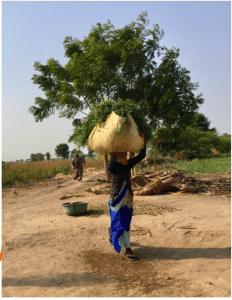 Again, this suggests the value of establishing a parallel power structure to the existing one. Land is power, water is power. Naireeta Services was the institutional mechanism Jain and Paul used to promote the Bhungroo program. One major challenge was that the state government assumed that they would be available, free-of-charge, to promote the project. The reality was that dealing with government bureaucracy required enormous time and energy, including making presentations and shadowing the trail of paperwork that required official Memoranda of Understanding (MOUs). At the same time, they experienced difficulties in overseeing the installation and maintenance of the irrigation technology in the field: While the state government allowed for the construction of 3,000 Bhungroo irrigation units, it turned out, as one might expect, that some units did not work for various reasons. Therefore, they needed people outside of the village structure to regularly monitor and oversee the units.
Initially, Jain and Paul didn’t plan to establish a social enterprise. Because Jain had worked for two decades in Gujarat implementing development programs for the national government and Paul had worked on accounting procedures for a local NGO, they did not know what it would take to establish a profit-making institution in the form of a social enterprise. At the same time, while they were establishing Naireeta Services, they became somewhat overwhelmed by the international awards they received (including an award in 2007 through the UNFCCC), and extensive media attention all over India that highlighted the way Bhungroo supported local communities.
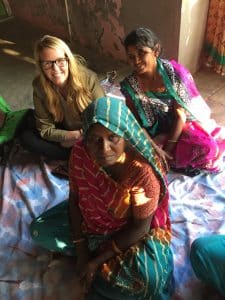 They soon realized that they needed a steady flow of funds to sustain the program. It took four years to identify the best legal structure — to replicate, scale it up throughout India, and register it. It was challenging to identify the right legal structure to register as a social enterprise. They didn’t know what kind of taxes they would need to pay or how to calculate startup costs; and tax and accounting liabilities initially were quite difficult to understand. They began to receive support in the form of mentorship from a variety of organizations, including the Indian Institute of Management in Ahmedabad, which has an information management program, and faculty members from Stanford University in California about legal liabilities and debts. Also, the Ashoka network, where Paul had received a fellowship, helped them understand the benefits of social enterprises.
In the meantime, farmers from other regions who were having problems irrigating their land asked Paul to help them combine his knowledge of hydrology with their traditional knowledge of the land. It took six or seven years of trial and error before they came up with several different versions of the Bhungroo technology. [Presently there are thirteen different versions.] According to Jain, “Now, the publicity is by word-of-mouth so that we get a key tool for marketing from that.” In addition to local farmer interest, outside organizations provided monetary support and more publicity, including the World Bank’s Department of Science and Technology, which enabled them to form partnerships outside of India. As Jain described it: “We had never planned to work in Vietnam or Ghana, but the partners approached us, and we eventually got the right partners to help us.”
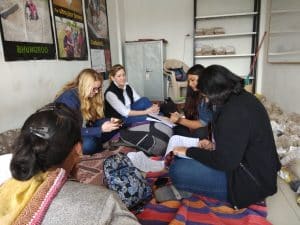 In addressing all the parts of how to work through government channels, address farmers’ needs, empower women, and gain support from outside of India, Jain and Paul were under a lot of pressure: An idea that began as a small endeavor was rapidly expanding. Still these additional interactions provided new motivation to have an impact in adapting to climate change disasters. For example, Jain’s and Paul’s in-country experiences with local and national government institutions enabled them to appreciate the intricacies of project management in other countries. In addition, they realized that the only way for women to sustain a sense of purpose within their families and communities is if the institutional channels were structured correctly.