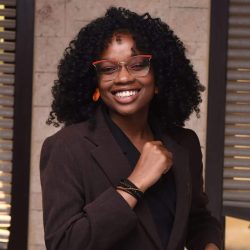
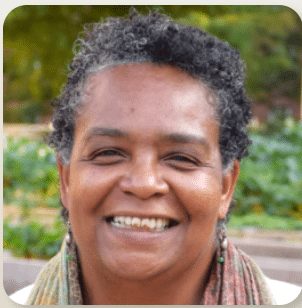
This oral history interview with Tonya Gayle took place on April 2nd, 2024, and was conducted by Peg Spitzer. It lasted thirty-nine minutes.
How has climate change impacted your community? And when did you first notice this? And how did it continue? And what do you think the future impacts will be?
Well, I am a native New Yorker, born and raised in Brooklyn. I did not grow up in public housing, but I grew up, like all New Yorkers, surrounded by public housing because one in fifteen New Yorkers lives in public housing. I first really started paying close attention a little over ten years ago, when I was working at the Housing Authority (aka NYCHA). I came across an organization, which I now run, Green City Force, because, at the time, the previous executive director and co-founder, Lisbeth Shepherd, was working in partnership with the Housing Authority. She came to us and talked about her vision of taking all the people in New York City that are the hardest hit by environmental injustice and creating tools for them to be agents of change, to transform the communities they come from while building their workforce skills. So that was when I started paying close attention to the idea of climate. By then I had built my career on workforce development, young people, and serving communities. Climate was the added layer.
Actually, it’s been longer than 10 years – for the past 14 or 15 years — all of my work has been with communities, not where I live, but where I work and serve.
I’m seeing the real effects of outcomes. I’m now involved in something called Rainproof, NYC, which, 20 years ago, would never have been a thing. Now, we’re trying to understand solutions to climate issues that we’re used to in the American South and all these other areas. The work we did during Superstorm Sandy is a great example of all we did on the ground for those in public housing.
It took me a little while to realize that climate change is real and that it has layered impacts of, you know, systemic problems that need to be addressed, and we need to tackle holistically. We’re trying to do that through our work at Green City Force.
What do you think the future impacts of climate change will be in our Greater New York community, especially in the underrepresented communities that you’re serving?
I want to try to take an optimistic lens and say it this way. If the current CLCPA (Climate Leadership and Community Protection Act) and federal commitments that are in place hold past this year, and if the state policies and the New York City laws around building codes – and climate justice — if those policies translate, stick and commit to deliverables, then I think we will be in a great place. We have very specific issues related to climate change, including jobs, health resources, and housing. … if the commitments that Mayor Eric Adams, Governor Kathy Hochul, and President Joe Biden have made really do prioritize marginalized and disadvantaged communities. If those things come to fruition, and the direction and thought is right, then we should be fine.
If there’s going to be any sort of “meat on the bone,” following the launch of these announcements, then we will be in a great place, because it means New Yorkers will be educated, and they’ll be prepared. They’ll be driving decisions around what it takes to create sustainable safety and health and resilience. And that’s a way forward. It’s a good starting point. And in my opinion, if it works, and if we stick to it, and commit to it, then we’re on our way to where we need to go.
How are the communities in New York that you serve impacted by climate change?
Okay. Take urban forestry and the heat island effect. Cities are hot in the summer and some parts of the city are hotter than others because there are no tree canopies. More affluent communities have robust tree canopies, and it affects air quality and heat. Contrary to popular opinion, more people die from heat stroke than from the cold. The percentages are higher in heat. Low-income communities have lots of concrete and not a lot of shade. Also, there are not a lot of cooling centers, resources or electricity for air conditioning. And these barriers cause severe health issues.
We need to train communities and our members to champion, literally a forest coalition. That’s about planting a million more trees in New York City, training people to be stewards, so that they understand how to maintain and keep the quality of trees. This is a simple, natural, example of how climate solutions can just come from education and commitment of community. We must prioritize messaging because you may not automatically think about the relationship between heat stroke and the need for more trees, but those things are real connections.
Another classic one is in the Bronx with the high volume of exhaust and air pollution from transportation: the Major Deegan Expressway (“the Deegan”) breaks up neighborhoods and causes all kinds of asthma related issues, and health disparities. We need campaigns to support clean energy and electric vehicles, and transitions through freight and all those deliveries that go through all parts of the city, but particularly through low-income communities because the community is not empowered to stop them from doing that. Those are examples of how frontline communities are disadvantaged and affected by a lot of health and climate challenges.
Could you describe your work and how you became involved?
So Green City Force is a nonprofit, and our mission is to train young people, young adults to drive a green and inclusive economy through service. We are a workforce nonprofit organization. We are also an AmeriCorps program. Young people between 18 to 24 years old join us full-time for 6 months at first and then, if they want a second opportunity, for 10 months after that. But most of our folks come in for 6 months full-time. They have completed high school, but they have no next step training towards a career track. They come to us primarily because they need income, and they want training. They want a job because they’re low-income folks. And so, when we bring them into our program, we use service learning as a platform to teach folks about our environmental justice challenges. We train them to understand what the climate crisis is and how it affects the communities they come from: What are some of the solutions? What are careers that work towards these solutions? How could they be agents of change?
Through Americorps, we deploy our members into service, to go back into public housing communities across the five boroughs. They educate other residents about the climate crisis. They educate community members about what solutions can happen locally, where they live. They build and manage urban farms on public housing properties and grow and distribute food to the local residents. They collect food scraps to learn about how to create compost from the community that goes back into the soil to grow the food that goes to the community. They learn about solar installations and off the grid, closed loop systems, rainwater catchment and circular economies.
They do all of this while also learning about energy, education, how to reduce your carbon footprint, and how those savings and solutions can help sustain the public housing that they come from and where they live.
And we work with them to then get placed in jobs, whether that’s green infrastructure, construction, green construction, urban agriculture, solar, other clean energy types of roles, you name it. Our whole model is built around the young people from the communities. We center narratives of what their value potential and talents are and uplift them to be the force that truly highlights the need and power of thriving communities as driven by folks across the city.
It sounds like what you’re doing is empowering many young people through this.
We’re finding young people with great potential and talent, and giving them a platform to thrive.
About how many people do you serve?
We have anywhere from 100-150 people full-time during a year in cohort groups of entry, and then we have a population of seven hundred graduates who are in various places and roles throughout the world. Some of them we hire back to be graduate staff members with us. About a third of our staff are graduates, and others are deployed into all different types of career tracks. And so sometimes we do training. We might do upskilling. We might bring them back quarterly for gatherings and community engagement. We’re working full-time with a couple of hundred folks a year, with the goal of growing over the coming years.
How do you become involved with all these people? I mean, it’s amazing to think about that.
It’s exciting. Yeah, it’s mission driven work for sure. As I said, the last part of my career training was the climate piece and folding that into my other experience. What’s fabulous about it is that people come to us because they care about the workforce. People come to us because they care about the environment…I mean young people and other people. So, the world comes to us because they care about public housing or they care about young people of color, or they care about systems change in the world. For anyone who’s interested in any of the things we do, there are different ways through our website, through volunteering, through donation. There are all kinds of ways to be involved, and there is value in win-win partnerships for us. We have employer partners; we have training partners. We have all kinds, community partners, outreach partners to help get the word out to other young people to come into our program.
What is your educational background? You mentioned a little bit about that. You grew up in Brooklyn. In that sense, you are part of the community that you serve. But can you tell me a little bit about your background personally?
Sure. I grew up in Brooklyn in the seventies, and I was raised by a single parent first generation, Jamaican. But I lived in a family with relatives in different parts of the building, literally in a brownstone, so one floor had my aunt and uncle and twin cousins. Another floor had me and my mom and I had cousins in Queens and aunts and uncles in the Bronx.
When I was a young person growing up in Brooklyn, my mother was involved in early childhood education, and I remember as a child going to her workplace when I was six and seven years old.
I came to work at the Public Housing Authority (aka NYCHA) after spending a career working with young people developing economic opportunities and college internships for young people of color on Wall Street and in other spaces. I always had a sort of servant/leader type of role in the work I was doing in the community. From the early days and then, through my networking, I was invited by somebody to come meet and learn about the public housing community. As a New Yorker, I had friends who lived in public housing. I had mentees I had worked with when I was in my twenties who lived in public housing: I didn’t think of it as “public housing,” but I hung out in public housing through just my life and experience. And then, when I started working at the Housing Authority, I was in the human services team to serve 500,000 people, half a million people. There were hundreds of staff there at the time who managed community centers, senior centers, workforce training, and youth development. This was in support of the community – quality of life resources leading to good renters and tenants. The model of the Housing Authority in New York is astronomical and Green City Force is, and was at the time, a workforce partner.
When I worked at the New York City Housing Authority (NYCHA) for two and a half years, I was on a work trip one night going to a community center to talk to residents. And I looked around and thought: “This place looks familiar to me. Why?” It turns out I was in the Manhattanville Community Center in Harlem, and that building, that space, was where my mother ran a Head Start program when I was a little kid!
I didn’t ever connect it or put it together, that I basically hung out in this public housing Head Start program where my mom worked when I was a little kid and then fast forward, there I was years later, working there. That was sort of a bizarre kind of full circle moment.
After a couple of years in housing, the previous executive director, the co-founder, who I knew as a workforce partner, approached me with “I want you to come talk with me about working for Green City Force, and I want you to be my development director.” I remember literally laughing and saying: “I think you’re great and I want to come talk to you. But there’s no way I’m going to be your director.” Within ten years, I went from Development Director to Chief Development Officer, and then for the last three years, Executive Director.
My life has always been connected to a sort of nonprofit foundation alignment to all types of public and private partnerships. I worked in college internship programs with folks on Wall Street. I met CEOs in major Wall Street investment banks because I was training young people to go work in those jobs so that they can have agency and have economic mobility to make change where they came from. I guess the theme throughout my career has been a commitment to young people. Commitment to creating spaces for folks to thrive. Often this is economically and in other ways as well. And I’ve just been grateful to have mission-driven work because it’s hard. And so, I feel for anyone who works hard.
I give a lot of credit to my mother who passed when I was 26. She always thought outside the box as an early childhood educator. I grew up in Bushwick, New York in the seventies. You know, not in public housing, but in middle-income, low-income housing for first generation Americans. My mother sent me to nursery school in Hewlett on Long Island because she heard there was a good program out there. She figured out a way, while she was working in Harlem at this Head Start program, to get the community to help get me on a train to Queens, and to get a school bus to take me to the nursery school in Hewlett, Long Island. So that’s how my education started.
And then for elementary school, again, word-of-mouth through education. She had heard about these private schools in Brooklyn that were doing good things. And so, I went to Brooklyn Friends School for elementary school. And then, halfway through the middle of fifth grade, she heard that Saint Ann’s had a more rigorous academic program. I tested and got accepted into Saint Ann’s.
She was a single parent, working at a nonprofit, and sending her kids to private school. Of course, there was no more money. And, so, I had to test into Stuyvesant. I went to public school for high school. After that I went to Wesleyan, and God bless my mother again, because, after all of that effort and investment, she had to hear me tell her I was going to be a theater major! But God bless the liberal arts education because I realize, in hindsight, that I am, in effect, a producer. I should have majored in producing. I’d probably be a producer today.
I used these skills to be successful in orchestrating my teams. And my work is basically equivalent to being a producer. So that’s my foundational educational path. I’ve dabbled in other things here and there. But that’s the kind of the arc of where I’ve landed. Through a general education, I figured out how to learn-as-you-go and the foundation of my work has been young people. If there had been an AmeriCorps program when I was young, I would have been a service member, for sure, because that’s how my work has been and so here I am.
And, I will say nobody, including me, thinks that I’m even remotely close to being young anymore. But I connect with the young people because I meet them where they are and with what I say. I literally had this conversation an hour ago. Nobody who’s 18-24 years old should only have one thing in their life: You’re not supposed to have decided your whole life when you’re eighteen. The whole idea is to try a bunch of different things, to walk and chew gum at the same time, the idea is to expose yourself to possibilities. And that’s what happened. I had no plan to come work at Green City Force. I had no plan to go work at NYCHA, but because I knew somebody, I was willing to try something and learn about it like that. Even this job as executive director—for six years, I was a development head. I did not want to have this job. It was through the pandemic and a lot of other things, which is a story for another day.
I mean I had this moment, at the height of the pandemic, where I thought: “The entire world is focusing on economic, environmental, and racial justice. Now is not the time for me to go somewhere else. Now is the time for me to give it a shot.” And that’s why I decided to apply to be executive director. I try to share that experience with young people, and just say, you don’t have to have it all figured out. You just have to be willing to keep moving, and try and see what’s there, and give yourself an opportunity to have a choice. That is really my message.
What other mentors or supporters did you have along the way, and how did they help you? What challenges did you encounter? Like we said, it was never really a linear kind of thing. So how did that all work out for you?
Yeah, it’s funny when you started the conversation you mentioned all these women and environmental people. And I just ran through my head a list of a billion of them, like Peggy Shepard, our co-founder, Lisbeth Shepherd, and some of our board members. You know, there’s so many women leaders in the environmental space just in New York City. So that just struck a nerve when I started.
In the early days and some of my early career, I had some great teachers growing up. I remember, in middle school, having a teacher that required us to write journals and I was very grumpy about it, and externally seemingly completely disinterested and negative about it. But I loved it, so I appreciate people who were pushing me to do things that I was not normally inclined to try. I learned the value of trying. And then, early in my career, I had an amazing boss named Susanne Dumbleton when I was working up in Albany, who was just super innovative, you know. She was a forward-thinking person, and a lot of my colleagues were older than me. She was piloting a lot of new projects, and they included travel and outreach to military bases and working with domestic recovery women, and all these things that were interesting, and nobody else wanted to do it. And she was like, “I think you should do it.” And she basically positioned me to have this leadership role that, literally, no one else wanted to take on. And so, I agreed to do it. And she was this great support and a great role model for me and super helpful. And then a couple here and there in between. Then I was recruited to meet with Sharon Myrie, who was running the division in NYCHA, who I later referred to as my big sister. She was, and still is an incredible champion for me. For the last fourteen years or so I’ve been involved with the New York Women’s Foundation.
Ana Oliveira, who’s an amazing person, has over the years been an incredible ally. She champions many people beyond me. But I personally appreciate that she’s always been a valuable support for me as well. I feel very grateful. I have a lot of folks out in the world who have been on my side. So, everybody should have that—everybody.
What are some of the challenges that you’ve encountered over your life?
It’s interesting to be on the other side of a lot of things. This work is hard. But I feel very privileged to be in a space where I know what we’re here to do, and I agree with it, and now I’m the executive director! I have a board of directors that I report to who are the drivers of decisions and the process. Like many people, I’ve worked in horrible jobs with awful leadership, and have been mistreated and all the things. To be honest, I probably experienced more gender bias than racial bias. That’s the reality of the work. I think it’s being in spaces where you feel your value. And most of the time, I’ve been fortunate, but you know everyone’s had a crappy job. Everyone’s had a job where they think: “Oh, man, I can’t believe I had that job.” What doesn’t kill you makes you stronger. Right?
Can you describe just a little to me about the gender bias that you’ve encountered?
In the younger parts of my career, there were times in organizations where I was doing the work, and there were men who were promoted for political reasons. It’s a challenge. The world is a bureaucratic and political place.
The other part I will say is that people should be valued by their merit. But if you’re in a toxic place, or if you’re in a place where it’s clear that there’s partisan anything, and you’re not on the right side of it…I’ve been in organizations where the power has shifted. And the result was me not being in a powerful role, being basically the poster child for what was before and being the punching bag, basically. Not physically, but emotionally. Just because of where I was, how I landed.
I say that there are three reasons why you stay in a job either because of the money or because you’re aligned with what the work is, or because you value your leadership. And if you have two out of the three you’re doing alright. So, you know when I’ve had two out of the three, it’s been okay.
Do you feel that, where you are now, do you feel that women may bring something valuable that was not present in the past? Or do you think it’s gender neutral?
Historically, women have always been involved in nonprofit work. You could debate whether they’ve been the drivers in climate. To some extent, the answer is, yes. I’ll say this: There are all the “isms” in the world. It doesn’t seem to be specific to climate change from where I sit. Just given all the amazing leaders that I see now, I think they need more investment and more lifting. And all those things, of course, but not surprisingly, women just get things done. They figure it out. But that shouldn’t have to be the case.
Ideally, there should be more intentional and ongoing equalization of the resources and the branding, and the clear and expressed value and appreciation for the contributions women are making.
How can those outside of your organization, and the communities that you work with—support your work?
Well, thank you for that question. First, you know, we reach our members through all different means, but word of mouth and credible messengers, people, you know. So, speaking on our behalf, introducing folks to our work. Also, being an influencer, following us on social media, you know, seeing what we’re up to in the world and helping to spread that information to others. We’re at the local level. But we also have national partnerships through a network of over one-hundred-and-fifty conservation corps called The Corps Networks. Helping to spread our message about what we’re doing and what we’re about is always welcome and valuable.
Help us invest in the next generation, help us build our next farm site across New York City. You know no gift is too small. We’re in multi-year strategy planning right now to expand and grow and serve more communities. And then, we have opportunities throughout the year to visit and attend either our graduations and or volunteer days we have on sites across the city. So, join our mailing list to hear what’s going on with us. And we’re always looking for employer partners and training partners and innovative ways to reach the community. If you’re involved with anybody who wants to learn more and get involved, we’d love to hear from you.
Do you have anything else that you’d like to add…that I haven’t covered?
I don’t think so, Peg. I really appreciate the opportunity. And I’m excited about what’s ahead, not just for Green City Force, but through the NY Climate Exchange. I love Governors Island. On my birthday in May, I am going to Governor’s Island to the NYCE spot. It’s always empowering to think of this. The saying is “If you want to go fast, go alone. If you want to go far, go together.” And so are these types of conversations, these types of connections, partnerships and collaborations. It sounds corny, but it’s true: “Fight the evil with the love and the good work. So that’s what we’re here to do.” I appreciate you and your time today.
I am also including some photos and videos here for you to include, please feel free to use what you would like from the collection:
- The NY Women’s Foundation With Ana Olivera
- GCF Earth Week Celebration 2022
- Gloria Steinem and Tonya Gayle
- Tonya with students from The Children’s Storefront School
- The Children’s Storefront School Camp in Connecticut
- Baby Tonya
- The NY Women’s Foundation Breakfast
- Tonya College Graduation
- DC Climate March
- GCF Earth Week Celebration 2022
- Tonya with NYCHA Colleagues
- Forest Houses Eco-Hub
- iHeart Radio Interview for Get Connected with Nina Del Rio
- Tonya and Vinson Cunningham (journalist for The New Yorker) Video
- Tonya with mentor Sharon Myrie and other women government and non-profit leaders
- Green City Force at Brooklyn Nets Non-profit of the Game