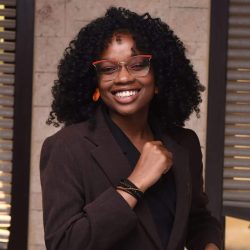
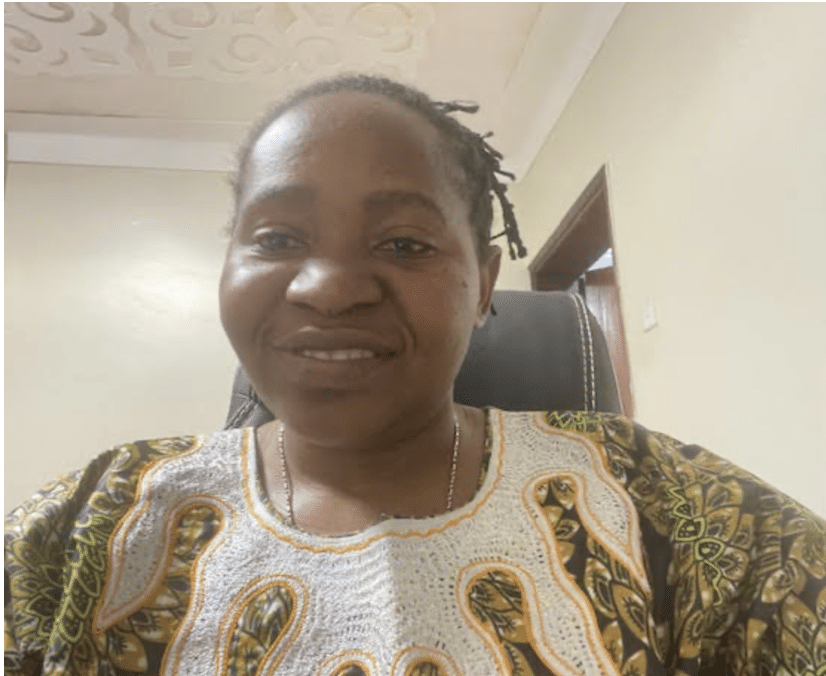
This oral history interview with Sister Semerita Mbambu took place on April 22nd, 2026, and was conducted by Amelia Hodges, Genevieve Tremblay, and Leio Koga.
Interview with Sister Semerita Mbambu
(this interview lasted approximately 57 minutes)
Can you tell us about where you grew up and your educational background? Do you come from the community you now serve?
I grew up in Kasese District or Kasese Diocese. That is in the western part of Uganda. Currently, I am working in Kampala. That is the central part of Uganda. So I grew up in the western part, and now I’m currently working in the central part of Uganda. I come from not a struggling family but a middle kind of family, whereby I grew up in a village where my parents struggled getting school fees, but by God’s grace, I was able to study. I joined the Sisters of the Holy Cross with a higher diploma in software engineering. When I joined the Sisters of the Holy Cross, I attained a degree in public administration and management. Then, a certificate in counseling. So that is my background, and where I grew up.
The community where I’m serving now is with the Saint Bakhita Anti-Human Trafficking Network. This is a network for religious men and women.
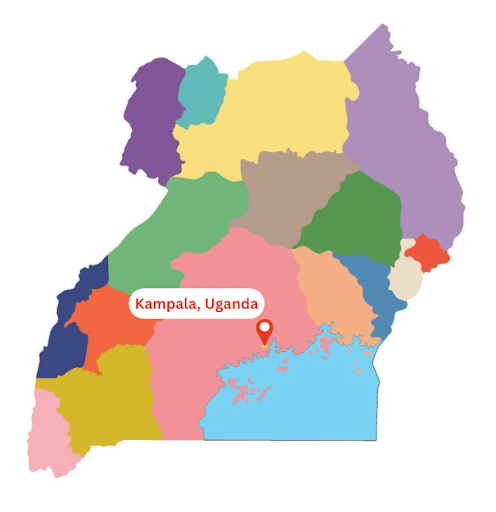
This map shows where Sister Semerita currently works.
Currently, we have also integrated the lay people to be part of this network because we found that the religious cannot work alone. So we felt we could come up with a strategy of also including the lay people. This is a network that was formed by the Sisters of the Holy Cross, so we are the founding kind of congregation that has brought other congregations to come and create awareness against human trafficking. Hilton, who is supporting this work, chose the Sisters of the Holy Cross through ARU, and the Association of Religious in Uganda. The Sisters of the Holy Cross, who happened to have experience in creating awareness, rehabilitating survivors of human trafficking, and working with other partners to make sure that people who have been trafficked in the Middle East come back. So that is the community where I am staying, working with the religious and also lay people to create awareness. I’m working in the 19 dioceses in Uganda as the coordinator of this network.
When I started this work in 2018, I happened to meet one of the ladies who was trafficked, and I didn’t know that this girl was trafficked. So, I met her in one of the communities because I was working with an NGO, a non-government organization, and I was coordinating activities for the youth. In that organization, we were also working on community reconciliation and trying to see how people could reunite, because there was some kind of tribal conflict. So, visiting different communities, I came across this lady. When I saw her, she did not appear to be happy, so my first question was, how are you doing? She said, “I am not okay.” Usually, when you greet someone, they say, “I am okay, I am fine,” and yet, you are not even fine. I was curious to find out what made her say, “I am, I’m not okay”. So, she told me, “I have issues, but you may not be able to listen to them”. I said, “No, I have time. Please, I can listen. I may not have plenty of time, but at least I can spend a few minutes listening to you because you told me you are not okay. So would you please share with me your story?” She responded, “Well, I may not share today, but how can I find you?” I gave her directions on where she could find me, so she told me, “I’ll come on this and this day.” We made an appointment, and she came. When she arrived, she met me at our convent. Then, she explained her story to me. She said, “I’ve never shared this story with anyone, not even my mother.” It was a long story, whereby she was trafficked, how she came back, how she was tortured, how she was treated, and all the kinds of torture she went through. She started crying and said, “It’s good that you have listened to me because I have my 3 children. I even wanted to commit suicide and throw these children in the lake that is near us. But thank God when you came, I was puzzled. I was feeling like I should end my life, but when I heard you say you would listen to me, I trusted that you would help me. That’s why I did not do that.” So that really touched me, and I felt like, “No, I think there is a call for me to do something.” So, by the grace of God, the Sisters of the Holy Cross had chosen me to coordinate justice and peace activities.
I came back with this story, and it was really hard for me to listen to such a story for the first time. I had never heard the word human trafficking in my life; I didn’t know about it. So, I shared this with our director for Justice and Peace at the congregation level at Saint Mary’s in Indiana. I wrote to her saying, “I have heard this story, and I’m confused. I don’t know how I can take action.” She told me, “That sounds like human trafficking.” She told me, “I can connect you to another organization that is creating awareness.” That organization is in Washington, D.C., and is the Africa Faith Justice Network. When she connected me to those people, one of them was a religious sister. I shared the story that I listened to, and she told me, “Those are signs of human trafficking. That girl was trafficked.” So then I said, “What can we do?” She said, “Can you manage to mobilize the sisters?” I said, “Yes.” I was also the chairperson for the religious in one of the dioceses in the western part of Uganda before I was transferred here. So I mobilized 50 religious sisters to come for training.
Can you share your journey to becoming a sister of the Holy Cross?
My journey of becoming a Sister of the Holy Cross started when I was young. Here, we have what we call Holy Childhood, Missionary Holy Childhood. When I was in that movement, I met one of the sisters who was to make her first vows. There, I was among those who were to entertain the visitors. I attended her first profession, and I admired the Sisters of the Holy Cross. I grew up now saying, “I will become a Sister of the Holy Cross.” And indeed, after my education, I felt that I was ready to join the Sisters of the Holy Cross because of that particular sister who touched my life. She was near my home, working in my home parish, so I kept on visiting her. She kept on telling me about religious life, and she encouraged me to study hard because the sisters don’t take people who have not gone to school. Because of this, I had to put my effort into making sure that I study and become a Sister of the Holy Cross.
When I was ready, I had to write to the sisters and the vocation director who received my application. She was very good to me, Sister Mary Louise Wolla. She kept in touch with me until I came for the discernment. I became a postulant and then joined the novitiate at St. Mary and I made my first vows in 2013.
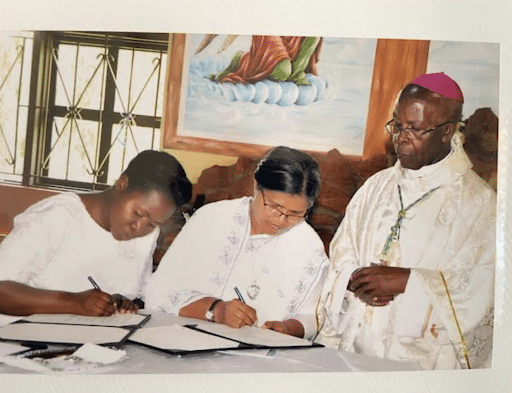
Sister Semerita (far right) signing her final vows at St Jude Kyarusonzi parish in western Uganda.
Then, in 2018, I made my perpetual vows. Currently, I’m still a Sister of the Holy Cross, and I don’t regret this decision.
How did you become involved in your current work? What inspired you to serve in this community or country?
I got to be in this work I do currently, when the person I met, when I saw her suffering, connected me to other ladies, those who are also in that kind of category. I started listening to their stories and, with that compassion, which is our charism as Sisters of the Holy Cross, it touched me deeply. I felt these people have not been listened to. The sisters are fond of going to schools, going to the hospitals, but I felt this was something that someone may not go to the hospital to say, “I am sick”, the psychological part of it, but needs someone to listen attentively, to counsel the person, listen to someone. But where would they go? So they needed a place where they could come and be listened to. With the help of the Sisters of the Holy Cross, we had to rent a place where these ladies would come and be listened to, and that was a therapy for them for psychological healing. We even had to have spiritual healing.
From that experience, the sisters, my superiors, chose me to be a director for this bigger network that I am currently coordinating activities for. I have grown from just one person to now over 500 people. Over 500 survivors whom I have met have been rehabilitated and reintegrated in communities, and we now have many success stories since 2018 up to date.
Is it women or men too that come to you that have experienced human trafficking?
There are men, children, and women. There are more women; the men are there, but they shy away. I have met with some men who have locked themselves indoors, fearing to come out and share their experiences. They say, “How will people look at me? I left my country, I was taken to another place. How will they see me? They may look at me as someone that is lazy, who never wanted to work.” They don’t know who to go to.
Can you describe the work you do and what it looks like on a day-to-day basis?
I do different things on a daily basis. At times, I come to work thinking I have this checklist of what I’m going to do, and I find that it is different on a day-to-day basis because sometimes a survivor pops in and I need to put them first. At times, I have two or three meetings in a day. When I come in the morning, I first pray with my staff and have a little catch-up on anything that happened.
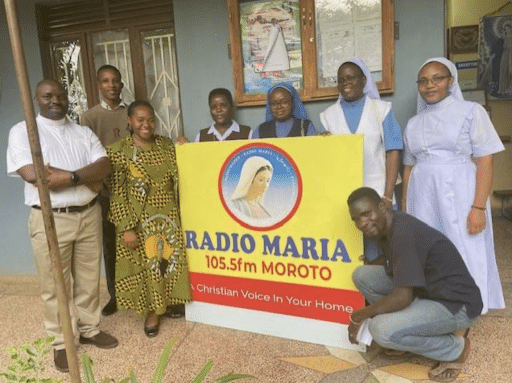
Sister Semerita (in green) and the St Bakhita committee.
This lets us see any emergency that we can respond to, any story that needs our attention today. We first catch up in the morning, then everyone goes to his or her desk to make sure that everything is okay. So I can say each day is different and does not have a common activity that can be done.
I have six staff members on the national team, but I also have staff in the different 19 dioceses. Each committee has about nine in the different dioceses, but the national staff is only 6 people. The national team coordinates and does follow-up and collects data from different dioceses. So we work hand in hand.
I work from 9 am up to 5 pm. Sometimes, we have those who are in charge of rehabilitation. So those who continue from 5:00 through the night, and they take shifts.
How has climate change affected your community? When did you first notice these changes, and how have they evolved? What do you see as future impacts?
When I was growing up, I was born in 1983, and we had a good climate. I would say the seasons did not change the way they are changing now. My mom told me the planting season is this month. When it starts raining this month, we need to collect firewood; we need to be ready for the rain. But the climate kept on changing in the early ’20s. My mom would tell me, “It used to rain during this month, but now it is fluctuating. It’s different. We don’t know what is happening.” It kept on accelerating up to now. Now, we are getting confused. When is the planting season? When will it rain? And the place is getting dry. We used to get vegetables with the rain, but now people are watering. People are planting crops, but they know the rain will stop, and then crop will dry. So, the effect on people is that now, there’s a lot of famine in some places.
Currently, it is raining in some places where they are not even planting crops. It is now raining in town, but it is no longer raining in the villages where we are getting food. It rains when the crops have germinated, then it stops. So, there’s a lot of famine, and I look at the future to be really terrible. In the northern and some eastern parts of Uganda, people are very hungry. They do not have food. It is getting worse and worse in some parts of the country due to climate change.
When it rains, it floods. We have been having a lot of floods. Mud floods, rivers overflowing; even people being killed, it has been terrible. People have been displaced, some have become homeless, and they don’t have places to go. It’s really terrible; sometimes when it rains too much, it brings diseases like cholera and diarrhea. So the climate is really something in Uganda.
Do the problems that come with climate change make it harder to manage human trafficking?
Yes, because now, when they are affected by this famine, they try to go out, and poverty pushes them to go out to search for food and basic needs. So they have to go and look for survival, and that’s how they end up being trafficked.
Who supported or mentored you along the way? What challenges have you encountered on your journey?
I can say I have had so many mentors on my journey, especially when I was growing up. I can say my mom was my first mentor in my life. She actually mentored me in leadership, how to take care of myself, how to take care of others, and how to take care of my relatives because I’m the eighth born. I had the elders there,
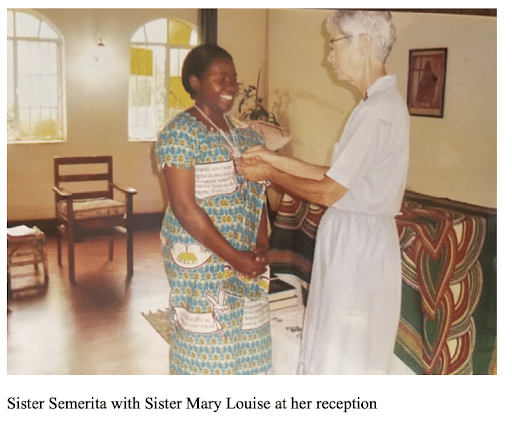
Sister Semerita (left) and Sister Mary Louise (right) at her reception to candidacy program formation at Jinja Convent.
but they left me at home, and I had two siblings following me, so I took care of those two that were with me, and my mom would go very far. So she mentored me to make sure that my followers are able to have food to eat, and they can go to school in a clean environment. Then, when I grew up, now joining the Sisters of the Holy Cross, my mentor was my formator, who was now Sister Mary Louise Wola. She mentored me to grow up being a really religious person and taught me what a religious person is supposed to be, supposed to behave, and what type of work they should do.
She mentored me in a way that I got to know the work and ministry. She taught me what ministry is, and what the work is, and to get to know the difference between those. That’s why even when I am overloaded with work, I say, “No, I think I have to first go back home to the convent. It’s time for me to pray. It’s time for me to be with the community members.” Because I learned from her that work and ministry are totally different from each other as a religious person.
I find that now it’s challenging for me to leave a survivor in the middle of her sharing because it’s time for prayer. It’s time for community. It’s hard for me to break and say, “Please wait, we will continue from there.” So then it becomes a challenge for me. But having that good mentorship, it pulls me back to say, “No, there’s ministry, there’s also work.” They know you have to balance here.
Another one of the challenges that I have encountered as an individual is the moment of motherhood. At times, I would feel like I wish I could also have my own child. When the survivors call me mother, I’m like, okay, I am a mother, and I was told I have to be a mother for the whole church. But then I’m like, okay, how would it feel like also holding a baby, a child of my own? So that has been a struggle for me. I have overcome that by talking to myself, having a retreat. I say, “Okay, let me have a retreat.” I look at my inner self and the reason why I became a sister, a religious sister. So that has helped me a lot to have annual retreats and also reconciliations. It has helped to say, “Okay, I am a mother for the church. I am a mother, and my motherhood is the fruits that I am offering, the success stories that I am seeing in these survivors, seeing them healing, calling me a mother. That is enough for me because this is the service that I am giving to the church.”
Is there something that’s unique to the Holy Cross Sister that tied to that idea of ministry that might be different from other orders of nuns?
Yes, there is that uniqueness in the ministry that Sisters of the Holy Cross are doing. We respond to the needs of the time; they make us know how to respond to the emergency that is rising. For example, when we had COVID, our Sisters of the Holy Cross could not stay at home. We still had to respond in that emergency time. I can give an example with myself. I even had to write permission to reach out to those who do not have what to eat. So that is the uniqueness I look at as Sisters of the Holy Cross. We don’t just sit when we are looking at people suffering. We have to respond. We have to find a way to respond to that need, that particular need that is rising in the community.
Can you describe a moment or experience in your work that had a deep impact on you?
The work that has had an impact on me is all about the survivors of human trafficking. Looking at what I have been doing, there was a moment that stayed with me when I talked to a survivor, and she shared her story and the way she was traumatized, even malnourished. But then I saw how she has grown from what she was going through. Even up to now, I see her as a grown-up person who has changed her life, and she is even now a councilor in a government position. So that has impacted my life. If I had left this person, I don’t know how she would be, and even herself, she goes around saying the Sisters of the Holy Cross touched my life. I would be dead by now. So that has really created an impact on my life. The little things that we do create an impact on someone’s life. It can save a soul.
How has your understanding of service or justice changed over time?
My understanding of service or justice has changed over time in a way that I started earlier looking at service as helping, giving and responding to needs. I also looked at justice as correcting wrongs or rescuing people. But then the way I was looking at it changed. Working closely with the survivors, I started looking at long-term healing challenges in survivors and also engaging with systems in communities and institutions or congregations that also changed my understanding. At the beginning of my journey, I understood service mainly as helping those in need, responding to immediate challenges, and offering support where possible. Justice to me meant rescuing victims of human trafficking and ensuring they were safe. However, through my experience working with the survivors and coordinating anti-trafficking efforts across the dioceses, my understanding has deepened. I have come to realize that service is not only about providing help, but about working with people in their healing journey, listening to their stories, and also restoring their dignity.
Have you been to other countries or places where you have been able to compare the work that you do in Uganda with the work that people in other countries do?
Yes, I have traveled to Indiana because I’ve been on the Congregational Justice Committee. I’ve met with other sisters from other areas, such as North America, South America, and also in the western part of Ghana. We have come together to share our experiences, we have come to share our ministries, what we have achieved, our success stories, our challenges, and to encourage each other. Besides the Sisters of the Holy Cross and this ministry where I am, the position where I am coordinating these activities, I’ve been exposed to Talitha Kum International, whereby people have gathered from different African countries. We gather annually to share our experiences, especially with the anti-trafficking ministry. I have had the chance to meet with other sisters from other places to share what they do on the other side. I also share with them what I do, and we have now been able to encourage each other on how best we can run this ministry. I have seen the value of partnership. When I get a survivor from here in Uganda, Kenya, I coordinate with the coordinator for Kenya, Tanzania, Zimbabwe, or wherever they may be from. We are connected. We work closely with each other in this kind of ministry. So I have traveled to some places, and I have gained experience in this work, in this ministry.
How can people outside your community–especially those in the Global North–support your work?
People outside my country or my community, especially, you know, in the Global North, can support our ministry best when they approach it as partners. Respecting local knowledge, the leadership, and also the context. Financial support, if it can be sustained and not a one-time thing. If the support can be long-term programs, not just emergencies. They can invest in survivor rehabilitation because that is a very big need here. If they can offer skills training, safe shelters, and probably also staff capacity. We had one of our sisters in general leadership before she became a counselor. She would give the staff capacity building on trauma, and how to handle trauma; that was very helpful for us to have her teach us. She would use Zoom wherever she was, and she gave us these skills. Her skills there and for us here in Africa were very helpful.
And if you can have someone with expertise in grant writing, it can also be very helpful. Also, people to create awareness, because we may think maybe it is only Africa that this affects, but I would say this is a global kind of issue that is affecting almost everyone. Continue with advocacy. Try to manage trauma-informed care. Providing technical and professional support. Also sharing our stories, like what I’ve shared today. So, maybe someone outside there may say, “This story touched me, I want to help in any way that I can.” For example, there are survivors who come with no clothes, no shoes, maybe someone can say, I have some clothes and shoes, I can take them over there. Some telepods, someone can help with those, just like short, short kind of help that someone may help with.