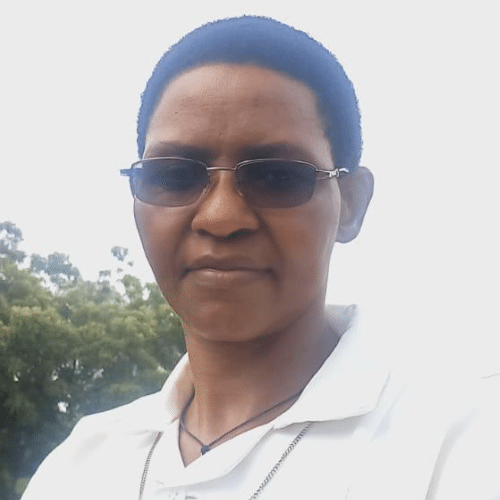
This oral history interview with Sister Jacinta Mueni took place on April 23rd, 2026, and was conducted by Tess Myers, Genevieve Tremblay, and Leio Koga.
Interview with Sister Jacinta Mueni
(this interview lasted approximately 54 minutes)
Can you speak on where you grew up and your educational background? Do you come from the community you now serve?
I’m a Kenyan, and I grew up in the eastern part of Kenya, Machakos County. There are two girls and three boys in my family, and I’m the second born. In Kenya, I studied in the 8-4-4 system. I went to primary school for eight years, and then spent four years in high school. Then for the next four years, usually you’d go to university, but I didn’t. Instead, after my 4th year in high school, I relocated to Nairobi, and I lived with my maternal uncle for approximately 2 years before I joined the Congregation of the Sisters of the Holy Cross. Now, I am currently serving in Western Uganda, not the community I come from.
Why did you decide to relocate from Kenya to Uganda?
As mentioned, I relocated from my village after my senior year of high school to live with my uncle in Nairobi. While I was there, I got heavily involved with some Christian groups in the parish. It was at this time that I met the Sisters of the Holy Cross, but they did not reside in Kenya, though they did happen to be in Uganda. Since the program to enter into religious life with the Sisters of the Holy Cross was in Uganda, that is how I found myself there.
What was your journey to becoming a Sister of the Holy Cross?
I felt the deep-seated desire towards religious life during my primary years, and the desire became more clear when I joined high school. Even though I felt this desire toward religious life, at the time, I didn’t fully understand what this entailed and never voiced this desire with anyone.
In high school, there was a certain teacher who used to call me sister and saw potential in me. He is the one who encouraged me to be a religious sister and told me, “To be a religious sister, you must pass your final exams.” Sisters must be well educated. His support was a confirmation statement that I was on the right track in life. I started working harder in my academics and praying that I’ll pass my examinations with the promise to the Lord that if I pass these exams, I will become a sister and serve him.
After high school, I joined my uncle in Nandora Parish. When staying with my uncle, I got heavily involved in different prayer groups. It is a very active parish, and this included the Charismatic Renewal and others. During this time, the desire to be a religious sister became even more evident.
I approached the parish priest, and I shared with him my desire to be a religious sister, though I wasn’t sure of the path to becoming one. So the parish priest gave me contacts for different congregations, but he also told me that “We have our Sisters of the Holy Cross. Would you like to try them?” I gladly said, “Why not?” The last contact given to me became my first choice: The Sisters of the Holy Cross. I connected with the vocation directors, and I was invited to come see the program for one week of discernment. Later on, I was admitted to the program. Today I find joy in walking this path, trusting that it’s where I am meant to be.
What did your family think of you becoming a sister of the Holy Cross?
As I said, I never voiced my desire to become a sister with anyone, not even my family. It was a deep-seated desire that I didn’t fully understand, as my family grew up very far from the parish. It was not as if we lived with the sisters, and that is how I got influenced into this vocation. It was more so a call, a mystery call, if you will, to become a sister.
So I didn’t share with anyone until after high school. I finally discussed it with my mother after my discernment week in Uganda, and I asked her, “Mom, the support you have given me through my education is immense. What would you like me to be? What would you like me to do with this education?” She kept quiet, and she didn’t have an answer for me that day, but after a few days, she responded. She said, “It’s your life. I would want you to choose what you would like to be and what you would like to do with your life.” I was afraid of how she would react with the struggle she went through to bring me and my siblings up, but her understanding and positivity were very comforting.
My siblings, my uncles, my aunties, they were all very supportive. I didn’t find any challenges in telling my family. For them, it was like giving a gift to the church.
How did you become involved with your current work? What inspired you to serve this community or country?
When I was growing up, I wanted to be either a primary teacher, a lawyer, or a nurse. I wanted to be a teacher while I was in primary school, but I soon realized I didn’t like the way the teachers were treating the pupils. Suddenly, I didn’t feel attracted to the profession. I then desired to be a lawyer because I wanted justice. Though, discussing with my colleagues, I realized that sometimes lawyers are not always honest. That demotivated me. I wanted to go into law to fight for the voiceless and to fight for justice, but a lawyer doesn’t always do this, and I left that career.
Then there was nursing. I had a lot of compassion for the sick and suffering. Once I had joined the Sisters of the Holy Cross, I shared my passion for nursing and I was admitted to work in the health center that belongs to our congregation. I still currently work at this health center, and from the beginning, I knew I was in the right place.
The compassion to be with the sick is ultimately how I came to be a nurse, and I really enjoy being a nurse. I went through the training and became an enrolled nurse before I went back to the same health center now as a registered nurse.
What work do you do and what does it look like on a day-to-day basis?
The sisters, including myself, who work at the facility, work from Monday to Friday. Mostly, we start at 8:30 am and leave at 6:00 or 6:30 pm. Though the nurses who work full-time work 12 hour shifts from 8:00 am to 8:00 pm, because the health center is open 24 hours. For us sisters, we work without time off, unless there’s an emergency or for something important. In number, because we have the medical and the support staff, there are approximately 33 workers at the health center.
In our facility, we have inpatients who come and are admitted into the health center. We also have outpatients who come and go. For our patients, we provide maternity care, dental care, laboratory services, ultrasound scan services, HIV services, TB services, and some of these services are free of charge. Looking at the community we serve is all children, women, and men. Most of them that we serve are peasants as well.
We have the most common conditions, like malaria. This is a seasonal condition, as when it has rained, the aftermath of rain is the breeding of the mosquitoes. Therefore, malaria is very common here. We also have so many cases of malnutrition among children under 5 years old. Much of the community is made up of farmers, but sometimes even the preparation of meals for the children can be a challenge for them, leading to malnutrition. Other conditions involve pneumonia cases. We also may have some car or motorcycle accidents, minor cases we can manage.
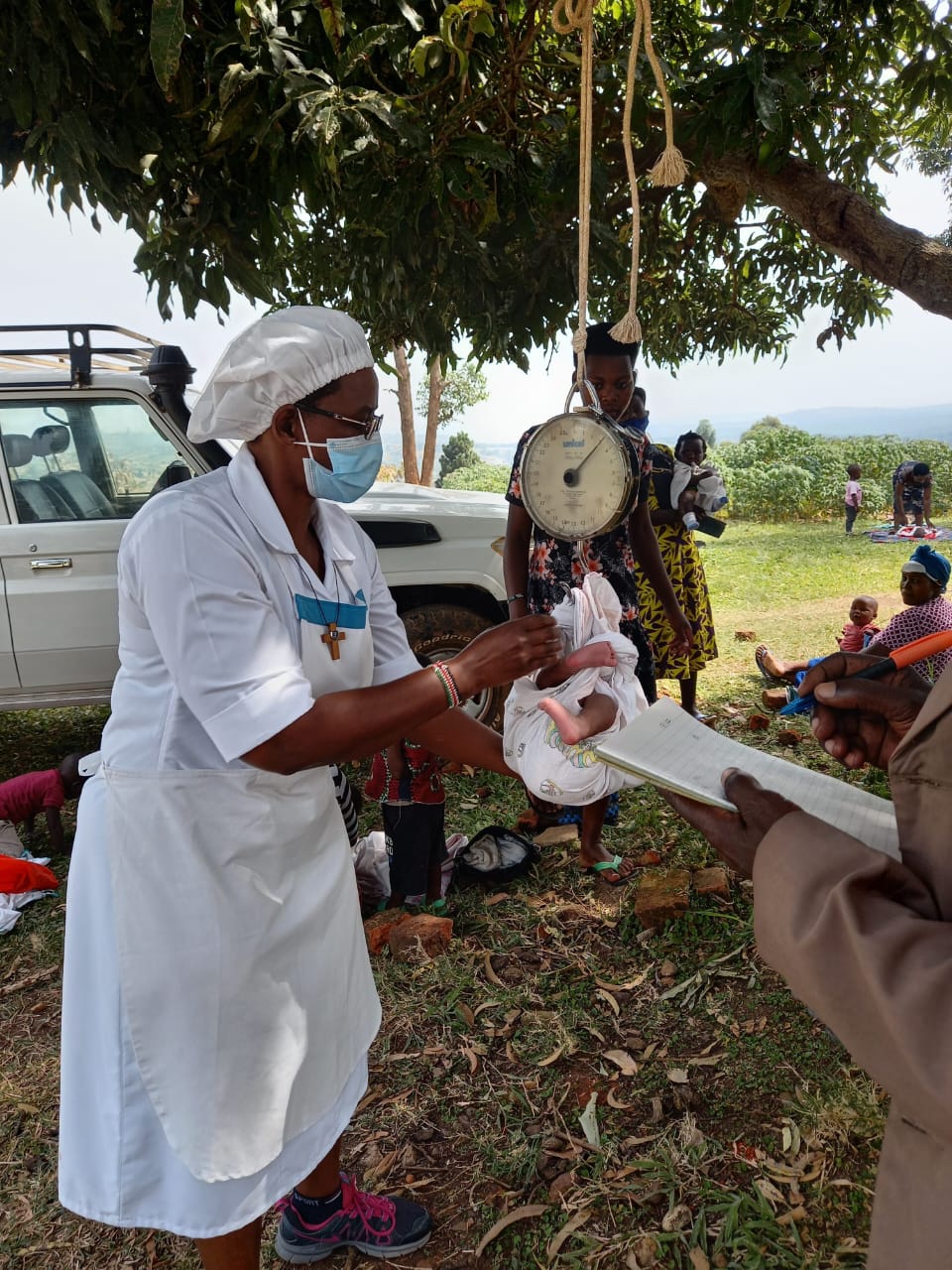
Sister Jacinta weighing an infant as a way of monitoring growth during an immunization outreach.
In addition to nursing, I also oversee the staff schedules, delegate tasks, ensure the facility runs smoothly, ensure that we have supplies, that the equipment is functional, observe protocols, monitor adherence to safety and hygiene standards, and implement improvements where needed.
How has climate change affected your community? When did you first notice these changes? What future impacts do you foresee?
Climate change has affected Muganan communities, where I am, and even beyond these communities. This change in climate is mostly concerning droughts. We’ve had landslides and unpredictable rainfall, with rain either arriving late or ending very early. As I said, most of the community here are farmers, and the change in climate greatly affects them and their crops. I noticed that these changes were occurring around 2010, and if rainfall continues to be unstable, it means that stable crops or food may decline. This leads to a higher cost of food, where there will be a lot of hunger, which also leads to poverty. Also, we have a lot of water sources in this area. Now, the swamps are dry.
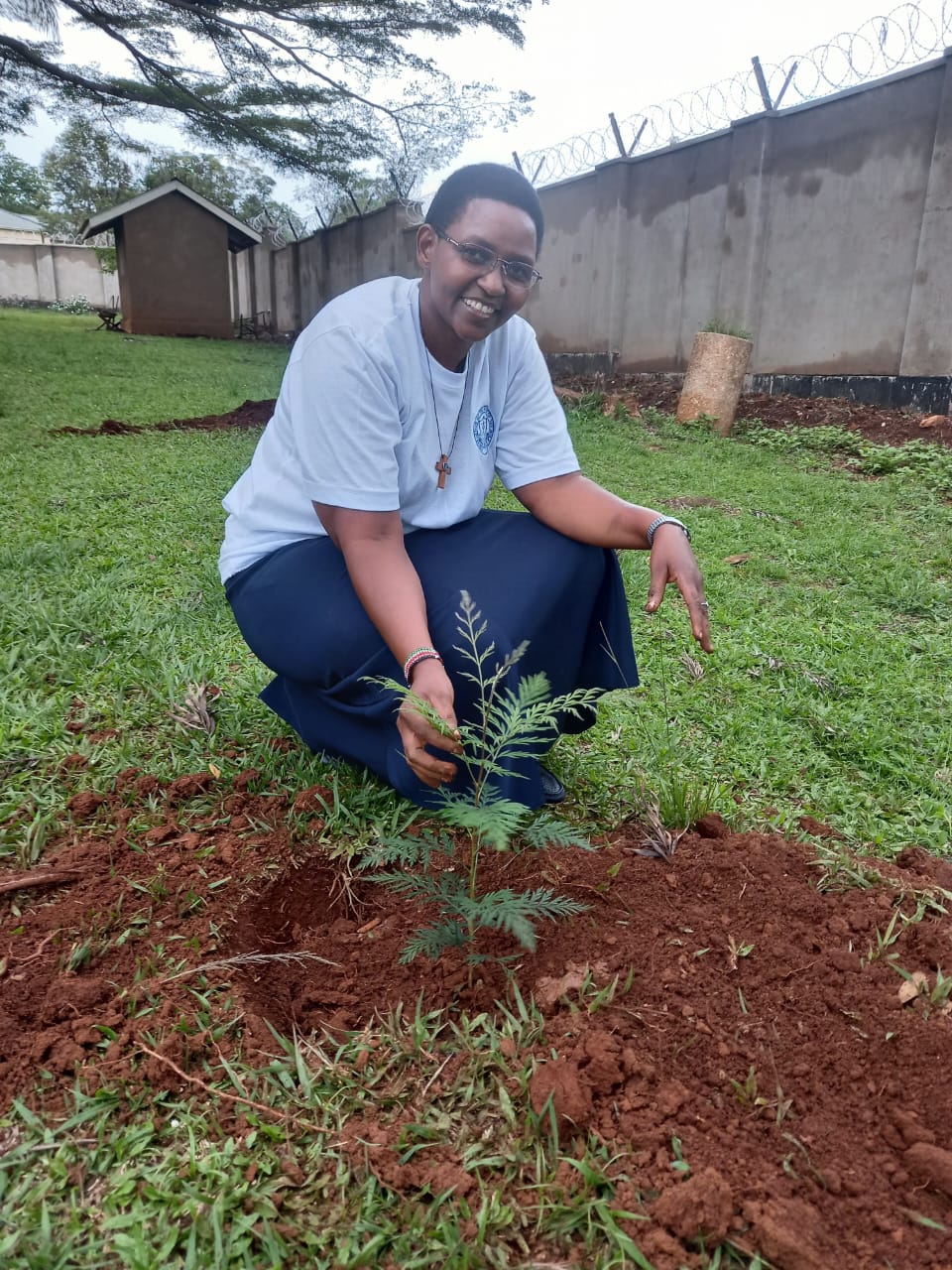
Sister Jacinta tree planting at their facility’s formation house.
So either droughts or unpredictable rain affect the community, making it difficult for them to eat, support their families, carry out their daily routines, or even educate their children. All because they rely so heavily on the crops. If there are no crops, it means there’s no really sustainable life for the communities. Life will be very difficult for people trying to survive.
Do people often migrate to a different place and away from their farms because of the bad climate?
The community where I reside right now in Eastern Uganda is more blessed than other communities. It has been affected, but not to the extreme. People aren’t necessarily migrating yet. Still, one can’t prepare for the unpredictable rain. There is instability. And people own land, so it will be very difficult for someone to migrate from Isiwa land to another place, unless they’re educated and know how to successfully buy new land and move there.
Who supported or mentored you along the way? What challenges have you encountered?
I have been mentored and supported by many people in my life. I have gotten mentorship and support from my family members, my teachers, my tutors, my formators, congregational leaders, my fellow sisters in the community and in the ministries, and also my friends.
As for the challenges, one would be language barriers, considering I grew up in Kenya before moving from one region to another, and being in different communities, one finds different languages. It is expected that you learn the language of the people because that helps to feel at home. The people feel part of you and feel part of them, and language is a big part of connecting with them.
The openness and readiness to learn and to embrace new cultures are essential and can be challenging, but I also view this as a blessing. I get to learn and experience different cultures and different lifestyles.
Another challenge is limited resources with a high demand. There are so many needs, but so few resources. It’s hard, and the situation can feel hopeless and helpless. Sometimes, you can’t do much, even if you feel the need to do something. What you can do is be a meaningful presence, be there for the person in need.
What moment or experience in your work had a deep impact on you?
I’ve had many impactful experiences, but there was this one experience where I met a poor pregnant mother in her first trimester. She had a history of vaginal bleeding and was at the health center receiving antenatal care, now on her way home. However, she looked very sad. I felt drawn to talk to her, and she shared with me how she had 4 consecutive abortions. With this kind of background, she had lost hope about her current pregnancy. Her biggest challenge was that she had no finances. She had nothing. Together we figured out how best she could be helped, I connected her to a gynecologist who was able to help her, and she was able to have her baby girl. It had an impact on me in the sense that the short interaction we had gave me a better understanding of what she was going through, and from that, a life was saved.
This mother had been advised before to go and see a gynecologist, but nobody gave a listening ear to understand her hidden struggles. Just listening to her and figuring out what was wrong was everything she needed to have her baby. She was so happy. A life was going to be lost. It had an impact on me insofar as I simply encountered her, simply met her, and it helped her immensely. I was interested to know her story and to know what she was going through, and just that helped her.
It made me realize that I should never take anything for granted. Always give your time to others, and pay attention to those around you. Sometimes you can pay attention and meet somebody with something to share, and that they share what he or she is going through with you is a beautiful gift. Because in one way or another, you can be of help.
Among so many experiences, that is one experience I carry with me. I see that child every day, and when I see that child, I see a miracle.
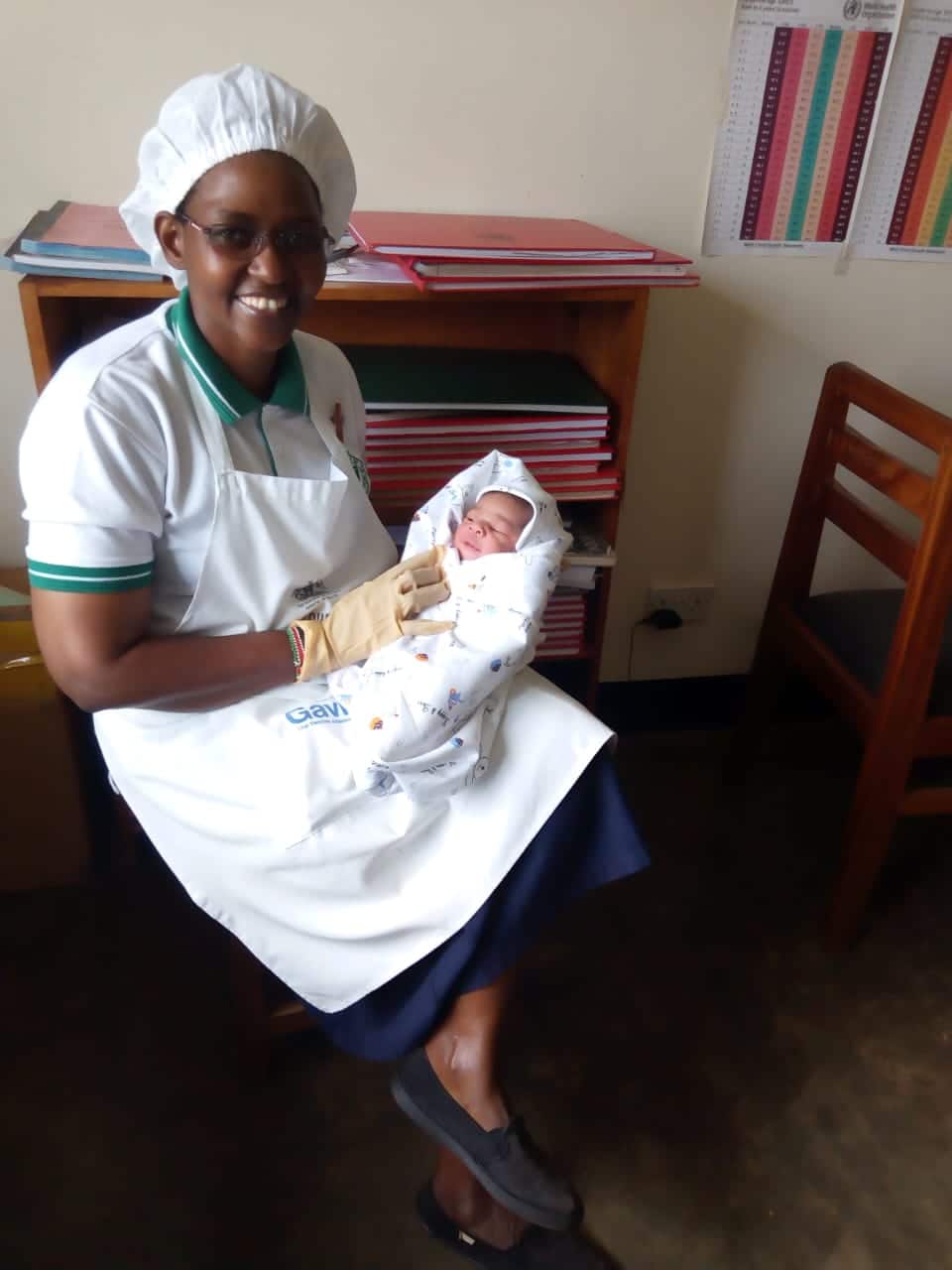
Sister Jacinta holding the healthy newborn girl from the story above.
How has your understanding of service and/or justice changed over time?
I used to think that service was just about helping people in need. However, with time, I have grown to realize that true service is connected to justice. Justice for me means standing with those in need, getting to understand their struggles, and working to ensure that their dignity is restored. My understanding of service has grown from being charitable to being in solidarity.
I have come to learn that we minister with others to fully understand their needs. They understand their needs better. If I’m ministering with them, I’ll be able to listen to them. I’ll be able to understand what they need, and then I’ll be able to respond depending on what they need. I believe that being in service invites me to realize that I’m not doing charity.
I believe the future calls me to serve not only with compassion but also with courage to seek justice. In fact, it requires courage. Sometimes issues of justice are not easy. As I move with compassion, I need to have that courage too. I need to stand firm, to be a voice for the voiceless.
How can those outside your community, especially those in the Global North, support your work?
As I mentioned earlier, our community faces many needs. That includes material support like financial contributions. For us in the medical field, that could include medical supplies, educational resources, or technology. We have a lot of paperwork, and we are looking at how best technology could help us ease the burden of paperwork. We believe that can strengthen our ability to serve better. It can also help with capacity building, like training of staff members, empowering girls and women with skills. We also work to help the community be more self-sufficient and more independent, rather than giving. The question is “How can we equip them?” A community member here could say, “Teach me how to fish.” Not “Give me fish” but “Teach me how to fish. Then I’ll be able to move on without the support.” That’s how we support our community.
The Global North can help the community as well by creating awareness about our community struggles. Mobilizing any support could help our people grow more, to be more reliable, to be more dependent.