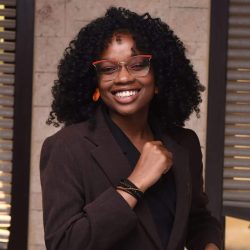
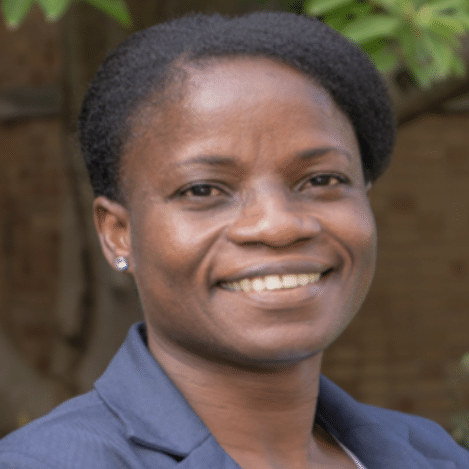
This oral history interview with Sister Comfort Arthur took place on April 27th, 2026, and was conducted by Amelia Hodges, Tess Myers, and Genevieve Tremblay.
Interview with Sister Comfort Arthur
(this interview lasted approximately 65 minutes)
Can you tell us about where you grew up and your educational background? Do you come from the community you now serve?
I was not born a Catholic; however, I grew up attending Catholic schools throughout my childhood, except for my high school, which was not a Catholic school. I grew up where I am currently serving. It’s the same community, or very close to the same. I wasn’t born a Catholic, but I did attend Catholic school, so I had a Catholic education throughout my life, and that might have triggered a lot of my decision and desire to be a sister.
Currently, I’m in the western part of Ghana, and right now, as I’m talking, I’m at Cape Coast Teaching Hospital because, after my master’s program in health administration, I needed to do an internship. But the community where I serve is in Takoradi. So I go in and out, and it’s a one-and-a-half to two-hour drive sometimes, but usually I come— if it’s one week, I’m in Cape Coast. I’m in the western part of Ghana, but currently speaking from the central part of Ghana.
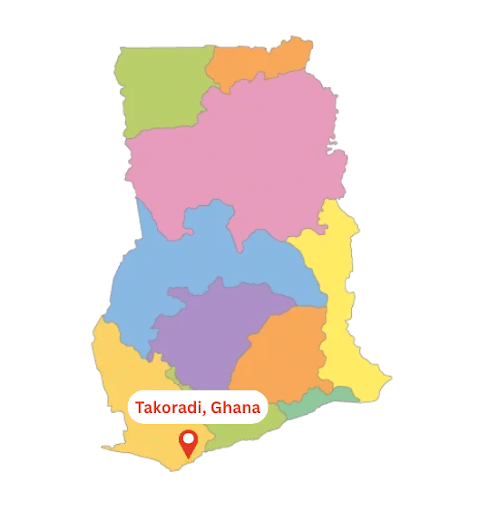
This map shows where Sister Comfort is currently working.
I didn’t grow up in a Catholic family. However, my dad told us that he was a Catholic when he was young and was even an altar server. So, when I joined the congregation, he came back to the Catholic Church before he passed away, so he passed away as a Catholic. But my mom is not a Catholic; she is a Pentecostal. My other siblings, some are Catholics, some are in Orthodox churches, some are in Pentecostal churches as well. We are kind of diverse in our denomination as well, but they are all from the western part of Ghana, Takoradi to be precise. Where I am living currently is close to home, where I get to see my mom. My dad passed away in 2012 when I was in the U.S. for my novitiate experience. So he passed away, but I came home before he was buried.
With your background did you encounter any of the differences between Pentecostal and Catholic?
I will put it as, literally, learning how to pray is where I encountered the differences. I always say we were taught to pray by my mom. My dad was busy sometimes because of work. He had to leave for work early, but before he even got up to go to work, every morning we had morning devotion. At my mom’s church, they also prayed the Nicene Creed and then the Apostle’s Creed. They also knew how to pray to Our Father, you know, the Lord’s Prayer. So those little things, I knew them. Translating them into the Catholic faith was not that much of a big problem. It was my elder sister who was learning a trade, and her madam, whom she used to live with, was a Catholic. She actually came back from the city to the rural area when she was a Catholic, and that’s what some of us kind of followed her into. But I was already into that Catholic doctrine because of the school that I attended. So prayers and everything were similar, and my faith foundation was really from the Pentecostal, but it grew and it became what it is now as a Catholic and religious.
Can you share your journey to becoming a sister of the Holy Cross?
At some point in my life after high school, as I indicated, I was working with an insurance company— because I did work with an insurance company for a year— and remembering my earlier encounter with the Holy Cross Brothers, because in junior high or grade 9, the Brothers of Holy Cross used to come to teach us. Their dedication and service deeply inspired me, and I began to feel a deeper calling, not just to live by myself, but to serve others and make a difference. So, that was it, and that’s when I thought, I didn’t want to serve only people in Ghana; I wanted to serve people abroad. I told them I want to join an international congregation so that my service could also go across borders. So that is what basically, in that journey, led me to become a Holy Cross sister today, because it was the time I encountered the brothers in grade school. Being a Sister of the Holy Cross means we are called to bring hope, especially where things feel broken or difficult, responding to the needs of the time. And that is what I was inspired by because I felt like some religious congregations are either purely into education or into health, but we are diverse because we help with many kinds of needs. We have sisters with different professional backgrounds. We are into health, education; some are lawyers, some are social workers. Everyone has different diverse professions and skills to help us serve the people better. So, it was my encounter with the brothers, the Holy Cross Charism, in the school I attended. I was inspired by their service and dedication.
How did you become involved in your current work? What inspired you to serve in this community or country?
Currently, I am working as a public health officer. Now my master’s internship is as a health administrator and also the director for SOAR, that is, Sisters Organizing and Advancing Recycling, besides my other congregational responsibilities. So alongside my religious life, I work as a public health professional. Public health is about helping people live healthier lives, not just in hospitals, but in communities. One of the ways I live this mission is through my work with SOAR, focusing on environmental health and sanitation because that is key for public health. Most of our diseases, we know, are from the environment. Especially in our part of the world, sanitation is a big problem. So, as a sister with that background in public health, it inspired the recycling that we do.
At SOAR, we collect plastic waste, especially what we call the sachet and the bottles, and then turn them into opportunities. Opportunities in the sense that we hire people to create employment, people who sell the plastic to us earn a living or wage to help them put something on their table, providing a source of income.
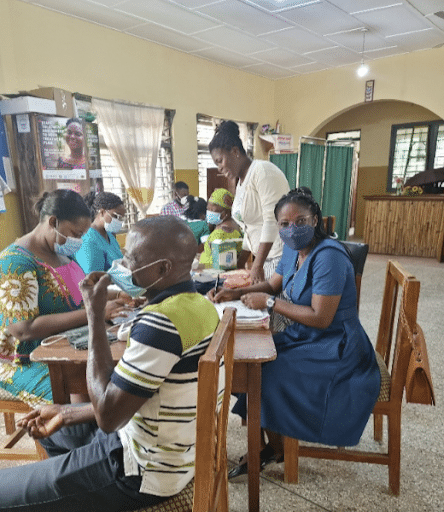
Sister Comfort (blue dress) at Holy Child Catholic hospital in Ghana attending to people with diabetes and hypertension at the Public Health Unit.
So we do that. We do so by protecting the environment, supporting livelihoods, and educating young people. Besides buying and hiring people for employment, we engage a lot of young women and men in schools and other institutions. When we go, we usually book an appointment. We talked about recycling and environmental pollution. In your part of the world, I think when I came to the States, I realized you do a lot of waste segregation. We lack a lot of waste segregation. So that is where the focus is: the young people who would like to make a difference in the world, knowing that if you want to make a difference, the change begins with us. So I thought of it, and I said, well, as a sister who will say, “Go out there and do that,” but it’s part of the call of responding to environmental pollution in this place, talking about plastic pollution. So to make a difference, we needed to take action, and it’s not just about talking about it. So, we went there, we would talk about it on the radio, talk about it in schools, in churches, as well as institutions, and then to get the young people, first of all, to understand the problem we have of plastic pollution and help them to be part of the solution.
I would say faith is not separate from my work. It is what drives it. You have faith, and then it moves you into action. That is how I do all those combinations.
Do some of the young people who are involved help repurpose some of the materials in a particular way, such as for crafts or weaving and are there businesses involved?
As we do education, we provide bins in classrooms and offices for them to do waste segregation. What we have moved a step further, as compared to other recycling companies or NGOs, is that we have what we call SOAR clubs, clubs in various schools whereby the learners get to bring out their innovative skills. They turn these waste materials into different things. So they weave, and they’ve been able to use the materials to make raincoats, school bags, fruit baskets, and other different things out of them. We bring them to the site to learn, as well as going to their classrooms. So, we first of all train the teachers to be facilitators and patrons of the club. They have a full curriculum we have developed that has become part of their studies in school. Every week, every Friday, that’s where they have their meetings. They started with the knowledge part and then got into the practicality. They’ve made robots out of plastic bottles and all that.
Unfortunately, our governments have not done so much, or done so well, with sanitation so far as plastic pollution is concerned. That is why, in our part of the country, the Central and Western parts of Ghana don’t have these recycling companies. We have to do the primary aspects of education and the secondary aspect of compressing. The tertiary aspect is that we take it to the bigger recycling companies in the cities. So at the end, we have to haul it to them. They change it into a mattress, into different durable things, oil paint, and all that. In our own small way, what we do is involve the learners whereby they could practicalize some of the things to be innovative as much as possible, but a bigger chunk of it goes to these recycling companies. So the things that we actually give out to the schools as souvenirs for the bins are all recycled materials. We partner with these companies, and they do the end products once we do the sanitization and the compression for them.
What we intend to do is that, now that we have piloted 14 schools with a SOAR club, whereby the learners could make some of these things I mentioned earlier, like the raincoats and the bags. The bigger recycling companies in Ghana— which are 90% owned by foreign companies— because, like I said, our government has not done so much about recycling, so it’s the foreign companies. The other part is that the learners use their creativity, and then we help with experts in making some of them. So, in the end, we want to do a gallery show, an exhibition show in their schools, whereby the parents can also patronize and appreciate some of these things.
Can you describe the work you do and what it looks like on a day-to-day basis?
So on a day-to-day basis in terms of the recycling, right now I’m in the hospital with my internship, but the workers are there. So, in the morning, every Monday, there is a staff meeting to have a brief of the week’s activities. There are some women who are on site to sort out. Sometimes, no matter how you give the education, because waste segregation has not been our practice, that’s what we are educating people on. They come, and the materials that we don’t need are mixed up. So there are women on the site who do the sorting out. Then, two teams of drivers and tricycle riders go to town. Some go for pickups. What we call pickups is when they go to schools, they go to churches, and other institutions. For those that we have done the education and provided the bins, they go and do the pickups. They go and collect them, and there is another team that is going to buy it. There are older women that, like I said, collecting plastic waste has become their source of income. So they go, and then scale it, and per the weight, we give them the price they deserve.
Then they do the buying of that. Those that we don’t buy, like the schools, what we give them in return is to motivate them with the SOAR souvenirs. The teachers each get a SOAR T-shirt. We give the school supplies to the learners, and they get many souvenirs in addition. So, in our day-to-day activities, some groups are doing the sorting out, some are going to do the pickups, some are going to do the buying, and there is an education team, or the community engagement team, who go around to the new schools and new places that we are in touch with to do the sanitization.
How has climate change affected your community? When did you first notice these changes, and how have they evolved? What do you see as future impacts?
First of all, it started with our rain pattern. We have two seasons, the dry season and the rainy season. Sometimes these days, if you tell somebody that it has been raining since May, you tend to be called a liar because of climate change; things have changed. As we speak, next month we are supposed to be having the rainy season, but already it started last month. You get a few drops of rain, and then now we have what we call the heat wave. It’s too hot. Even in a room with a fan, it still doesn’t help. So first of all, our rain pattern and then the dry season patterns have changed completely. Knowing that, even the water bodies are polluted with this plastic waste. It’s everywhere because people litter in the streets, and then at the end, when it rains, it’s all washed down by the rain into the bodies of water, and then it affects the aquatic life. It affects our farmers because, if the soil is mixed up, it also affects our crop production as well.
It has its own breeding of mosquitoes that lead to malaria, typhoid, cholera because of poor sanitation. So, as far as climate change is concerned, we realize that things are changing, and people need to change their actions, and the change has to start with us. I think we always say in Ghana, we need a behavioral change and then a mindset change, because it’s the attitude. People will eat and then just throw the waste away anyhow. But we are saying that, could you put it at the right place? Could you recycle? Could you reduce the use of single-use plastic? Could you reuse it? So then it’s not clogged up somewhere. Because in the end, if the water body is filled with plastic because of the rain, it flows and then it gets there, and it’s filled with all these plastics— the plants can’t grow well. If they don’t grow well and people are also cutting down forests, what happens is that, with climate change, things have changed. One thing we realize is that years ago, our people used to serve food, especially hot meals, in leaves like plantain leaves.
The introduction of plastic came, and then we used plastic for everything, even things that shouldn’t even be served with hot food. When it’s like that, the chemicals in the plastic get into the food. So, always when we are doing the education, we tell them that we end up eating poisoned food, and that is why we have all these chronic conditions, different types of cancers, and so many things. It really does not just affect the pattern of the rain or the dry season; it affects our whole life, and it’s a big problem. It’s been ten or fifteen years since the heat waves and the problem began, and it’s been terrible. Because now it rains in some parts of the country, and as soon as it rains, the sun comes and it sucks everything up. It gets hot, and you will go like, “Did it even rain at all?” So, things have changed drastically.
Who supported or mentored you along the way? What challenges have you encountered on your journey?
When I was growing up as a child, we used to love nature. We used to go to the farm. I mean, it was subsistence farming, but we could literally have everything fresh. Along the line, I realized things have changed. First of all, my mother said, well, these days food is not served in leaves anymore because leaves are medicinal, and now it’s plastic with all the chemicals. So from time to time she will say, “Kuku, could Ghana get better with this plastic pollution?” So I would say my mom and dad were my first mentors because they couldn’t stand the change of what was coming all of a sudden. It’s like nothing has to do with fresh greens and things anymore, and it all should be plastic and polythene, and it was getting worse and worse.
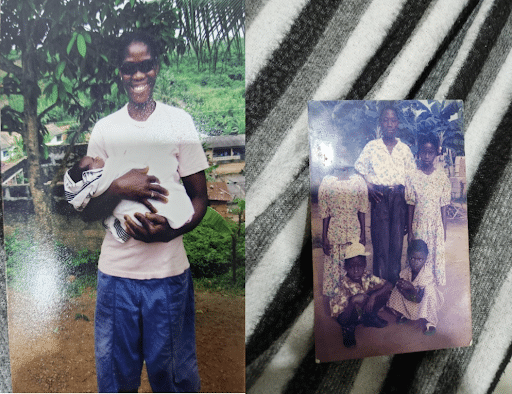
Sister Comfort’s mom and childhood growing up with some of her siblings and her niece.
However, I’ve also learned that through the congregation, joining the Sisters of the Holy Cross through the Justice Committee, we have a corporate stand on ecological sustainability. So for me, ecology is also another blend. Knowing my background with the farming aspect, I love nature.
So to see that other creatures suffer because of our human activities of this waste disposal, I felt it.
The Holy Cross has also become a big role model or a mentor, especially the Justice Committee. Sister Mary Teji is one of the sisters because she was in the Justice Office for a long time. I was appointed in 2015 as the Justice Coordinator for Ghana, and I just ended my term last year after 10 years of being there. Now, I’ve been put on the International Justice Committee of Holy Cross. So now, it’s like another upgrade. Sister Mary Teji has been a great mentor so far, as far as the justice work and ecological responsibility are concerned. For challenges in life, of course, it hasn’t been easy, especially when people are towing in different directions, it’s like easy life, fast, fast food, fast life. We used to say that. And you want to do the traditional way of trying to conserve certain things to save the environment. It has not been easy. And especially for the work of SOAR, it’s also not easy.
There are times when resources are limited due to the many needs that we address. Like we say, the women who sell the plastic to us, just the other day, one of our sisters was saying, “Comfort, did you think of the pastoral part of the recycling?” Because these women who collect plastic waste and sell it to us to earn a living, sometimes they don’t have it, and they will call that, “Oh, sister, I am sick, my son is sick, my child is this”, and you need to help them in different ways. It’s not like you are just dealing with plastic exchange, but their life becomes part of your life as well. There are so many needs, and that’s why sometimes the challenge is when plans do not go as expected. We started this recycling as a pilot project in 2017. Pope Francis brought this Laudato Si’, care for nature, our Mother Earth, and that was what we started 2 years after. And it’s been like that. Just last year, we opened an official kind of site or company, so to speak, but it has been in the piloting process.
So it has kind of slowed down, but then finally it is established. Sometimes when plans don’t go as expected, or when work feels overwhelming because you do get a lot and you don’t have enough machines to compress or to do things, you wish you could collect more, you wish you could engage as many people as possible, but you may not have the resources to take all in at once. But those moments have taught me something important. For me, I always say that we do not need to have everything figured out before we make a difference, you know. We just need to start doing something and keep going. And I think that is what, for me, keeps me going, that the plans may not be set, but you have a vision, and we stick to it, we stay focused, and then you just have to start it. If you don’t start, you don’t know where you will get to, but if you start it and you keep at it, I think things will work well.
Can you describe a moment or experience in your work that had a deep impact on you?
For me, the moment that had a deep impact on me, especially knowing that I did public health as my undergrad, was when we would go to the community. Like I said, public health concerns are preventable diseases or illnesses, and they are all contracted from the environment. For instance Malaria, we talk about it all the time. People will say, “you get it, you come, they will give you medication, it is treatable, they will give you a mosquito net to go and sleep”. And, and I will say, “no, the root cause is actually the sanitation”. How long will you get infested with this malaria parasite? And then how long are you going to be taking the malaria meds? How long are you going to be sleeping under a mosquito net? If the root cause could be tackled, then we don’t have to go through all this chain. And that is what, for me, anytime we went for health education, I would say that if people are to clean their environment, if they distill their drainages, if they weed around areas where mosquitoes will not be able to breed.
Instead of tackling the root cause, which for me is public health, people want to cut, and then we go in circles. So for me, that is why I said no, I need to do something. They change, we said, a small drop of water makes a mighty ocean, and brightens the corner where you are. So it’s just a drop. We may not be able to change the whole Ghana or the whole world, but that little corner of the sanitation system at least can do something to help people’s lives improve, be conscious of what they do to the environment, see the problem, and be part of the solution.
How has your understanding of service or justice changed over time?
Faith works with action. It’s one thing that leads to the other. We do pray, which I do appreciate, the charism of the congregation. As an Apostolic Congregation, we gather to pray, and we go out there to work. It’s like we bring all that is around the world and bring it to prayer, everybody’s intentions. We know that today we met this and that. We talk after we have brought it in front of the Lord in prayer, then during our table conversation, we ask: What can we do? As individuals, as a community, as a congregation. For me, what helped was the fact that I brought an idea on board, something that was unpopular— plastic waste. It’s a group of sisters who go to the street to help people to collect waste. And for me, I said, people may not realize it today, but sometimes the religious have to be the ones to begin, and then it will get to the society for them to see. Today, it is Sisters Organizing and Advancing Recycling. I know in the future it will be Society Organizing and Advancing Recycling.
The name will be so, but we’ll still have a greater impact. The fact that we brought it to prayer, we saw the need. We use the Justice theme: See, Judge, and Act. So we saw the need. I saw the streets everywhere with gutters filled with plastic waste. People are not doing waste segregation, and I said, okay, “So now how do we analyze it?” We talk about that at the table, we talk about it at the Justice Committee, and then we have to do something now.
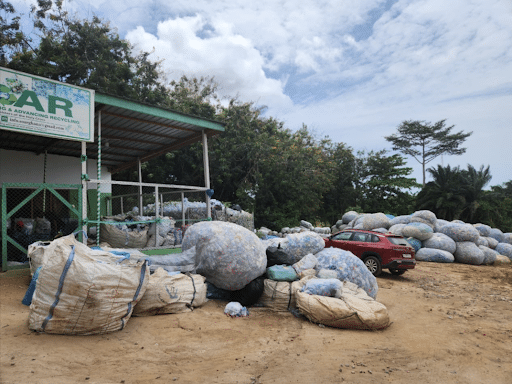
New SOAR site with lots of plastic waste.
We have seen, we judge by the analysis, and then we have to act. We act by really going out there, using the public to create awareness, going to radios, going to schools. And then we saw the practicality of giving them the bins, letting them do the waste segregation, demonstrating, and letting them do it. We started with the bins; they would collect, and at the end, it got back to the street. And that is why we said, no, we need to get it to the recycling companies. That’s where we got the donor fund to help us with a truck so then we could haul it to the appropriate place for recycling. So it was faith that got into action using See, Judge, Act model.
How can people outside your community–especially those in the Global North–support your work?
This is a great support to get the story out there that we are doing something in our little corner as a congregation and in Ghana. In 2023, a group of students came to Ghana and they were, and there were 3 facilitators who came with them. We did a cleanup exercise, and as we speak, at our school, they did this mural using plastic bottles to make a tree. So, first of all, the opportunity to have this platform to engage you, or for me to learn from you, and for you also to learn from me, and then to propagate it out there that we may be doing it in our country as recycling, but how effective is that? I think that is the question for those of you out there who already have the practice of recycling.
Unlike us, we don’t have recycling; we are going by the grassroots of teaching them even the waste segregation. But with yours, how effective is that? And how much plastic do we use? Especially talking of the plastic pollution, how much plastic do we generate, and how much does it end up in the recycling for something to be done? So the support is, first of all, the platform. Secondly, to get to share with you all, to learn. Whenever you get a chance, we could have an exchange program. You come, we come, and give the education or the presentation as well. And if there is a way the school could help in funding some of these learners, because these are some of the materials for education we need. The publicity, the sensitization, the SOAR Club. We need some school supplies, petty, petty things that we can give to the learners to bring the creativity in them.