
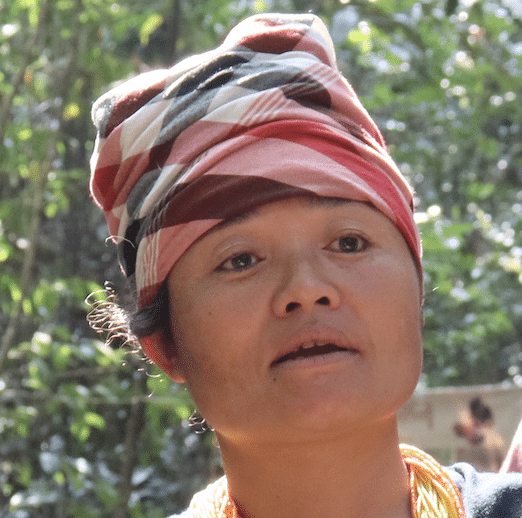
This oral history interview with Naw Paw Tha (Plant Nursery Garden Lead) took place on September 9, 2025. Because of unreliable internet service in the Salween Peace Park in Myanmar, she submitted her answers in writing to Peg Spitzer.
How has climate change impacted your community? When did you first notice this, and how did it continue? What do you think the future impacts will be?
When we talk about climate change in our Karen communities, we are not only talking about distant problems, but we are also talking about the reality we face every day. In recent years, floods, storms, and droughts have become more frequent and intense. These unstable weather conditions are directly harming our livelihoods, especially the rice fields and orchards that we depend on for food and survival. For example, in 2024, many Karen villages lost nearly all of their rice harvests due to severe floods that destroyed the fields before the crops could be harvested. This was devastating for families because rice is not only our staple food, but also part of our culture, traditions, and way of life.
Since around 2012, we have seen these impacts growing worse year by year. Farmers inform us that the seasons no longer follow their traditional patterns, which makes it very difficult to plan rotational farming and planting times. The knowledge passed down from our elders about when to plant, when to harvest, and how to manage the land in balance with the forest is being disrupted by climate change. When the rains come too early, too late, or in unpredictable bursts, they damage both crops and soil fertility.
For the Karen, our identity and survival are deeply connected to the land and forest. When the climate changes, it not only harms our food systems but also our spiritual and cultural practices, because many of our rituals and traditions are linked to planting cycles, forest products, and biodiversity. If we do not act now, climate change will bring not only hunger, but also the erosion of our cultural heritage.
This is why we must collaborate on how we can respond and adapt. The Karen people have strong traditional knowledge of farming, forest conservation, and living in harmony with nature, and this wisdom is a key strength. But at the same time, climate change is bringing challenges greater than any single community can face alone. If we do not take action both locally and globally, there is a real risk that in the future, our communities will face widespread hunger and deep loss.
Please describe your work. How did you become involved?
I have always taken an active role in helping my Karen community, especially in restoration work and in protecting our Indigenous rights. For many years, I worked together with my husband, Saw Oh Moo, who was also deeply committed to these struggles. He was not only my partner in life but also my partner in this important work for our people and our land.
But in 2018, something very painful happened. My husband was killed by the Burmese army. This was the hardest moment of my life. Losing him changed everything for me. It was not only a personal loss, but it also became a turning point. I suddenly had to take full responsibility for my children and, at the same time, continue supporting my people. That experience made me stronger, even though it was very difficult.
Since then, I have decided to keep moving forward, not just for myself but for my community. I have dedicated my life to protecting our forests and defending the rights of our people. One way I do this is by leading community plant nursery gardens, which help us restore our forests and bring back important species. I also support my community in managing and governing our territories, so that our people have control over our land and can make decisions that protect it for the next generations.
For me, this journey is about turning pain into strength and using that strength to care for my family, my people, and our land.
Before you became involved in this work, what was your educational background? Where did you grow up? Are you part of the community that you serve?
I grew up in Ler Mu Plaw village, Lu Thaw Township, Mutraw District, Karen State. I did not have the chance to finish school or earn a degree, but I was taught at home by my parents, who shared with me Karen traditional knowledge such as the use of herbal plants and the importance of traditional ceremonies. I am also a part of the very community that I now serve.
Regarding mentors or supporters: Who helped you along the way and how? What challenges did you encounter?
As I have been working with local communities, I have witnessed strong support from community leaders and committees who stand with us in restoring our forests and strengthening community livelihoods. Alongside these local supporters, KESAN has also remained by our side for more than 24 years, providing continuous support to help us implement our activities.
However, our restoration journey has never been easy. From the very beginning, we have faced many challenges. Living in a conflict zone, we have endured attacks by the Burmese military junta, personal threats, and the loss of our lands and forests. Beyond the conflict, climate change has now become one of the greatest threats we must confront. It brings new and pressing challenges, forcing our communities to find ways to adapt and build resilience in the face of these difficult and rapidly changing conditions.
Finally, how can those outside of your community (even those in the Global North) support your work?
They can support us by providing financial resources, which will enable us to officially implement our restoration work. We also need recognition from the outside community to acknowledge Indigenous peoples especially women not only as beneficiaries, but as knowledge holders, decision-makers, and rights holders.