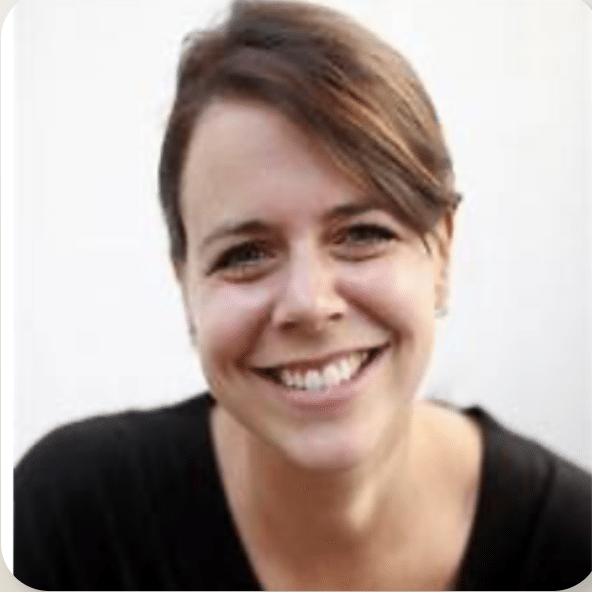
This Zoom interview with Jo Ashbridge took place on Tuesday, August 6, 2024, at 9 am EDT and was conducted by Peg Spitzer and Ayuska Motha. It lasted for approximately 40 minutes.
When did you first notice that climate change was affecting the community and what types of changes evolved over time?
First, I want to tell you that our nonprofit, AzuKo—which means “all of humanity” is an architecture charity that works in Bangladesh and in the UK. It just celebrated its 10th anniversary in June. For this interview, I will just talk about our work in Bangladesh.
I was first stationed in Bangladesh in 2012, through Engineers without Borders. I worked in a local shelter organization called Nirapod Bangladesh Songstha, in the rural northwest. Nirapod is now AzuKo’s partner—we’ve been working together for over a decade.
Our work together looked at how to make structural and material improvements when building with sustainable construction materials, things like bamboo and earth. But, most importantly, how to keep these improvements low cost, so that low-income communities could use them. And that’s because Bangladesh is very much at the forefront of climate change, and there’s deep and widespread poverty. Every year they experience floods, cyclones, earthquakes, and landslides. These are no longer Black Swan events: they’re happening more and more. They’re devastating and particularly hard hitting to those communities that are already struggling. We asked ourselves, “What improvements can we make so that the next time there’s a really strong storm, the entire building is not razed to the ground?”
We were working on how to treat bamboo to make it more resistant to termites, and what simple design principles we could share, so that structures could better withstand the elements – flash floods, high humidity, and heavy and prolonged rainfall.
We were looking at earthen construction, particularly earthen plasters, which is a very common construction technique in rural areas. We wanted to explore what natural additives we could use to make plasters more water resilient. Not to go into too much detail, but we found a glue from a local tree known as the Bijla, that outperformed synthetic additives at a low percentage level. It used to be a common tree locally, and the glue from that tree was used to make kites (kite-flying was a common pastime). But, things change over time and the amount of money people can get from different timbers rose, so less and less people grow this tree today. This remains a challenge, despite the glue’s potential in improving the performance of earthen plasters.
We’ve seen the impacts of climate change worsen over the last 12 years. I’ve certainly seen it where AzuKo works in northwest Bangladesh.
This region has deepened in poverty, compared to the other seven divisions of Bangladesh which have reduced poverty rates. The climate crisis adds yet another dimension. It is very challenging for the communities that we work with. Our focus is on how to build more climate resilient homes that can not only cope with extreme weather events today, but withstand future conditions.
Could you tell us a little bit about your work and what motivates you to do it?
I studied architecture in my undergrad program at the University of Bath and then specialized in environmental design at the University of Cambridge: It was that time when it started to click for me—the relationship between housing and climate and how they are so connected. Buildings and the construction sector contribute somewhere between 36-40% of global carbon emissions. The sector needs to do better. Everyone who’s involved in the sector, including designers, architects, and engineers, need to be pushing for better buildings that tread more lightly on our planet. Housing is the first line of defense.
This became a passion for me, and I started to look for roles that were non-traditional in architecture. That’s when I moved into international development. When I graduated I worked in policy and environmental design. I then had the opportunity to work directly with communities and I realized that’s where I belonged. I tried to find and support grassroots groups who were doing amazing things. To work together to realize their dreams. I set up AzuKo in 2014.
Can you tell us more about where you grew up and your family life?
I grew up in the northeast of England in a place called Gateshead, which is a relatively poor part of the UK. I don’t have any family who are architects or engineers, but my father is a welder, and I have other family members in construction. I grew up with an understanding of building. I’m good at ‘making’ – and I soon fell in love with architecture.
In architecture school, I think they do students a disservice by suggesting that this is a vocational degree, and you’ll end up in a traditional studio. But, when you come out of design school, you have many qualities that can contribute to other sectors and roles.
I didn’t necessarily move into international development as a result of my degree, but because of people I connected with, and spoke to, and learned from. Before Bangladesh, I was working in different parts of Africa, and I worked in construction in South East Asia. As soon as I started working with communities it just felt like “This is where I belong. This is where I can add the most value.” I still hope that’s the case.
Was there anything that sparked your interest in the “wider world” as a child?
I grew up in a rural part of Gateshead and my family is from a working-class background. Education was always a top priority. My parents worked incredibly hard to give my sister and I opportunities to learn. And every year we went on an international adventure somewhere. I think that must have sparked something in me, a curiosity and a sense of adventure. I took that to university and then, in my third year, I went on to do an Erasmus exchange to study in a different country. This then led me to Vietnam and I worked on a construction project out there. The rest is history. I have itchy feet when I stay somewhere too long.
I’m trying to travel less now to reduce my carbon footprint, and we have an incredible team in Bangladesh who lead those projects. But I do try to get there as often as I can because it keeps me inspired and it gives me energy.
How do you interact with the community in Bangladesh, especially those who are struggling?
AzuKo’s partner, Nirapod Bangladesh Songstha isa small organization whose team live, have been brought up, and work in that area. They are trusted members of the community, and they drive our Bangladesh projects.
We operate in a very rural part of Bangladesh. It’s a very agricultural part of the country. It’s very flat, it’s very green. It’s incredibly beautiful.
But there is significant housing poverty. This region has the highest rate of open defecation. Too many people have no latrine, and have no other option than to go in forests and ponds, which, of course impacts safety and security, particularly for women.
Most people are day laborers, and they spend what they earn that day. It’s very difficult for them to save. Many don’t have access to bank accounts, or credit. They may get involved in loan schemes which can lead to spiraling debt. And when you add climate challenges on top of that, it’s incredibly difficult for people to rise above poverty.
You may have seen on the news that, this year, Bangladesh faced unprecedented heat waves. I can’t imagine—I wasn’t there at that time—what it must have been like for people to live with temperatures reaching 42 degrees Celsius (app. 107 degrees Fahrenheit) in a place where electricity is down because the system can’t cope.
Despite these many challenges, Bangladesh is an incredible country in terms of hospitality. I’ve been welcomed with open arms. It’s my second home. I’ve always been treated as family. It’s a real privilege to work alongside communities who have such strength in the face of such adversity.
Have you encountered any resistance in the community in terms of women becoming involved in working with concrete and building?
It’s still rare. The workforce is predominantly male. In rural areas, women spend much of their time in the home (maintaining the home, looking after children, livestock, etc.) But this is why we want to work with women—many men work away, sometimes for long periods, in the cities—it’s the women who are maintaining the home. And yet they’re not involved in the design and construction of it. It’s very difficult for them to maintain without understanding basic principles.
For us, it’s a no brainer. We want to support women to understand design and construction so that the next time there is a flash flood they can repair it. They need to know how to go to the market, materials to buy and how much they cost. They need to know how to save for home improvements.
One of the reasons we offer women-only trainings is because it is still difficult, culturally, for some women to raise their hand and ask questions if it’s a mixed group. We create a safe space. And women feel that they can fully engage in both theory and hands-on construction.
Can you tell us more about your mentors or supporters who helped you along the way? Is there anybody special who really supported you at a point when you really needed it?
So many people have supported myself and AzuKo. But I would say that first and foremost, it is the communities that we work with. It’s those conversations that help our projects fly. We try to make sure that everyone around the design table is seen as an expert and we build a culture of not just listening but learning from the community. That’s what I think takes our projects to the next level.
I can give an example from my early days. We were working with a family of five—mother, father, two sons and a daughter. They had been chosen by the community to receive housing support, and rightly so. They had a very small housing area, and their one room building was in very poor condition. Traditionally in Bangladesh, when a son gets married, the daughter-in-law moves into the household. So, with two sons soon to be married, that meant the size of the family was about to increase. The only option was to build up because we couldn’t build out. They didn’t have any land. It would be the first two-story building in the village.
We worked together on different design proposals and I created a little cardboard model to talk around. They had been incredibly engaged throughout the whole process, and then, suddenly, they were silent. We thought, “Oh, no, something’s gone terribly wrong!?” They were giving one-word answers. They looked very serious, and in the end it was so difficult for us, we decided we’d leave the drawings and models with them, and they could have a think about it. We would come back tomorrow.
When we left them, we were quite despondent. We went back to where we were living a little bit down the road, and went for a cup of tea in a local teashop. While we were sipping our tea we started to tell this story, and an elderly gentleman we didn’t know—a farmer—shouted across the tea room, “Have they ever been in a double-story building? Have they ever climbed a set of stairs?” We hadn’t asked the question.
The next day we did, and they hadn’t. We suggested: “Would you like to join us for an adventure to the city?” In the city, there are many multi-story buildings. As soon as they walked up a set of stairs and they felt it was solid and safe, they said, “Let’s do it!” We broke ground that month.
How can those outside of your project (and the community) help or support your work?
Education is the key. Everyone has a duty to educate themselves, to do sufficient research to understand what’s happening. The climate crisis is particularly serious for those who are already struggling. Certain groups who are living in extreme poverty, including women and children, are the hardest hit. If there is anything you can do to level the playing field—if you’re able to give your time, money, or expertise—then do it.
Donating money is not possible for everyone. You can share information, and connect people to others who may be able to make change. Everybody needs to step up because we are facing a huge global challenge.
Do you see yourself working in other countries?
We don’t want to spread ourselves too thinly. AzuKo is a small charity. The more we learn, the better our projects get. We believe in staying with communities and doing what we say [fulfilling our promises]. We don’t just dip our toe in, and leave. We cultivate trust and collaborate to achieve better outcomes.
I have worked in many different parts of the world, and I have seen real challenges in terms of housing and climate crises pretty much everywhere I’ve worked. I would like to see the next generation pivot slightly and demand projects that better serve all people and our planet. Not just the 5% that can afford an architect.
I don’t know if working in other countries again is part of my future, because I have such a love for Bangladesh and the UK… and there is such a need in both places. But I do hope that, with every person I speak to, with every student who gets in contact, and says, “I feel like there’s something more in architecture that I could and should be doing.” I can inspire. If I can unlock a couple more minds to think differently, to work more ethically and collaboratively, I’ll be proud.
Is there anything else that we should know about your work?
Would you be interested in connecting with our local partner? Maybe there’s a way for you to connect our stories – that of myself and my project manager, Apu Roy. I think that would be a wonderful angle for your CKCollective website platform. We’ve been working together for so long now. I would love to hear his perspective on that journey, so I’d be very happy to connect you.
We will probably have to wait for a good internet connection because of the upheaval against Prime Minister Sheikh Hasina.
The army had just announced the takeover: the violence, the protests, the looting, are all happening in the major cities predominantly. We are about nine hours northwest of Dhaka. We are waiting to see what will happen within communities. I’ll wait until we get a sense of the landscape. Typically, my project manager does have good connection, but the internet is down right now.
[Jo also said that she will share more photos in a Google drive for us to add to this oral history project.]