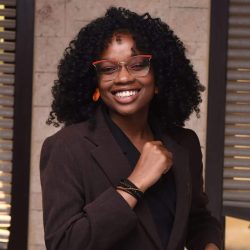
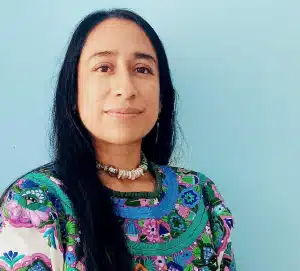
This oral history interview with Waleska Crowe took place on Friday, June 6, 2025, and was conducted by Peg Spitzer and Susan Davis. It lasted one hour and fifteen minutes.
How has climate change impacted your community or your country? When did you first notice that, and what do you think the future impacts will be?
Thank you very much for this space and this time. [Waleska says this in the language her mother used to speak and that she is still learning.] I think that I would answer this question in two parts. First, when I was little, I used to always notice changes in the rain and natural disasters—to me, these change patterns paired with increased natural disasters like Hurricane Mitch. I come from a country where we have rainy and dry seasons. But the patterns of rain started to change. I noticed that the rain started to get delayed which would affect agriculture production and, eventually, you would hear in the news more disasters from the very rainy times, el Niño and la Niña effects showing up. I remember we got many storms that were devastating for Central America, specifically my country of Guatemala. I didn’t understand at the time but then, in the future, I was learning these were the effects of climate change.
Second, related to the economy and deforestation, also as a kid I started to notice that the prices in wood were increasing. I grew up in a house where we would cook with propane and wood. There was a time when we used both because wood would help us save money on propane. But we reached the point where wood was more expensive, and it was almost like a luxury. This was worrisome because some people in our community would depend or rely only on wood. Later in my life, I learned about deforestation and how big companies were planting industrial crops, different things like palm trees. We’re not speaking about the family size crops. The big industries made it difficult—for deforestation. We also had some traditional agricultural practices that are still in place, like burning what’s left over from the land after harvesting corn. Unfortunately, this has caused fires in the mountains since I can remember and continues to be a problem. Families are suffering economically and there’s a lot of tension. Poverty along with the load of the impacts of climate change stresses people out. It adds another source of uncertainty and, psychologically, a feeling of helplessness. We felt powerless because at the time, my mother didn’t know what to do. She didn’t know she could do something about it: “I am such a small person. How can I do something about this?”
This is the reality for most people who are living in poor and vulnerable climate change regions. I grew up in a peri-urban place at the time: Quetzaltenango, the second-largest city in Guatemala, and later moved to the nearby municipality of La Esperanza. Because it was in between urban and rural places, the sense of community doesn’t prevail. In rural communities, everything is done in the community. When you’re getting closer to urban areas, people feel alone; they don’t stand with their people. They stand alone, and it’s easy to have a helpless feeling. Noticing that, in the later years, I ended up trying to alleviate this situation.
What do you think the future impacts of this will be? Now that you’ve realized what’s happening and noticed the changes, just what are your thoughts about that the future?
To sum it up in one word, I think I have hope that things will turn out okay, that the planet will adapt, that we will adapt. I know we have been doing a lot of stuff that we cannot just go back from here. We’re running out of time, and I answer the question by saying I am going through a process where I am changing my internal conceptions. I joined a group called “Zen and the Art of Saving the Planet.” There’s a book, too. When I came to the class, I realized that I was angry because I could tell things were going to be bad and I was worried about Central America. A small piece of land that could just disappear if something happens; and we’re surrounded by volcanoes. I could see all the disasters in my head, and I kept looking at how we consume and use so much plastic to wrap our products. You know how very processed products with lots of non-treated waste, and plastic are everywhere, and it doesn’t seem to end. I kept focusing on how it seems to me that as a society we’re aiming at a life where consumerism is our goal.
I realized I was angry, and I needed to have a different perspective. During this class I was able to face this in community, with other people that are also looking at ways on how to deal with this issue. I thought that I needed to go back to the main roots. For me personally, this means the Mayan way of conceiving the world: Earth is our mother; she is to be approached as a living entity, not an object. It’s not that we humans are superior and can see earth as a simple resource. In fact, we depend on her and we are part of her, and Earth can feel the pain; and Earth can express when she’s not doing okay—by storming, by not storming. I believe there is hope if humanity opens spaces to indigenous peoples perspectives from around the world. On one side we have science and that’s going to be always so important. We need scientists. On the other hand, I think indigenous people should be allowed to be part of coming up with solutions. Indigenous people, who have kept their practices, have experience in how to live a different type of life than what we are used to. In indigenous views of the world, they don’t need the flashiest cell phone. They don’t need the last model of a car. They don’t need the newest brands. They are grounded and don’t have the “want more” pain, I think because of the ability to connect with earth as a living being. As Mayans, we say that the earth gives us everything as a mother, with love and generosity. Take only what you need and have a reciprocal relationship with your mother.
I think that if we bring this aspect as part of the solution, I have a lot of hope. But if we keep living like we are living, I am concerned about my grandchildren and my nephews and nieces. I think of their kids and the next generation.
Is there a way that you can now describe your work and how you became involved in it?
Currently I am taking the time to rewire myself so I’m doing work on that, and I am participating with Mayan groups. We’re studying old texts that tell the story of the Mayan people. Today’s narrative says (at least what I learned in school), “you were rescued and saved by people who brought you faith and you should be grateful you were saved.” This narrative has brought shame and pity for where we come from, who we are, and drives us to deny ourselves. Maybe that’s one way on how one could describe the experience of racism. When we stop, take a breath, observe, take a step back and review history, we know there was a lot of violence and shame that was imposed on our people. There was a terrible disruption in how we interacted with land and how we interacted with the environment. Yes, we were not perfect, but our processes and humanity got brought to a category system where we became less than humans and were no longer in charge of writing our own history. But somehow we’re still here. That’s what I am doing now. I am participating in this group of people who are trying to learn our history and change that narrative to help us heal and put ourselves back on our feet. We dream we can also have some influence, some voice, to do something for the greater good.
Outside of that, I have had over fifteen years’ experience working with communities in water hygiene and sanitation (WASH), infrastructure projects: schools, bridges, renewable energy, and wood cookstoves. Commenting on how I see climate change affecting those categories where I have experience: Communities are growing, water sources aren’t increasing, right? In Guatemala most of the springs are taken and maybe have started to dry out. The growing population needs water. We’re talking now about drilling but we don’t know how much drilling wells specific regions of land can take, and how much of that people’s pockets can pay for. Speaking about hygiene, we’re still trying to help people learn how to wash hands. Menstrual hygiene is a taboo topic, human waste is almost taboo as well, which is very basic and impacts our environment, too. So, in terms of WASH in Central America, there is still opportunity to join efforts to support people who continue to work on this issue.
I also have experience with wood stoves, not only because I had to cook with the wood stove when I was little but also because I and some friends started a company that is operating nowadays. I am no longer actively involved but I’m still a champion for this effort. Chispa Stoves is offering wood stoves where efficiency and functionality meet perfectly in my humble opinion. I say this because through our process of reiterating the product, we noticed people weren’t adopting traditional efficient wood stoves because they were too small, and for the highlands, efficient stoves would not help people stay warm around the stove. I can tell you a story about this. We were selling this type of stove that’s very efficient where no heat would escape and, when we went to visit the families, we found the stove was working as a cooking device and then, on the floor, was an open fire. I wanted to die at that moment but then, of course, we had to be curious about what’s happening. It was too cold that night!
You’ve introduced again a very real example of what happens with these kinds of different technologies.
I go back to the point that we need to be careful in the willingness to try to do good and to be part of the solution because in this excitement of helping others, it’s easy to exclude the voices that need to be included. I think that the very first voices that we need to listen to are communities because they are the people we are intending to serve. I’ve always said you know they are your clients: If you think about them as clients, you do not disrespect them. You want to treat your clients well; that’s a way to say it. What I really mean, is that you need to love working with communities, this will guide you to interact with respect.
Some mental constructions that we may have made are “oh, the ‘poor’ communities, the ‘helpless’ people.” We think that we know better—not consciously. I don’t think anybody would do it with bad intentions or feelings of superiority. But subconsciously it could be that we’re driven to save and rescue them. We need to see them, I mean to meet, recognize and relate with each person from our shared humanity ground. We need to learn to work with people, not necessarily for them.
The other experience I’ve had in the past was working with micro hydroelectric plants in Guatemala where there was no electricity. With my husband, other organizations would hire us to assess the feasibility of the systems. My husband is an engineer so he developed the design, and I would do the social aspect of the project. With this we got to participate in a beautiful, multiple community effort to access electricity for the first time. Communities organized in a way that they’re managing their systems. We saw how this access increased the prosperity of communities. This was helpful! In specific circumstances, these systems had a limited capacity for the community size. We saw how access to electricity changed some people, who in advance knew they were going to have enough electricity for light at night and maybe for a radio, but not more than that, and they were happy with this idea. But once this one community had electricity, they wanted a refrigerator, a television, a stereo, computers, etc. They wanted more. And that’s understandable! There are still some places that are too remote to have access to electricity. I think that there’s still much more room to provide electric service to people in these places where a combination of sources can be developed: micro hydro and solar, for example. I hope more community friendly, and renewable energy projects are developed in Latin America.
Before you became involved in this work, what was your educational background? Tell us where you grew up—you told us about that already and that you are part of the communities that you serve—but could you tell us a little bit more about that and how you interact with those folks?
I went to Universidad Rafael Landivar and Universidad San Carlos de Guatemala. My mother was a woman who knew the value of education because she was daughter to a woman who didn’t know how to read and write who barely spoke Spanish, which was the official language of my country. My mother had to work as a little girl to go to school. She had to pay for her elementary school. She was so proud that she paid her way and completed 6th grade. That was a triumph, and it opened more opportunities for her.
Still, it was difficult, so she wanted her daughters to thrive. I was so blessed that I went to school. Universidad Rafael Landivar granted me a full scholarship to attend college. I went to college for business management with a focus on tourism. There are different categories of tourism—there is urban tourism, archaeological, gastronomy tourism and many different themes. While I was studying, what caught my attention was ecotourism, which involves nature and communities, so I focused on this. I also went to school to become a Spanish as a Second Language teacher. As a Spanish teacher, I was helping others from different countries learn Spanish and, through them, I started to travel to remote communities in my country and I just fell in love with people. I wondered how I could use the knowledge I have from college, so I started to volunteer with some organizations working with communities, keeping in mind eco-tourism. Eventually I just started working more with community organizations. I connected with people easily and people would trust me. That’s how I evolved to develop a career working with nonprofits and taking the side of community development and stakeholder engagement. Art and music are part of my life. I have some instruments that I play at home—piano, some flutes and whistles (mostly indigenous instruments) and drums.
You mentioned going to these remote communities. Do you feel like you connected with them? Do you feel like you are part of those communities? Do you do you feel like you are part of the communities that you serve [that you work with]? Tell us more about that.
I need to say that, at the beginning, I didn’t feel part of the communities just because I was going through a process of adjusting. Being in remote places takes adjustment. Even though I did not grow up in the most affluent house, I was living close to a city, which meant I had a different style of life. I didn’t have to work for hours to gather water, I just opened the tap, I had a flushing toilet, anyway, I had access to the comforts of a modest peri urban Guatemalan corner at the time. I had to bike to school for 8 kilometers each way, but it was all asphalt. All I was carrying was my bookbag. So, at the beginning, I didn’t feel part of the remote communities. But the more I interacted with people, the more I became familiar with them, and the more I realized their happiness was abundant despite their difficult life (from my perspective), I don’t think people were thinking of themselves as poor. They changed me and made me realize that the moment I started working with them, I became part of their community, even if it’s only for the duration of our work together. People were always quick to treat me as a member of the community, and I think that’s how they interact with anyone who meets them from the human shared ground I mentioned.
Anyone who works with communities can become part of the community. I don’t think communities feel offended by this or feel like people are trying to steal their culture or something. You really have to have the sense of being part of the community if you really want to make a difference because, once you separate yourself from the communities, you are creating division. I don’t have science to back that up but just my experience.
Years ago, I was monitoring a water project, and, at the time, our team was small. In the remote communities in the mountains, one house can be one kilometer, and then you need to go down and climb another hill and go to the other community. I did that in one day and, at the end of the day, it was miserable because I was visiting with people, interviewing them and checking their systems but my legs were killing me. They were killing me. I was so sore. I was suffering but I didn’t say anything to the host family. I just came in and said “Hi! I’m back” and then they were going to serve me food. I would usually just be there and eat and not interact much; but the woman from this house probably saw my expression. She said, “You are tired, aren’t you?” She started a Chuj, which is like a sauna that Mayan people usually have in their house. She told me to take off my shoes and then she showed me how to massage my legs and how to use the sauna. She said to please get in there and then go directly to bed. I cried because she didn’t need to do that, but she took the time, and she saw it and she treated me as part of her family. That changed my perspective and then, the next day, I felt different.
My interaction with them and other communities started to change because I realized that the people wanted me to show up as a human being: “When you are in the community, you are part of the community. If we see you tired, we’ll take care of you. If we see you hungry, we’re going to take care of you.” I also needed to take care of them so that’s how it all started – that one event.
At times, organizations institute the rule that if you go to a community, you should not accept anything from them because you don’t want to take from them. But quickly I learned that people want to be a good host, this helps them feel dignified. They want to offer you a piece of fruit from their backyard, or a glass of soda—to give you something because they’re happy that you are there. They are aware that when you get there you are traveling, and you are probably suffering because you come from a long journey and perhaps from what for them would be a “soft” environment.
The other thing that comes to mind is that becoming a mother changed me. Soon after I had my second baby, after two months, I started working and I said to myself: “I see women carrying their babies in the back all the time. I’ll do that, no problem.” I don’t know what I was thinking. It was so tough! I cried the first day I did that, and I realized that my body felt the way these women live every day. Then I kept starting to notice two-year old kids carrying water bottles. I could relate to them as a mother. Motherhood changed me. I was able to see kids with different eyes and see them as mine and put myself in other people’s shoes. I needed to change my perspective in how I interact and how I work with people. It’s still a process. It’s an art I would say, because it takes practice, intention and attention!
You also need to be careful and present, aware of your own biases. I don’t think I have spent so much time thinking about this and I could tell you some more about that skill with communities.
The next question is regarding mentors and supporters: Who helped you along the way in your journey and what challenges did you encounter? In other words, there were good things and challenges?
Yes, I’ve had many mentors. I think I would consider my first mentors my parents. My father was a good mentor to me from when I was little until he died when I was 12 years old. That he died at such an early time in my life, his absence mentored me to becoming a strong woman. When he was alive, I felt like he was my hero. He was my protector. And when he was not there, I had my mother. She was the source of tender love and she set an example of will power, consistency, and hard work for your goals. Her goals were to raise her kids and provide access to education for them. In each way, they made me a strong woman in a country where I had to take care of myself. We all know about the very popular “macho culture” in Latin America and, as a little girl, I needed to learn how to navigate through that. Throughout the years my mother persevered and persisted. You know, she didn’t go to college, but she made sure we did, and she had to do all types of work. Her example was amazing, I feel honored and grateful.
Throughout the years, I have found people like my first boss when I was a Spanish teacher, Julio Lima. He trusted me so much and that was rare at the time that a boss would trust a young person. He still treated me with respect and helped me feel confident. Another person who comes to mind is a neighbor. He saw me coming back from school one day and he said: “You look sad.” I didn’t answer him. The fact was that sometimes I didn’t even know how I was going to pay for school activities. But his words stuck with me: “The life of a student is hard. All the students at some point are poor because they are not workers yet; but if you never give up, if you keep going, you’re going to become a person who will do good. When you get there, don’t think about the money. Think about who you are going to help with what you are achieving. Don’t feel bad and keep going.” That neighbor is no longer with us but his words stayed with me, and helped me when I felt discouraged.
During my time with Engineers Without Borders, I had a good mentor named Mike Paddock. He was and still is a great mentor. He was a presence who believed in me, he saw my willingness and probably stubbornness to try to make a difference. I have learned so many things from him on how to interact with communities, and how to reach agreements in partnerships. Vincenzo Bollettino has been a mentor also, he helped to get started on my journey to find my voice, and learn about adaptive leadership. My husband has been a great mentor too. He has such care and tenderness to connect with communities. From him I learned patience and how to have conversations. I used to live by the clock even though I was in Guatemala. I would complain about community meetings—why do they have to be so long? My husband taught me that community meetings don’t have a clock and they can be as long as they can be and that’s how they are.
How can those outside of your community especially people in the global north (in the US and Europe), how can we best support your work?
People, countries, governments are coming together to solve global problems. I think that continuing to do that and supporting it is important. I think that making space to truly include, hear and consider unheard voices from communities around the globe without discrimination of age, race, sex or economic status is needed. That’s why, when I learned that you were collecting these stories, I was excited, how great this is! Giving space for people to participate—communities and people who are doing this work locally, to give them a space to have a voice and not just to make it a trend.
If policies say that strategy meetings, or any type of work needs to include women, men, young people, indigenous people from the global south, please, make sure it’s not something just to check in the list, or that they were there for the picture to confirm their participation. Please, make the effort to listen to those voices, take the time to confirm and ensure that you understand their viewpoints and incorporate what is useful in the ideation of solutions, strategies and action plans. Take the time to confirm that these groups that have different backgrounds than you, also comprehend your points, your ideas. Don’t hesitate to take time for this, it might sound lengthy, but it can make the difference for the success solutions.
Could you give us a quick example of maybe an individual or a resource or something that was useful? Was it expertise or just funds?
I think that something that was very helpful in coming up with solutions is just having teams be multidisciplinary. It depends on what things you are doing. For example, for infrastructure initiatives, multidisciplinary teams are important because you have technical aspects but then you also have social aspects, financial aspects. I think that stakeholder mapping with the community is so important because it helps you realize who you might be leaving out. “We’re leaving the government outside” or “We’re leaving the leadership of the community outside.” The community has a leadership structure that we didn’t consider before! I have used tools from The Waters Center for Systems Thinking, I like them. I also recommend the National NGO Program on Humanitarian Leadership, I have also used their tools working with my teams, they’re great. Human centered Design is a good packet too.
Another good partnership source, and they also have their tools to work alongside with communities, is Rotary, which is a great organization to connect locally. They are usually very knowledgeable of their context and really have a good network of people who have experience. I am a proud former member of Rotary.
When you are supporting other people’s efforts, if you don’t leave the people who need to be in the project out, you are going to be successful. If you leave important stakeholders outside, those same stakeholders probably will not support efforts and it’s hard to move things.
For the previous question, when you asked about my mentors, I don’t want to leave out community leaders as mentors. They have always been my mentors both women and men. Even though I went to college and graduated with a cum laude and honors, people in the communities taught me more than I knew and I am so grateful to them. They deserve the honors I got from school because there’s so much wisdom from them. Whenever you go to communities, just trust the community. They will know how to guide you. Lastly, I want to thank you for collecting these stories. I am so happy that you’re going to Guatemala and that you will be documenting stories. So many people do not have a space for their voice. Thank you for creating that space. Your work is important, and I hope this has more impact than you can imagine.
Other Information:
For updates on Iracema Waleska’s work, listen to her podcast, Voces del Tiempo