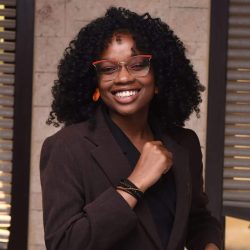

This interview with Gemma May-Kimani was conducted on June 20th, 2024, and was conducted by Peg Spitzer. It lasted 45 minutes.
How did you meet Dr. Olivia Kamkwamba of the Moving Windmills Project?
I met Olivia on a virtual-like session call. I was working with an organization that worked with youth networks at the time, InHive. The MasterCard Foundation was one of the larger organizations that I worked with. I was drawn to [Olivia’s] work because it gave me insight into funder perspectives and the importance of community leads. My background is fundraising and project management with communities, and this helped me learn the bigger picture and how we could shift the narrative.
As I’m sure you know, fundraising is huge. It’s a lot of work learning how to appeal to funders and reporting in the way that the funders want to be reported to. Actually, I think I got a little bit jaded with the process so, when I first met Olivia, it was wonderful to discuss the work that each of us were doing, and how it connected to the mission of Moving Windmills. Moving Windmills has a great local community and a great international community, and it is about learning, growing together, and being peer oriented.
Olivia asked me if I would like to work with her and be the Sparks Coordinator. A Sparks Coordinator encourages people to develop new ideas and creative problem-solving skills in communities. This comes from Williams’ Story in “The Boy Who Harnessed the Wind” when Gilbert gave William him “the spark” for the bike season. Then, he goes on to put together the windmill out of scraps. This was the sparking of ideas and innovation. My role at Moving Windmills is facilitating partnerships and assisting with any kind of resources needed.
I’ve been with Moving Windmills for about two years now. I’m based in Nairobi, Kenya, but I have also been in Kasungu, Malawi (where the Moving Windmills community hub projects are located)
.
So, can you tell me a little bit about what sparked your interest in climate change – or maybe we don’t even call it that because, a lot of times, it’s more than climate change that affects these communities?
The context in Malawi is that most of the people in Malawi are farmers, and they rely on subsistence farming both in what they farm in exchange for money and what they trade to pay for school and medical fees.
One of Malawi’s issues was the tobacco industry. The tobacco industry ruined farming because it became more profitable to grow tobacco than food. Following this was food scarcity. Food needed to be shipped from another place and became expensive to buy. Tobacco also poisons the soil, contributing to environmental degradation.
The climate change aspect was that Malawi had terrible floods.
This affected farming because people caught diseases such as cholera from contaminated food and water. And then, on the other end, Malawi experienced prolonged periods of drought. William’s story highlighted the tobacco industry, issues of the food chain, and drought. His story also emphasized the need to get water up to irrigate. Moving Windmills is very much a part of that community. So how can we help to support those farmers to increase the growing and introduce something different that could be more nutritious or could bring in a higher income?
One of the projects is a feeding program where we cook for the community to demonstrate how we are cooking with soybeans. We cook the soybeans with milk, which is a great way to get protein into the food chain.
People have problems, and we want to help create solutions. Farmers can come to Moving Windmills, and we can distribute resources. We can provide the space to grow things because it is dangerous to fail as they would lose food and money to do so on their land because they don’t have the resources. The Moving Windmills land provides a good place to grow, learn, and even fail – to try things out. Whether it’s being able to provide books, internet access, connections with external institutions (and partnerships) across the world, online learning, etc. This is for students who are conducting projects or others in the community who would like to do research in real-world learning situations. That’s where we fit in with climate change.
Solar is coming in because we need to provide electricity. We have an E-bike fleet helping move people and goods around at a much more affordable price. E-bikes are important because fuel is very expensive. In Malawi, fuel went up about 40% overnight last year, which makes it difficult for people to travel to the market or hospital. By providing an E-bike, you can help people get to the market much cheaper. We see the effects of climate change, and that’s where we can provide resources for these farmers.


How many people are in the community that you serve? Is there a breakdown of men and women? I have a reason to ask you about this, which I’ll mention later.
We have six community hubs and serve about 2,000 people per hub per year. One of the hubs is near a primary school where William attended. We serve children, teachers, as well as the community. We conduct a feeding program at least two to three times a week there. We’re feeding at least 200 people. We also installed solar panels in the schools. On a yearly basis, we touch tens of thousands of people’s lives in one way or another.
It’s an interesting question around the gender breakdown. We haven’t looked at that data closely enough. I would say that a lot of women use our hubs, and they come with their children because they’re the main caregivers. We also have young men who will come and use the library if they would like to learn more about different farming practices. Schoolchildren would also come to our library hub. It would be interesting to look at the data beyond children, I think.
My guess is that men use the community hubs more than women because the men have more free time. We run apprenticeship programs, but we haven’t been intentional with gender programs.
Do you feel there’s equal decision-making or ways of respecting the roles of both genders in Malawi?
In our apprenticeship program, we mentor women and assist them with finding the agency to speak up. We also help them make decisions based on their own thoughts and experiences. We also have a football team – we have a men’s team and a women’s team. That may be the only project that is gender focused where the goal is to build up women’s confidence. Culturally, you are right. It is the men who are usually the decision-makers and women are hesitant to speak up in the presence of men. We are trying to work on women mentoring.
In one project in India, women were trained to use a simple Bhungroo irrigation technology, which enabled them to save and store water and use it for their crops to maintain land. They faced enormous difficulties with floods and droughts, as farmers in Malawi do.
That would be something of interest to us, especially in our apprenticeship program. I could imagine that this would be a project for our women to work on over six months in Malawi. I think getting women to take on leadership is an issue, though.
Right. You can’t just put someone in a leadership role and expect them to lead without the tools. Can you talk a little bit about your educational background? Where did you grow up? What part of the community do you serve?
I’m from the United Kingdom. My dad was in the army, so we moved around a lot. I got a bit of a travel bug and knew I wanted to live in different places. I went to Anglia Ruskin University, based in Cambridge, England. I majored in ecology and conservation with an emphasis on animal behavior there. Like a lot of young people who are interested in “saving the elephants,” I soon realized that it’s a very competitive field of study. And you must have money to go out to these places and gain experience (I got a scholarship). However, the lectures were phenomenal, and it was a good discipline.
We would go to the London Zoo and watch the meerkat for three hours; or go to Scotland and watch rabbits. Eventually, I moved to London to build up my skills in the NGO world. I worked in London and volunteered for a very small sustainable fishing organization, Sustainable Fish City. We did everything, including supporting policy changes, research and finding supper, and that also gave me the background in fundraising.
I moved to Kenya and consciously applied to a couple of projects. I conducted a conservation project as well as a community project to figure out what I was passionate about. I realized that I loved the community work more than the conservation work. I felt there is no point saving the elephants when people are starving and they need access to land and money. A more conscious, holistic approach needs to be taken that benefits all. That’s my journey into community development work and fundraising. Nobody wants to do fundraising: They’re all afraid of it. I learned that because I did a lot of work with girls’ empowerment programs in schools and with refugee programs.
I just completed my master’s last year at the University of London. My thesis was on “The Evaluation of a Refugee Education Program.” I’m hoping to turn that into a PhD, but we’ll see.
I really love doing community work at Moving Windmills because I see the importance of community participation by having them ask what the problem is and what impact we need to have. It is also important for them to have a say in programming and the evaluation of a program. The other side of it, with the network, is whether we can do some kind of collaborative funding. Everyone is looking for funding and, if you want some kind of system change, you need everyone to be working on the same thing. We must have conversations with funders to get them to let go of power and trust that the money will get spent in the best way for the community. The transition into Moving Windmills was perfect. It was combining the environment side with a community-led project. We have great conversations with donors who understand the work we do and trust the community to decide what to do with the money. This brings together all the elements that I feel that I am good at and am passionate about.
A lot of communities are trying to figure out how to work on-the-ground and apply external funding. It’s difficult to balance and it’s great that you are focused on funding opportunities.
Can you describe who helped you along the way? What challenges have you encountered?
I worked in Tanzania with UWC East Africa for a while. While I was there, I had a great female boss, Dr. Anna Marsden. I’d never had a female boss at that level before. I’d never seen a woman at that level of leadership. She would spend a lot of time helping me with fundraising strategies and putting me at the forefront of lots of meetings … and helping me pinpoint where my strong and weak areas are. I had never had that before. That was my experience of having a real mentor.
The network organization I worked with again had another female boss who was the leader of the organization. She was very good at mentoring. We would have one-on-one sessions together. She would have me put myself out there in speaking and leading.
Also, aside from those two, my husband was a great mentor. It’s not really spoken about in the NGO world but there are many women in it. Women want to do things for other people. For some reason, we don’t want to say that we want to get paid. There are many women in the NGO world who are not married, do not make enough money, and certainly can’t afford to buy a house. In contrast, some of the men that I have met in the NGO world are extremely senior. I would meet all these contractor/fundraisers, and they were all men making a lot of money. But I wouldn’t know how to get there. I just wouldn’t know how to do it. But my husband, who is in a completely different field as a data scientist, would tell me: “You need to be asking for more money, and this is how you do it. If you don’t ask for things, you’ll never get them. These organizations are businesses and if they want you for your brains, you should get money.” He’s also the one who encouraged me to get my master’s degree. Not just for the money but because I could learn to analyze and think through problems—programmatic work—and I became so much more confident. You need male allies. This was this switch in my brain. So now I mentor other women to do the same thing! I refuse to have this narrative of “charity work.”
I think I must learn more from you!
There’s a great book that, when I read it, made me very angry by Caroline Criado-Perez, Invisible Women: Data Bias in a World Designed for Men. I really believe that if we don’t start doing this now, things are never going to change. You must be confident. If someone says “no,” there must be a reason why. When you see the NGO data on women and mental health, you can understand that we must keep pushing.
How can those outside of your community that you’re working with support your work in Malawi? How can I tell students, or people we work with every day, how we can help? Obviously you can go to NGOs for money and for a base, but are there other ways?
There are three ways to do this. The first way is to champion what we do. For example, talk to us about what we do, read about us, and go on the website to learn about Malawi. It is also best to read about William’s story and talk about us. The more conversations we have, the more partnerships we have.
The second way is inviting people from schools and universities. There might be exchange programs, scholarship funding, and research opportunities.
The third way is to provide financial support, such as by serving as a donor or running a fundraiser. That keeps us alive. We had a school do a 24-hour electricity hack[athon], which was sponsored by others. These students used solar and had a session with solar technicians. This is a cool way to raise money and have fun.
Keywords/ Concepts
Additional Resources
Community Hubs – Moving Windmills Project
Cultivating Change-Makers through Community Reading Hubs in Malawi (youtube.com)
Create a Moving Windmill Project – STEM Activities for Kids
Malawi | Floods 2024 – DREF Operation (MDRMW020) – Malawi | ReliefWeb