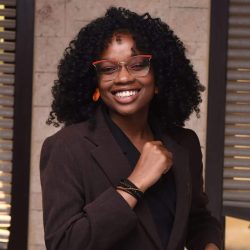
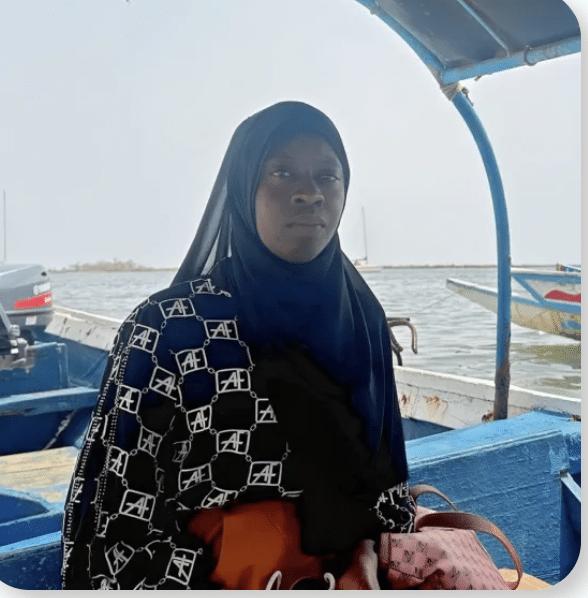
This oral history interview with Fatoumata Fall took place on June 11th, 2024, and was conducted by Susan Hinley, with French-to-English translations done by Susan herself.
What is the impact of climate change in your community?
Climate change has a lot of impact on our work because we spend most of our time with women, and they tell us about the difficulties it is creating. For example, those who process local products such as cereals, fruits, and vegetables, have noticed an increase in the price of raw materials. For fishery products, we notice the scarcity of products, but also the disappearance of certain kinds of fish. There are difficulties in accessing shellfish, including oysters, which leads to a lower income because all their time is spent trying to find these fish that used to be abundant. We also are witnessing the advance of the sea, the salt water, which leads to a scarcity of fish, which is caused directly by climate change.
Yes, I can see that there are a wide range of responses to that question. In your opinion, what other impacts will climate change have in the near future?
One can observe an exodus from the rural areas partly due to the scarcity of rain. Migration from the region is also caused by the deterioration of soil quality caused by chemical products and by the disappearance of wildlife. Irregular migration will continue to expand because, for example, those who used to live off the income from fishing have difficulty surviving. Their best recourse is to attempt to migrate.
Could you please describe the nature of your work? What are some of the things that you do here?
What do I do? I am a project facilitator. I work with women in entrepreneurship, management, monitoring, and support. For example, we can help a woman figure out if her work is producing a profit or is operating at a deficit. Because you can’t keep working if you’re not earning anything in return. Sometimes we see husbands who don’t want their wives to work because they don’t earn very much, and their work doesn’t leave as much time for them to take care of their husbands. We help the women with their investments and to learn to control expenses. For example, if I make an investment of 100,000, I should create a profit of 25,000 to 50,000 by controlling my costs and expenses, plus be able to bring a little bit home. This is a source of motivation for the women.
How did you become involved in this work?
I saw an advertisement for the job on the internet, and I applied. I was called for an interview with Fatou Ndoye, and I was selected as the project facilitator for the Saloum Delta.
Before beginning this position, what kind of training or educational preparation did you have?
I have training in marketing and communications, and I have my Level Three license. I worked in marketing communications. In addition, I did an internship at the NGO CAREM [Coordination of Actions for the Restoration of Ecosystems and Mangroves], and I also worked at a job in finance in Kaolack [a regional capital city about 60 kilometers east of Fimela]. I earned my baccalaureate in commercial management and technology.
Where did you grow up?
I grew up in a village, Diaoulé. It was a village, but it has grown into a commune. It’s located in the Fatick Region.

Sine Saloum Delta. Fimela is represented by the blue dot. Diaoulé is represented by the red
dot.
Are you a member of the community that you serve, that is, are you from this area? Certainly, I know you speak the same language.
Yes, I speak Serer. I speak Pular, and I speak Wolof. My mother is the one who taught me Pulaar and Wolof. She gave me that knowledge. Yes, of course, I work for my own community.
What about any mentors or supporters that have helped you in your development, for example, was there an important professor or instructor?
My older sister. She’s the one who raised me and took charge of my education. She was the one who encouraged me and taught me how to find employment. It wasn’t easy to finish my education. I remember a saying that my mother used to tell me: Don’t think about men. When it’s time to be learning, focus on your studies. Afterward, the men will come. When you are hungry and you see a man walking toward you, don’t say to yourself, “here comes a bag of rice”. [Laughter.] She never stopped repeating this saying so that I would continue my education.
Have you encountered difficulties in your training, in the pathway that has brought you to this work? Perhaps difficulties in finding the time, or due to family needs, I don’t know, but have there been impediments that you encountered from the beginning of your training up to the present?
It was difficult to have the resources necessary to complete my studies. Because, I had to be a little patient in life. There were days when you could go without eating your fill, instead of having three meals, you only had one. In addition, I walked from neighborhood to neighborhood, for example, from one school to another far away. I walked, yes. I didn’t have the money to pay for a taxi.
Finally, how do you think people outside of your community, including people outside of Senegal, how can they best support your work?
By helping me get training and continuing education to have a wider experience. But also exchange programs to better know the outside world, to travel and to know more. Because here it’s a little closed off. There are a lot of things I don’t know, though I know a little about life. I would like to go and to search other skills and be able to return and expose the women here to the wider world so that they can advance.
One of the goals of this project is to make the experience and knowledge of women like yourself available to women in other parts of the world who are facing some of the same challenges. Through the website, we hope to bring them together so they may learn from one another.
Yes, to add to each other.
Thank you so much for your stories that will help us with this project.
Thank you very much. I’m very happy. It’s been a pleasure to talk with you.