
Interview with Daniella Rossi
(this interview lasted 51 minutes)
How has climate change impacted you/your community in Chile? When did you first notice this, and how did it continue? What do you think the future impacts will be?
The major changes I have noticed in Chile, starting about 10 to 15 years ago, are the violent phenomena caused by climate change — drastic temperature fluctuations, heat waves, heavy rain, and droughts. In general, we are now seeing more intense weather than ever before.
I am worried about the challenges climate change has brought and will continue to bring for future generations. My outlook on the future with climate change is somewhat pessimistic and complicated, as I don’t see any meaningful action taken by the government to create or change policies that prioritize climate change. As a mother of two children, ages 18 and 20, I constantly think about their future and the fear their generation must face. What affects me the most is their anguish because, through my children, I witness firsthand how climate change impacts their anxiety about the future. For example, they worry about whether the effects of climate change will influence their decisions to marry or have children, affect their career choices, or determine where they will live. Overall, I fear that future generations will have a limited vision of their possibilities due to the impacts of climate change.
I feel that my generation has not been as strongly impacted by climate change. Speaking from my own experience, I did not share this level of angst or preoccupation about climate change when I was my children’s age. I grew up in a generation that was more focused on development and global growth, and I did not experience the mental burden of climate change.
Today, in Chile, we are seeing more and more young people seeking help from psychologists and mental health professionals to cope with the anxiety and stress caused by the uncertainty of the future with rapid climate change. A unique factor that has amplified this anxiety among youth is the pandemic — an experience unlike anything we have seen before.
Please describe your work. How did you become involved in it?
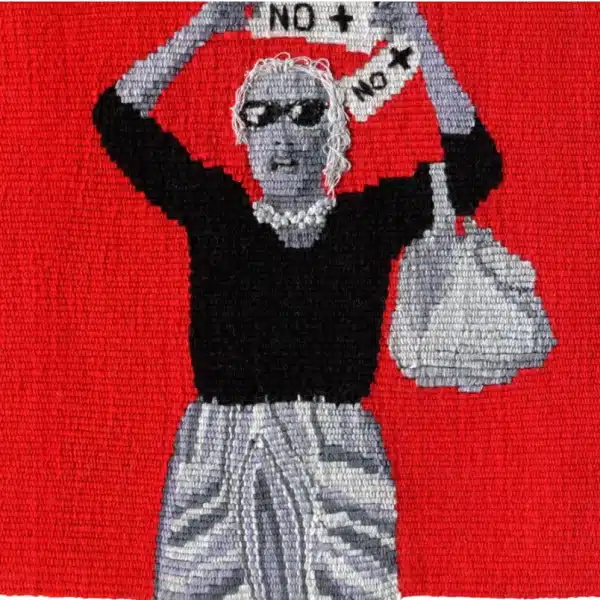
The collective began in the workshops taught by Daniela C. Daniela and I met during a workshop she was teaching at a cultural center in Santiago. When I started, within the context and events happening in Chile at the time, the collective was focused on doing something more traditional, with the intention of working in a group setting.
When did you start weaving and how did you learn to weave?
I have taken classes in other types of weaving, such as loom weaving, but I learned this particular style of weaving from Daniela C in her workshops.
I have always had a personal interest and sensitivity toward clothing, textiles, and aesthetics. My grandmother crocheted, embroidered, and knitted, but this type of art was not common among other family members. My mother, who has always worked and is now 75 years old, grew up during the first wave of feminism and was involved in issues related to the early feminist movement. At the time, she was strongly opposed to sewing and textile work because it was stigmatized as something anti-feminist. Many women wanted to distance themselves from this “gender-specific” work, which society traditionally assigned to women in the home. As a result, my mother did not connect with this tradition and chose to reject it. However, my mother appreciates my work, as do my children, who also find it interesting.
Why do you weave? And who is the audience for your weavings?
I come from a background that has nothing to do with weaving, but I have always had a sensitivity to design, a passion for working with textiles, and an eye for discovering aesthetics in clothing. I wanted to find something connecting me to more artistic work, and I feel deeply satisfied and happy when I practice weaving.
As for my audience, I do not think about a specific audience while weaving. The workshop collective with Daniela C attracts people drawn to memories, history, and a general curiosity about transmitting information and legacy. Our exhibition in Seattle is more political, though it can also be tied to ecological themes. In essence, my weaving is about coming together and sharing a collective interest in politics, history, and cultural themes, while also learning how to preserve and honor that legacy.
To what extent do you apply ancestral practices or indigenous techniques in your art?
The technique used in my art is the same as what is used in both Europe and Latin America. While the technique itself is the same, its application differs. In Latin America, the technique is often used to reproduce images in a way similar to photography. This is a more contemporary approach to weaving because, in the past, photorealistic production was not as popular. In Peru, for example, the images created in the past were less focused on high-quality image reproduction and more about conveying symbolic knowledge or figures.
Weaving has many purposes. For instance, it can be used as a political tool, as demonstrated in our “Interweaving the Archive” project. However, weaving is also deeply tied to the transmission of knowledge and culture, making it far more functional than just a political tool.
In what ways is your weaving connected to the land?
I would describe it through the rhythms of tapestry: it is a very slow process, a technique that requires close attention to detail. It’s similar to agriculture — you plant seeds, and it takes time for them to grow. Tapestry is just like that. It can take hundreds of hours to create a single piece. It is a slow and methodical process.
Before you became involved in this work, what was your educational background? Where did you grow up? Are you part of the community that you serve?
I studied psychology and practiced as a psychologist for 15 years. I have since transitioned to other endeavors, creating space for tapestry and weaving, as well as work that is not directly related to psychology.
I was born and raised in Rome, Italy. While I am not deeply connected to that community, I do stay in touch with old high school friends. My parents fled Chile before I was born to escape Pinochet’s military dictatorship. They were in exile for 15 years. There is significant solidarity between the Italian people and Chilean exiles who fled Pinochet. While not all of them returned to Chile, many eventually did.
For me, Santiago is home. I have been living here for 35 years now.
What communities does your weaving intersect with?
In my personal history, I am connected to both Italian and Chilean communities, and the weaving techniques I use were developed in both of these worlds. Weaving helps me bridge my European and Latin American identities. I appreciate that weaving was invented on both sides of the world and has served as an inspiration for both cultures.
Regarding mentors or supporters: Who helped you along the way and how? What challenges did you encounter?
It’s hard for me to choose just a few people. My family is small in numbers, but we are very united. I have four cousins — four women who are very important in my life and who have supported me significantly. I think the close relationship I have with my cousins is something I tend to replicate in the friendships I form.
As I mentioned earlier, Daniela C taught me how to weave tapestry. She has a very methodical teaching style, which is incredibly helpful when the weaving process becomes frustrating. The process involves many detailed steps and requires a patient, step-by-step approach to achieve a photorealistic result. While it takes a long time to reach the final outcome, this slow journey has taught me so much.
How can those outside of your community (even those in the Global North) support your work?
Indeed, tapestry alone does not provide enough income to live on. I work in my family’s company, which is my main source of income, while dedicating time on the side to weaving. In general, culture in Chile is not well-funded, and this is a significant issue. Chilean society lacks substantial public funding for culture, but it could greatly benefit from increased support in this area.