Interview with Daniella Contreras
(this interview lasted 53 minutes)
How has climate change impacted you/your community in Chile? When did you first notice this, and how did it continue? What do you think the future impacts will be?
I think the topic of climate change is important in Chile because of its impact on the country and territory: Chile is becoming a desert more and more with each passing day, the glaciers are melting away, and I fear that maybe in a thousand years, the territory will not even exist anymore. In addition to this, I am not sure that many people are concerned about the effects of climate change in Chile, because there is a significant lack of access to information for the public to be informed.
I am specifically from Santiago, and in this city, I have noticed two main impacts of climate change: first, the city is drying out because it barely rains. This impacts the population; many people are already moving out of the city and many more would like to, but cannot for economic reasons. The second thing I noticed was the premature change of seasons. For example, for the past few years I have noticed that spring now starts in August rather than September in Chile. I think I have a rather dystopian vision of the future of my country and our planet. I fear that many of us will have to move out of Chile because the country is at such a high risk of destruction due to climate change.
Please describe your work. How did you become involved in it?
I have been connected to textiles since I was young, largely influenced by my aunties on my mother’s side, who used to weave. They focused more on techniques such as knitting, crocheting, and embroidery rather than tapestry.
I started weaving in 2010, under the guidance of Paula Moreno, another Chilean textile artist in the School of Art at the University of Chile. It was not until I started studying arts at university that I learned about the specialty of textile art. I started first with Paula, who taught me the foundations, but became more involved in tapestry in the specific context of pre-Colombian societies.
I realized how comfortable I felt working in tapestry. I found myself wanting to build spaces to connect with others and to share knowledge with people. Doing this made me feel very happy and brought me a certain joy. I believe that it is necessary to find an identity for ourselves to be able to look back into our history and understand who we are today. For example, my work is connected to what happens in Peru, the north of Argentina, Bolivia, and the north of Chile.
Why do you weave? And who is the audience for your weavings?
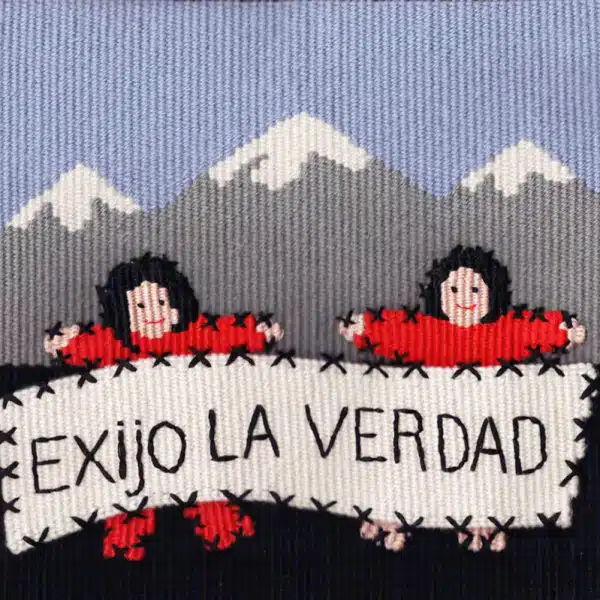
Weaving is my life. Weaving has given me everything I have ever had. To me, tapestry is not only a way to preserve our memories but also a way to resist the dystopian changes of our world. Tapestry allows me to connect with people, new places, and everything that comes with creating such bonds. It allows me to build a community among those who also weave.
As for my audience, I have noticed that a lot has changed within the demographic in the past few years. When I started weaving 14 years ago, all my students were over 45 years old. Now, the audience is more diverse and I see students between the ages of 25 to 65. I feel that more people are involved in the art world than when I first started and want to weave a new tool or create a new technique, catering to new audiences.
Another main category within my audience is women, especially women who are retired. Those who have more time to weave have joined the space as a way to connect with themselves. Contrarily, there are not many men that do tapestry and if there is one, he is typically an artist. But I feel as though I have all the audience that I need.
To what extent do you apply ancestral practices or indigenous techniques in your art?
Something that I love about tapestry is that you can find its artistic form in many different cultures, highlighting not only its versatility, but also how tapestry has been used as an important method of communication, especially in ancient times. This is because tapestry’s image reproduction allowed people to create coded messages within the weaving of the tapestry. While I do not have all the information on all the ways of weaving coded messages, I am aware of some of the uses. For example, in the ancient Andean culture, communities used different images with various colors, for example, in their clothing. Each image represented something very specific, and these messages were used to communicate secret messages between communities. Today, we are not able to decode all the messages but we are aware of its use and its significance.
For me, I like to use certain colors that are more symbolic to me, as they express certain emotions in my weavings. For example, red is an important color in my work. All my works used to have red woven into them because this color represents humanity — something related to our flesh and blood and the experience of existing. Moreover, the ancient Andean culture had a very important relationship with the color red (cochinilla rojo).
In what ways is your weaving connected to the land?
I thought of myself as a city person up until I started to investigate and work with tapestry from the Andes. When I started working in tapestry, my connection to the land became very specific; it was as if a gate opened within me, allowing me to connect with nature in a way I had not before. Through tapestry’s ancient historical and cultural knowledge, I have found a way to connect with the land, and show an approach to nature that represents this knowledge.
Before you became involved in this work, what was your educational background? Where did you grow up? Are you part of the community that you serve?
I grew up in Santiago, in a very poor family not far from the center of the city. My father did not finish university, but he worked hard to help me finish my own studies. He works in furniture making, wood crafting, and fixing houses. I have two older brothers who finished high school but did not go to university.
To give some context on the education system in Chile, it is a system based on the concept of a market: you have private schools and municipal schools. Chile mostly has municipal schools, and many of these schools suffer from financial problems. You can find 40 or 50 students in one classroom, which is a big problem.
I studied in one school in Santiago, a municipal school only for girls. It is quite famous because it is one of the oldest schools (liceos) for women in Santiago. It is known as a very competitive school. After finishing at this municipal school, I went to university.
Now, my individual work is shared with various communities, but most often with academic or artistic communities. However, these are not the only spaces I want to be in. My hope is to expand into and inspire communities who do not have much access to the arts. However, in order to successfully expand into these spaces, we need the funds.
Regarding mentors or supporters: Who helped you along the way and how? What challenges did you encounter?
My first teacher was my mother, who taught me how to knit. The neighborhood in which I grew up was quite dangerous, full of drugs, and so my mother would find ways to keep us in the house. We spent the days and evenings weaving together, always inside, and doing things to keep our hands busy while still having fun.
My second teacher was Paula Moreno, who, as I mentioned earlier, was a professor at my university. Nemesia, an artisan woman who I met in Cusco, taught me how to make cotton threads. In general, I would say that I am largely inspired by artisan women — they will always be mentors for me.
One of the biggest challenges are the economic and financial barriers that I face. Another is figuring out how to validate the tapestry and the textile art specifically as art, rather than a craft, in a strongly patriarchal society.
How can those outside of your community (even those in the Global North) support your work?
I believe it is imperative to open spaces for artists like me, who come from my world, and that we are not identified as “artists of the South.” It would be helpful to recognize the processes and the experiences that we are living in Latin America, because a commitment to understanding helps to build connections. And it is exactly these connections that open gates for dialogues and exhibitions to showcase art in many different forms.
Another undeniable support would be financial. The artists of the Global South are creating without having many financial resources. For example, in Latin America, it is difficult to share your work with people outside the art community because we do not have the money, or the reputation of a good institution to connect us to opportunities. It’s funny when people from here [United States] tell us that this artwork is amazing, that it is so special, when our art is only a response to precarity. This is why the financial aspect is so vital for us.
Lastly, at the core of my philosophy is the desire to create art that goes beyond what is conventionally beautiful or intellectual. I want my art to be and show some connection to the people and to the memories of our past. That is what is most important to me, and precisely why I work in tapestry. Tapestry is part of our memory, and our memories need to be shaped and woven to keep each narrative alive.