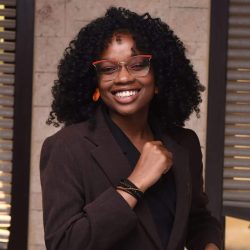

Interview with Claudia Moreno
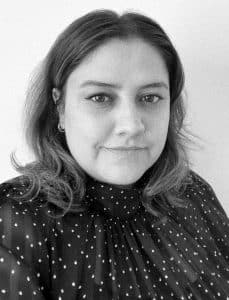
(this interview lasted 31 minutes)
The first question that I have is to ask you to talk a little bit about how climate change has affected or impacted your own community in Chile.
I think climate change is like a social issue in Chile. There is a social injustice in all of this because it’s always the poor people who are the most affected. For example, the avocado industry is not appropriate because of lack of water in the region. The community that lives nearby has no water. Climate change affects Chile because 90% of the people are poor.
An act of resistance is not consuming products that affect the poor. For example, I don’t like to buy alcohol. I don’t like to buy avocados that are from that specific zone where people don’t have water.
It’s something that you do on your own. Can you remember, looking at Chile, when you first noticed that climate change was affecting the people, especially the poor people that you see?
It’s been a permanent problem in some territories. There’s a lot of industries that are contributing to the problem. For example, in Cerro El Plomo (a mountain in the Andes near Santiago), there is a lot of lead poisoning because of the miners in Chile. The government wants to close this place, which is like an entire city with tunnels. It’s a problem that I’ve always been conscious of. Land use, right?
It may not be completely climate, but climate justice and land use — it’s really very much a part of that. So a lot of people have to move from their homes. So I guess I’ve always been aware of that.
What do you see the future to be? Do you think it’s going to change at all?
I think it is going to change in the future because I think the political influence in the decisions of the land, the people, how the money is distributed… I don’t think it’s going to be better. I think it’s going to be worse.
Can you describe your own work? What do you do, and how did you become involved in the work that you do?
In the matters of tapestry? I was friends with Alice. And I went to tapestry classes with Daniella. I was in a place in my life where I just finished college, and I didn’t know what to do. I started studying with her and, I don’t know, I think I’m good at it. I keep coming back to tapestry as an act of resistance. I think an act of resistance of mine is that I like to work with women and friends and do our own projects that we like. And we want to give. I think that’s the message that is working and is strong.
It was kind of a way of working with other women in tapestry that is a form of resistance, if I understand this correctly.
Yes. I like to choose what I do.
Alice introduced you to the collective, and Daniela introduced you to the techniques…
I was friends with Alice in college. And I took classes with Daniella. And then we formed the collective together. When I came to visit Belen, Belen took me to the studio. This was in 2021. We were starting to work on the panels to show what happened [during the social revolt against Pinochet]. It was just sort of coming together, and this idea that we were all working together in the studio. And it was a mix. I work from my home and in Daniela’s studio.
And you live in Santiago?
Yes. I live there.
When did you start weaving? What year did you start weaving?
In 2018.
And you learned to weave from Daniela?
Before that I didn’t have any experience with textiles.
What did you major in in college?
I’m a strategic designer.
Why do you weave?
For me, I really like to disconnect, and just focus on one thing, and everything around me doesn’t matter. I don’t meditate. I don’t do yoga.
Who do you think the audience is for the weaving that you all produce?
I think it’s diverse. Because maybe the people who are interested in weaving can appreciate the tapestry that we made. But it’s also politics, so people who are interested in history or Chileans in general that didn’t know about [the social revolt]. Also feminists, I think, is a broad aspect of it — people can appreciate the art.
I would like to ask you to tell us a little bit about your work. I wondered, to what extent you apply, say, traditional or ancestral practices in the weaving, or indigenous techniques in the weaving, in your art?
I think you can see it in the tapestry. All the techniques from the Andes are there.
You are a weaver who has been taught by Daniella, who has employed these ancestral techniques. Because you’re new to weaving, you didn’t have a previous background — this is all you know, the ancestral techniques — is that correct?
Yes and no. When you are introduced to tapestry, you must learn, you learn by just listening. The techniques that we apply are from here, from the Andes, and from Europe. So it’s a mix and we apply it to the tapestries.
[From the translator, Valeria: What she’s saying is that the image reproduction, meaning like the ones that look almost photographic, that’s a European tapestry technique. You’re putting an image behind and then laying it on, almost as if you were a mimeograph machine, like a printer, and that’s European. Then they’re taking these other techniques, so they’re sort of jumping between two techniques.]
For example, the one I did of the dog. That is a reproduction. And it also has embroidery and embarrilado [Andean wrapping] techniques.
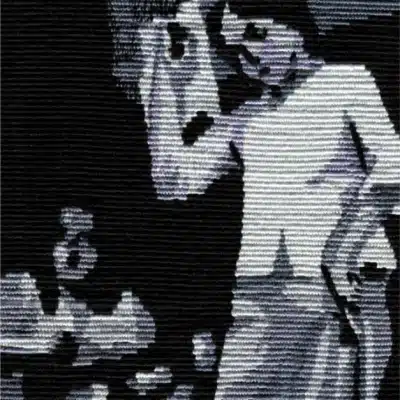
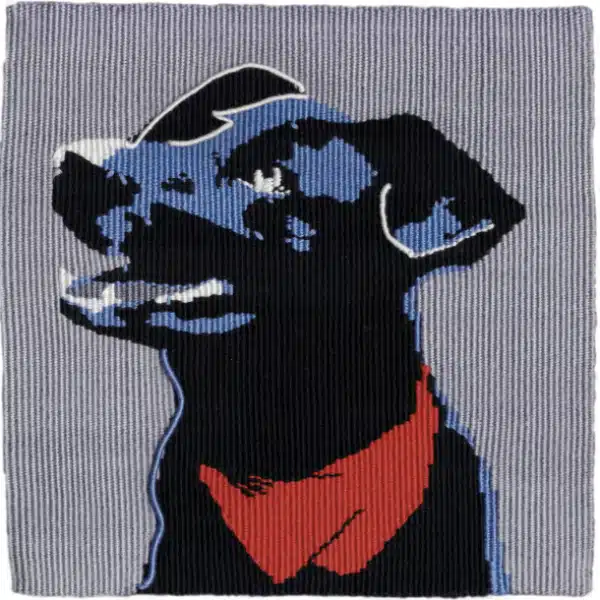
These are three techniques. The dog is also an image reproduction, but it has a weaving technique that is very interesting.
In what ways do you think of weaving as maybe connecting to the animal? How do you connect it to the tradition or the land in Chile?
This is something we were taught from the past. People used tapestries to transmit messages, to talk about tradition. Nowadays, tapestry is a representation of the world that we are seeing.
So, the first collective tapestry is talking about a moment that we were living in, the social revolt. And it was something so chaotic and explosive in the moment that we didn’t know that was happening. And now we want to capture the moment. In our work, we want to talk about what has happened.
Before you became involved in the weaving, what were you interested in? What was your family? Do you live with your family? Do you still live in the community where you grew up? What was your educational background, et cetera? Tell me a little bit about you.
So I’m living in another place, and I don’t have a connection with friends from my childhood because I moved from place to place. When I live in Santiago, sometimes with my parents, they live in the country, so they come and go.
Before this, before my involvement with tapestry, I didn’t know what to do because I just finished college, and I was looking for a job. I couldn’t find one, so I was in between a lot of things and doing nothing, so weaving was a life saver — to do something because I couldn’t find a job.
Do you have brothers and sisters?
Yes, I have one sister and one brother.
Do they do anything related to what you’re doing?
No, I’m the only one. The other member of my family that is related to art is my father. But he’s an engineer. A full stack developer. He works on computers, but he always wanted to be a painter. He started painting when he was 40.
With your weaving, what kind of communities do you interact with in Chile? Aside from the collective, what other communities do you personally interact with?
We used to meet once a week at Daniela’s with a group of people, but that ended when Daniela moved to Mexico. Now, with my friends, we are planning to develop a space because they don’t do tapestry, but two of them do embroidery, and one likes to crochet.
Any social or political groups that you’re involved with?
I’m part of the official government — one of the people that sign, it’s a political party. It’s official, one for the president. I signed for him to be elected.
It’s a party affiliation? So you belong to the Communist Party or the Socialist Party?
It’s not communist, neither socialist, but it’s the same thing, in a way. It’s more like the communists, but not. So that is my only affiliation with politics.
Are your parents also part of a political party, or your siblings?
No, not really, but they are also leftists. More leftist.
Aside from Daniella, who is a feminist, is there anybody else who helped you along the way to discover the work that you wanted to do and the life that you want to lead?
No, not really. I know that Alice has her grandmother, and she has a background and everything. But I don’t — I was introduced to tapestry by Alice, but I don’t really have a mentor. Maybe I’m still exploring this field — finding it and trying to.
What are some of the difficulties that you’ve had along the way in trying to figure out what you want to do?
I have a lot of interests. I think sometimes I can’t focus on some things. I’m still learning about all of this — about textiles in general. Because there is a lot I don’t know. Yes, I’m still learning, reading, investigating about this.
Can you think about anybody outside of your weaving community that can support you in any way?
The act of sharing the work, financial support — but I don’t think about where to get that. I think making other people know about the world — I’m supporting this, I think it’s a really big help. But I can’t ask for anything. It’s still just trying to figure out ways.
Anything that I haven’t asked you?
We’ve already talked about how the climate is linked to the social fight — social justice — and I think it’s a topic that is in all the countries, in this city [Seattle] too.