Interview with Belén Gallardo
(this interview lasted 70 minutes)
To begin, I wanted to ask you a question about your mission and your work. You have a PhD in…?
Ecology.
How do you think climate change has impacted you and your community? And I’m assuming in Chile. And then the sub-questions are: When did you first notice climate change? And how did it continue? And then what do you think the future impacts will be?
It’s huge. My background is that my family is very vulnerable, so I am the first in my family to go to university. So these things like climate change used to be very far from me, because the real problems are like food, education, health. I always liked to study, and the arts, too. When I had the opportunity to go to university, I needed to work to pay for my mom and me. So my context is, this is very far from me. When I started biology, it was because I love nature, but I am a city girl. The tiny opportunities to connect with nature were everything for me, so I think that was my main motivation to study biology.
But in my 4th year in university, I said, no, this is not what I want. Then I started a course in ecology and my world changed. In ecology, one of the main issues is the global chain with five drivers. One is climate change, another is the loss of biodiversity, biochemical changes in the cycles, contamination, and invasive species. So of all these five things, only one is climate change, and they are the drivers of change in the forest. I started my ecology education with these drivers and I thought, “Oh, wow! I didn’t know any of this.” I felt so behind.
That is the field from a student’s perspective. Because of that feeling, I started to work immediately in parallel with my study. I felt I needed to do more, but I understood it was impossible to do only with your own background. You need to interweave other knowledge. So at the beginning of this path, I started to connect with people in communication, in education. I started projects about interdisciplinary education — for example, I co-created courses in botanical illustration. The idea is to bring people in artistic careers together with the excuse to learn a technique, so they understand, with many perspectives, what a habitat is and to recognize the forest, all the beings, and the connections, and then communicate this with different graphic ideas. This is how I knew Gen, because with a colleague, we created a marine illustration course.
Then, I understood it did not only happen in the forest, but it happens in the ocean. I think I am always learning in different ways — knowledge, disciplines, people, narratives. I think in time, I arrived at physically weaving, because I was always weaving.
What do you think the future impacts of climate change will be? From what you’ve talked about, this amazing interdisciplinary effort that defines you — what do you think the future will be?
It’s very tricky, because I remember 3 years ago, or maybe more, I wrote an essay about Solastalgia — the word for ecological grief. In my essay I put that for the people with intersectionality, like poor women, the future is now. Only for the privileged, climate change is in the future. For all other communities, it is now, because now we are living with extreme climate consequences.
Other people have the opportunity to move on, but this is not a possibility in many communities. For example, privileged communities have the opportunity to buy water or create technology, so these communities can live in the driest places. The agricultural and food consequences in poor communities are happening now, but more privileged people can just go to the supermarket.
I think you might have answered the second question, but maybe not — so can you describe your work? How you became involved in understanding climate change, from biology to ecology?
Professionally, I’m a biologist and ecologist. But my practice is interweaving practice, people, disciplines, ideas, and narratives. It’s very fluid and depends on the group of people I know, so in that way it’s difficult. Now, I am a researcher and an assistant professor in a private university in Chile in the faculty of architecture, design, and animation. UDLA is the university — Universidad de las Americas. I started this new job in August.
Previously, I was the director of a conservation foundation for 4 years in Patagonia, but the research and conservation projects finished in February, so my job disappeared because of this. I asked myself, what do I want to do now? It was difficult because my PhD research was in renewable energy, but in marine energy. That was because I wanted to understand the context of renewable energy. But I also wanted to understand a theoretical framework around social ecology. So my PhD research was about interweaving social and ecological perspectives in marine energy.
Chile is one of the countries with the largest coastlines, so we obviously need to incorporate this energy, but the government is not sure. So my work was to first study the potential social and ecological consequences — not separating the two, but interweaving them, because they are one and the same.
In fact, we use the term intersectional a lot when we’re talking about these things.
The second part was interviewing the Chilean people to understand their perspectives and attitudes on marine energy. I concentrated on the fishermen because they would be the most potentially affected by this technology.
Parallel to that, in the 4th year of my PhD, I was the director of the Patagonia forest ecology foundation. So when I say I’m interweaving things, it’s because my consistent personal projects are very diverse. In my PhD, of course, marine energy is a way to mitigate climate change — a very focused solution, but in a very technical and governmental perspective. In my work in Patagonia, the scale is super tiny because it’s interweaving practice with people and how to integrate practices to incorporate conservation perspectives.
I have a question about when you mentioned interviewing the people — did that include what we in the West often call indigenous communities?
In this case, no. In Patagonia, no, because the climate condition is so extreme. In the valley, the rain is extremely heavy. The unique way to get to this place is by air or ocean. The only people that lived there used to be indigenous communities, but they moved. Now they have little communities there with a lot of technology, but technology associated with oil. That is the thing we are trying to change, too.
In parallel with this, 5 years ago I started weaving with Daniela, because I wanted to understand how we’ve seen things in a physical way. Then we started these projects very organically. Then it was too much because of the exhibit and all the other things. Last year, I started to put a social and environmental agenda in our collective. We needed to move to that because I’m very connected with the political consequences of dictatorship. That is in me, too. I saw so many things. That is what we are doing now.
When did you start weaving and how did you learn to weave?
5 years ago, I needed to understand how to physically interweave things. I started classes with Daniela.
And how did you meet Daniela?
Because she used to be my neighbor. She lived in the building in front of me, but I didn’t know that. I looked it up on the Internet and I saw the address. We started, but because I am always moving between projects, at the beginning the tapestry was super difficult for me, because it’s super slow. I needed to maintain it to finish. I felt like no, this is too slow for me, this doesn’t work. But through this, I am learning because it’s a process. I am learning to sustain projects because all projects have different velocities. In certain areas it is necessary to maintain gears. I know that it’s only that you create the space and then move on.
Why do you weave?
Yeah, I connected with it. It’s emotional for me, too. There are so many reasons — the first is to sustain, create, and co-create any space to share. Now it’s different, because Daniela lives in Mexico, but for the last 5 years, every week in any context, rainy or not, no matter what is happening in our lives, we joined and weaved our lives.
That is what it is. Weaving our lives. We are really very different people. We think in a very different way. In fact, maybe in a way, weaving is the only thing we have in common. But in all these years, we created an emerging property. It’s a side of us that connects us. Through this we connected with more than 50 people — our collaborators. We have more than 50 weavers, translators, writers, because everyone has their own web. Everyone puts their nest and their web, their auras interweaving. That is one thing for me, the necessity to connect with one another and create not only a meaningful piece, but meaningful conversations and meaningful space. Being a woman, creating this group, and sustaining this group is very hard through time. Another thing we discuss a lot is the need to maintain these traditions.
The tapestry has many origins in the world, but in the Andean, it is not just a way to weave. It’s about the language. It’s a language, because in the Andean we didn’t have a form of writing. Our form of knowledge is through weaving. The people weaving were like books, the cloth was the books. When the Spanish arrived and colonized, they put them in the fires and destroyed all of them. There are so many tiny pieces of these puzzles. So we women must study, understand, and maintain. This tradition is our legacy. This technique used to be done by women, not by men, so it’s a special tradition, too. It’s associated with the feminist perspective. It’s like a women’s language.
I wonder, then, who is the audience for your weaving?
It depends, because we create these projects to connect with others with our collective tapestry. First, we were thinking about the Chilean audience, but the idea is to connect with another form. For example, my family, and my mom in particular, is a conservative in the context of Chile, while I am liberal. In Chile the dictatorship split everything in two — the families, the country, the narrative, the perspective, all of it. So if you are a conservative and a liberal, it’s not possible to even talk. It’s super difficult.
The Conservatives were the people who supported the dictatorship, and until now they haven’t recognized all the consequences, the terror, the deaths, and all the things that happened in the dictatorship. So it’s super difficult, these things with my family and my parents, because how is it possible that you don’t recognize this? It’s impossible. Through weaving, in my case, I will start to have this conversation. It’s different because you have another medium. It’s different from when I start to talk at the table.
My mom went to the inauguration when we had the opening in the National Archive of this piece and started crying. She didn’t know. So that is the kind of conversation we want to start. It’s so difficult to start a conversation. Say, for example, Henry Kissinger, the Secretary of State, was behind the dictatorship and all its consequences until now. It’s super hard to start the conversation. But if you see the tapestry and the history and understand the context, it’s like, “Wow, I didn’t know.”
The expat and exiled community here, I suppose, is really learning from this as well.
We had an activity for the exiled and a lot of people came. One was a man who arrived in Seattle in 1976 who is Aymara, so he is indigenous. Recently we started to talk and collaborate with the Indigenous people here in Seattle. They felt so lost all these years and they now realize they have a community here through this, because they have a shared vision. We have other assistants not just from Chile, but from Ecuador, Brazil, and Peru. Henry Kissinger supported the Chilean dictatorship in Operation Condor, where he supported dictatorships across Latin America. It is really hard, because we share this same terrifying history with Peru, Brazil, and other countries from the 70s and 80s. So our work is about Chile, but it’s also about all of Latin America.
To what extent do you apply these ancestral practices, or indigenous techniques in your weaving?
I think learning from Daniela, you have respect for the moment when you’re weaving. Our lives are so fast, so all the people say, “Oh, this is very meditative, it’s like doing yoga.” You have that, of course, but when you connect with the process, for me, it’s like you understand what you’ve imagined. I imagine there are so many women behind me, living through me. When I first started weaving, I put a lot of noise on, like Netflix or a podcast. It was a very physical thing to me.
But last year, in September, I was weaving. My cat, May, was like my soulmate. She kept coming in front of me, and I said, “May, I’m really busy.” I put a lot of time into that tapestry, but minutes after, she died. She was trying to say goodbye. At that moment, I realized I should focus on understanding that weaving is a very important moment of connection with women. So now, I’m trying not to distract myself with anything.
You were really connecting, and your cat was kind of the person that was trying to tell you, “Hey, look back and connect with those women.”
Thank you, I know that sometimes it’s so hard when you’re thinking about this. I wondered, in what ways is your weaving connected to the land?
In so many ways. That is why I’m trying to work with communities and ecological, social, and environmental topics. All the conversations I put on the table with women are related to these things, because it’s my day to day. With all these previous projects, they were only about the political things in the past. We have a constitution created in a dictatorship. Right now in Chile there are many villages that don’t have water, because in our constitution, water is owned by enterprises, like the forestry industry, and that is in our constitution.
So there’s no way to help the people who don’t have the water?
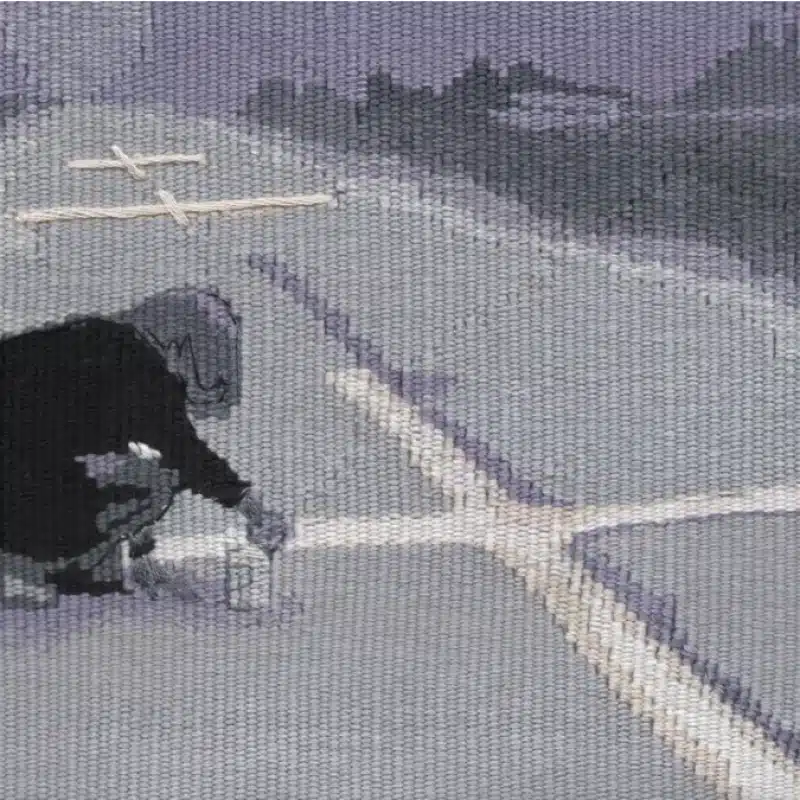
Yeah, the more logical idea is that the water is for the people. This connects with the land because we are the same. We have a tapestry called “To Reveal the Social Fabric,” because we are textile, in the way. We are all interwoven — all the beings, the humans and the animals, and climate change. Our society is not aligned with the Earth’s natural cycles, because we have CO2, energy, and emissions. That is ecological study. The framework of the social ecological system is not integrated. We need to realize we are the same.
When I was weaving, I saw this. Embroidery has six threads, and when you’re weaving and making a tapestry, imagine only one of these threads tries to escape the tapestry — this infinite tapestry. Of course, when you put it out, it would make a mess of the rest of the tapestry.
Can you tell me a little bit about your educational background, and where you grew up? And if you’re still part of that community?
I was born in Puente Alto, and this district is the most populated district in Chile. It’s very urban, but it is one of the poorest districts. My district is very famous for having buildings that don’t work because of the rain, for poor housing security, and for other bad things. A lot of violence and drugs. So that is why my history is very weird in this context, since I became an academic. Even right now, it’s weird to look in the past because I don’t know how I transformed into this.
Are your parents still living there?
Yes and no. All my family lives there except for my parents. We moved 10 years ago to another peripheral district — one less populated and more rural. That was because my mom used to take a bus for two and a half hours to go to work.
What did she do?
Chief Secretary to the same boss for 20 years. And it’s not possible for my parents to retire because the pension is so slow in Chile that it is ridiculous. So they maintain their jobs. My dad is a security guard at night.
Do you have any other siblings?
Yes, I have two. The oldest, he is bipolar, and five years ago he had an accident, so he lost some limbs. It’s very difficult for him, because he has a disability, physical and mental illness, so he lives with my parents. He has good days and bad days. And my little brother is not so little anymore, but he lives in the north of the country. He has a wife and a son, my nephew Alvaro, and Alvaro and I help my parents.
Did he go to college? Was he able to go?
Yes, but he’s attending right now. He studied a technical career in computing and informatics, and then he started to have little jobs and create his own company. It was a little company with around five people working with him. And now he has realized he wants to know more, so he is studying electrical engineering. It’s his 1st year right now.
So do you go back to that community where you grew up?
Yes and no. Yes, but to visit my family, not for projects or anything.
What about friends from school? Do you still maintain the friendships that you had when you were younger?
No, it is difficult.
Because you’re in a completely different world?
Exactly. Right now, yes.
What communities does your weaving intersect with?
There is the SECOS community that was created with Gen — there is U.S., Chile, and others. I work with a lot of these people, including Gen. One part of this community, we created the project in Brand New Way, the foundation I had leadership in for the last 4 years. Three of the fellows of this program are working on this in Patagonia. In parallel, with Gen and Fernanda, who used to be part of this too, I participated in the Secos Institute — a social ecological institute about practice in the ocean and in the coastal regions. This is in the south of Chile, and that is where I did my PhD research. In part of this, there is Collectiva Tramando. We are in all of Chile, too, and now we are connected with Gen. I have another collective, too, not connected with anything, called Collectoras de Naturalesa, and it’s through Chile and Latin America.
And what is it?
We focus on child and juvenile literature. We are the researchers, the editors, the designers, the illustrators, and the writers of books. There are 15 women and we have met two times a month for six years. We analyze these books and create others. For example, in Chile there used to not be any books for children about amphibians, so a team created a book about amphibians based on research.
How did you become part of it then?
Because of the illustration course about the forest and marine life in the south of Chile. I knew dozens, maybe hundreds of illustrators because it was over a span of 6 years. We, as a group, co-created this.
Right now, I’m in this new position, and this is part of my research line. At UDLA, my university, I am now an associate professor. So I want to maintain research about the effects of nature books on children, what happens with renewable energy, and what happens with the consequences of climate change in Patagonia. With this we have our 3rd project, our Tesla Collective project — connecting the consequences of dictatorships with social, environmental, and feminist perspectives in Latin America. Because in Latin America, there is the highest quantity of women killed for environmental activism. So the idea is to put light on these women and the ecosystem and the problems associated. The idea is to have 24 little windows of history again, but with a new topic.
I know that there are people that have mentored you and supported you, and we want to know about them. And we want to know about the challenges you’ve faced.
I’ll start with the positive. I think my biggest mentor is Gen because I feel in Chile, in Latin America too, it’s so difficult to imagine big projects because it’s all against you. But the energy of Gen is like, “It’s possible.” So in my mind, I’m always like, “Really? I don’t know.” But I trust her. Even this interview and all these other things happening are so crazy. When we started this, it was all a dream. Fernanda and Nelly were the Chileans in this, our co-creators. Gen’s idea was that we want to create a program, if we put ourselves 5 or 10 years ago and think about the dream program we would want to apply to as a student. So we wanted to create this for others.
But then every step was super difficult, and I saw all of us start to get exhausted, but Gen always maintained the energy. So for me, this was the biggest gift because I think I applied this in all my other projects. Another thing is, Gen is very much a giver.
The only way to create this space is that to start, you have to put all of yourself into it, because if you expect others to take the first steps, nothing will happen. So it’s more like a work of confidence and constructing a relationship in the first part.
Gen gives you the opportunity to take risks that you wouldn’t in Chile. If you were just in Chile, you wouldn’t be able to?
No, because it is too dangerous. For example, here in my PhD, I felt great in every step. Thinking I shouldn’t get things wrong, but in science it’s impossible, because you learn through your mistakes. For me it was super slow, because I was scared, terrified to make mistakes. So in all my other positions, it wasn’t so bad because I had this nest in a way. It’s different.
I don’t know if this is correct, but you had the reputation to be able to do it?
Exactly. Because I was working behind the scenes, but then this is like my actual job. So it was scary, and even in the beginning, my supervisors and advisors were men, so the communication…
My supervisor was the director of the Institute, so he is the boss of Gen, too. And Gen will tell you it’s super difficult to talk with him because he is always busy with many things. For example, to review my thesis, I only had 5 minutes. So it was super difficult in my academic life. In Chile, with ecology particularly, in my university 95% of scholars are men. It’s super difficult to find a woman on the teams. The only possibility is men, and the men are super busy, it’s not possible.
I thought a lot about if this was what I wanted to do. But my decision was that we need to start to occupy this position for other women.
And more generations?
Yeah, to feel secure.
How can those outside of your community, even those in what we call the Global North, support the work that you’re doing?
I think doing what Gen is doing. Supporting in a really weekly way. It’s not open funding or putting money on the problem. It’s more like having a meeting through Zoom, opening the door to where we are, having great connections and starting conversations. Gen always says, I am doing this, and I don’t know how we will connect, or if it’s possible, or even if you want to or not — but there is this, if you want to participate in any way. That support shows confidence in us.
Maybe you don’t want to participate, but opening the opportunity creates another way to learn about this project. She taught me how to make these things and she learned how we work, so it is more in the process of collaboration that we understand that way of supporting. Because many times, it’s like, I don’t have anything substantial to offer. But it’s not about that. It’s more about maintaining the conversation.
Is there anything that I haven’t covered that you wanted to add before we finish?
Only that I’d like to know more about the project of the Collective, because we need to decide how to do this, use your methodologies and how you create this project in a way to incorporate these things in our project.
There are so many histories of hope that we want to shed light on. This methodology is, I think, perfect, because our tapestry is about hope. We are shining light on these women activists. They are the leadership in these communities and they are in danger. We want to support their legacy. Not only the ones who have been killed, but the ones that are still alive.
If I understand this correctly, you want to respect, and honor those who have passed away as a result of the work that they’ve done, and you want to support and advocate for those people who are alive?
Exactly. This is the adversity — these women activists are the most killed in the world. But the focus for us is to put light on the leadership of right now, not in the past. What are women doing right now for leadership and environmental activism in Latin America?
Because that is the way to hope. This is the context, this practice is very, very dangerous, so how do we bring this practice, these women, and these leaders to light?