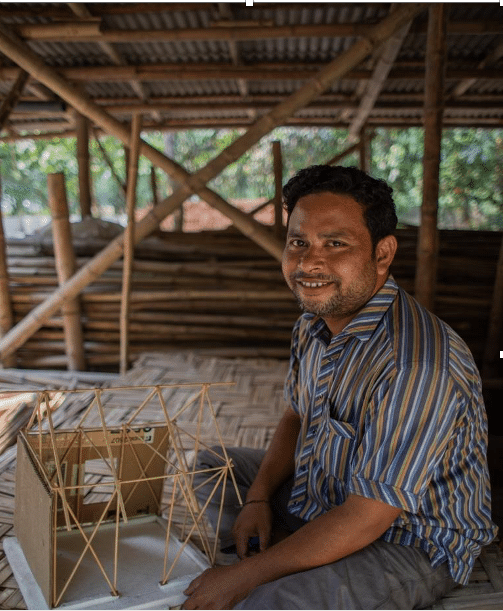
This oral history interview with Apu Chandra Roy took place on December 9, 2024, and was conducted by Peg Spitzer and Ayuska Motha. It lasted 70 minutes.
How has climate change affected the community that you’re working in and when did you start to notice any of these changes?
From my personal experience working with Nirapod Bangladesh Songstha and from what I’ve seen since childhood I slowly began to realize that I could give feedback and raise my voice from within my own organization. I was born and brought up in Sundarban Village. I completed my primary, secondary, and college education there. Over the years, I’ve witnessed many changes in my village, and most of them are linked to climate change. But climate change is not just about temperature it’s about everything around us.
When I was younger, we used to go to the pond near our home every day to bathe, clean, wash clothes, even to wash cows.. That same pond water was used for drinking and household work. We also had a river near our house. We used to swim there, catch fish, and collect vegetables and other natural resources from around the area. Life was simpler, and nature was generous.
But today, things have changed. The river is almost dry. The pond has shrunk. Trees around the village have decreased a lot. The environment feels different. The weather is hotter than before extreme heat is now a regular part of life. Every year, floods are damaging our homes, lands, and roads.
When I was preparing for the CKC meeting, I started thinking: What does climate change really mean for me, for my community? And I realized it means watching our river dry up. It means seeing agricultural lands eroded by riverbank collapse. It means fishermen losing their livelihoods because there are no fish left. Many of them are now switching jobs or migrating to towns.
Where I used to swim and catch fish as a child those places no longer exist. Even the trees that were once free for everyone are gone. Because of population growth and the demand for agricultural land, people have cut down the jungles. They’ve even filled up ponds to turn them into crop fields. As a result, the underground water level has gone down, and we now struggle every year to access enough water.
Our farming system has also changed. Before, we used to depend on nature. Rain would come during the rainy season, and we’d harvest during the dry season. But now, that pattern doesn’t work anymore. Rain comes late, or not at all, when we need it. So, we are forced to use groundwater for irrigation, which costs more and is not always available.
This year, I personally faced this problem. My neighbors who had shallow pumps used groundwater and planted their paddies on time. But I had to wait for rain because I didn’t have irrigation access. So, I planted late. Now, I’m harvesting one month after everyone else. My yield is lower and my costs are higher.
Floods, too, are now more unpredictable and damaging. When rain does come, it’s often too heavy. It breaks the riverbanks and floods the area. Homes, crops, and roads are washed away. People are being displaced; they’re forced to leave the land they’ve lived on for generations and move elsewhere.
Even in farming, we are struggling. We thought filling up ponds and using tube wells would help grow more vegetables. But now there is no water left. The soil is dry, crops don’t grow well, and we are forced to use more fertilizers and pesticides. That’s increasing our costs and harming our health. After every flood, we see more illness. And from regular exposure to pesticides, people are facing slow health damage almost like slow poisoning.
Deforestation continues. Land use is changing. And with that, people’s traditional ways of living are disappearing. Rivers, ponds, forests these were part of our identity. But they are vanishing in front of our eyes. These are the real effects of climate change I see every day in my village.
If I understand correctly, not only are you the project manager, but you’re a farmer too, is that right?
Yes, that’s right! Along with my work as a project manager, I’m also a farmer. My family and I have some agricultural land where we grow paddy, jute, corn, onion, garlic, and seasonal fruits like litchi and mango. We also raise animals- cows, goats, chickens, ducks, and pigeons.
Just this morning, I received some joyful news. While I was taking a shower before heading to the office, I saw one of our cows giving birth. My mother and I helped during the delivery. We had to gently pull the baby calf out. It was a very special moment for us.
Could you speculate on future impacts?
Because I can already see the problems happening around me, I keep wondering what will happen in the future. It’s very possible that more people will be forced to move away from riverside areas, as the land is no longer stable or cultivable. Many may even migrate to the city in search of work, because they don’t have enough land anymore, or they can’t farm properly due to problems like lack of irrigation, overuse of pesticides, or poor soil quality.
Water shortage is becoming a big challenge for agriculture, and if this continues, food scarcity will be a major issue. Farmers won’t be able to grow enough crops. On top of that, there are problems with food storage and high prices in the market. Everything is getting more expensive, now higher than ever before. This financial pressure is also pushing people to cut down trees and clear land just to survive.
But nature must be protected. Our land should stay green. If things go on like this, I feel we will lose even more of our natural environment in the future. You cannot specifically say that it is not related to climate change. Everything is related.
Can you describe your work related to what you and Jo are doing and how you became involved in that work?
That’s actually a nice story to share. I was still a student when this organization started. I passed my Secondary School Certificate (SSC) in 2006 and my Higher Secondary Certificate (HSC) in 2008, and I completed my Master’s in 2016. During that time, I was already helping my father with volunteer work for the organization. I also worked with a few other organizations, especially in the education and health sectors, as a volunteer.
In 2013, Jo came to Bangladesh as a volunteer and as one of the participants in an international housing workshop organized by us. She joined the workshop and then decided to stay longer and support our work. From 2013 to 2014, she lived in our village for one and a half years. During that time, we worked together on many housing-related projects. We focused on using local materials, providing housing advice, and raising community awareness. That’s how our journey with Jo and Azuko began.
Apu: Since then, from 2013 till now, we’ve worked together like one single team, not as two separate organizations. Even though Jo is working with Azuko and I’m with Nirapod Bangladesh Songstha, we’ve always seen it as one mission. We’ve collaborated on housing construction, design, and training. We provide housing advice to the community and support financial planning through women’s savings groups. One of the core aspects of our work is co-design where the community is directly involved in designing their own homes, toilets, and kitchens to meet their basic needs.
We also run construction training and maintenance sessions to ensure sustainability. Our work takes place mostly in marginalized areas and informal settlements. We also work with universities to give students hands-on experience through field workshops and knowledge sharing between students, experts, and the community.
Over the years, many architects and professionals from different fields have come here to support us as volunteers or well-wishers. Our core is small, only five members. The rest are freelancers, day laborers, community leaders, and local government representatives. We also collaborate with construction workers, women leaders, and academics. Our process is all about working together experimenting, learning, and building with the community.
When you talk about the community there, how many members are there in that community that you’re serving, that you’re working with?
We work with many different types of community groups, both in urban slums and in rural villages. In the city, we’re actively engaged with four slum communities. These are very dense areas with limited space. For example, in just one of these slums, we work with around 52 families, and each family usually has at least four or five members. So that’s already over 200 people in just one location. All of them are considered part of our community.
Our work in the slums focuses on housing improvements, savings groups, and helping families co-design their own living environment. We don’t just offer solutions, we begin by understanding the specific problems each community is facing and then work with them to find practical ways to address those challenges.
In addition to the slums, we also work in rural areas where we’ve formed more than 30 community groups. Each group usually includes 15 to 30 members, mostly women. These village groups take the lead in identifying their local issue whether it’s related to housing, sanitation, water, or agriculture and they work together to solve them. When they need broader support, they can connect with other nearby groups through our network.
That’s one of our goals to create a strong network across Dinajpur where these community groups share knowledge, support one another, and learn from each other’s experiences whether that’s a solution they came up with, a challenge they’re facing, or a success story they’ve achieved.
So, in total, our community includes hundreds of families and individuals urban and rural who are all part of this growing, collaborative movement for change.
You grew up in the village that you’re still living in. Correct?
Yes, that’s correct.
Who helped you along the way in what you’re doing with your life these days, and how did they help you? Also, what challenges did you have? What were some of the problems that you had to overcome?
At first, it was difficult for me to put everything together, but I can say clearly that the biggest inspiration and support in my life has always been my family. Since 2010, everything I’ve done has been shaped by their advice and encouragement.
My father played a particularly important role. He was a poet, a singer, and also worked in many different fields, at the university, in private companies, and even as a housing consultant. He always encouraged me to take responsibility for helping my community. He used to tell me that there are many problems around us, but with effort we could try to solve them. He believed I could lead an organization and build something meaningful.
When I was young, I used to see foreigners visiting our village. I was very curious about them, about how they spoke English and how they worked. Eventually, I got the chance to work with them as a translator, and that experience changed everything for me. I traveled with them to visit different projects, listened to their ideas, and saw how they thought about community problems. One memory that really stayed with me was when I saw a pregnant woman in our village who had no access to doctors or hospitals. That moment made me realize that I wanted to dedicate myself to serving the community and addressing these kinds of issues.
During that time, many of my uncles were also working with international organizations, and they inspired me too. So, starting in 2010, I began organizing training sessions. My father and I also ran “housing advice workshops.” At the beginning, international volunteers from the UK supported us. I asked them endless questions, and they guided me on things like how projects are planned, how to apply for grants, and how to use the internet and computers. That was really the start of my journey.
In 2013, I met Jo, and she became not just a colleague but like a family member like a sister to me. She has been one of my greatest mentors. She helped me focus, reminding me that even small-scale work can make a deep impact if it is done thoughtfully. With her guidance, I learned how to approach donors and funders, and how to build partnerships. I also had support from senior colleagues with government experience, who guided me through the legal challenges of running an organization in Bangladesh.
And, most importantly, I have been inspired by the community itself, especially the women I work with. When I go to them, they share their struggles, and together we look for solutions. The most rewarding part is seeing that, even after a project ends, they continue to work on improving their own lives. That motivates me to keep going.
We’ve also had encouragement from global partners. At the beginning, volunteers from BRAC University, North South University, the Australian High Commission, and the German Embassy helped us secure small-scale funding. BRAC in particular has been a huge influence, as it’s one of the largest organizations in Bangladesh.
Do you have somebody in charge of the applications for the funding? How do you find out about them?
At the beginning, most of the funding opportunities came through the international volunteers. We would share ideas with them, prepare case studies, and then they helped us apply for support from donors like the Australian High Commission and the German Embassy. For national funding, we tried to apply on our own.
We are still a very small organization, and our real strength is in the community. We have around 30 places within villages where we can sit down with people and work. We don’t need a big platform; the community itself is our platform. Sometimes, when I organize events, community members even help with the paperwork.
Of course, funding is always a major challenge. Personally, I prefer to focus on the work itself on being directly involved in the projects, rather than constantly thinking about money. But in reality, we must also deal with funding issues. Another challenge is education. Growing up in a village, many people, including myself, had limited access to education. Fifteen years ago, it was even worse. Families often encouraged children to start earning money by the age of 14 or 15, instead of continuing school. That was a barrier I had to overcome, and education was expensive.
We also face cultural and social challenges. For example, women in the community are often not prioritized, and in some cases, because of religious or social traditions, they are kept inside the home. To overcome this, we form women’s groups of 30 or more, so they can support one another in solving problems together.
Technically, we also face challenges in promoting traditional building materials. We work with bamboo and mud, which people often see as “old-fashioned.” But we’re trying to improve techniques and designs so that these materials are stronger and more resilient. It’s not always easy to change perceptions.
On top of that, we deal with climate change, which constantly affects our work, and right now Bangladesh is facing political and social instability. Since August 5, we’ve had no proper government, only an interim administration and it has been very difficult to get support from government offices. Prices of basic goods like rice and vegetables have doubled, making life even harder for communities. The army is now in control, which brings a sense of order but also uncertainty.
So, to sum up: I’ve been lifted up by my family, by mentors like Jo, by colleagues, by international volunteers, and most of all by the community itself. At the same time, I’ve had to face challenges of funding, education, cultural barriers, climate change, and now political instability. But all these experiences have shaped my journey and strengthened my determination to keep working for my community.
How can those outside of your community, such as those in the global north, support your work best? What’s the best way you envision that?
What I need most is guidance, experience, and direction. Every day I face questions from the community, about housing security, about women’s roles, about leadership in families and I know I cannot solve them alone. Women especially face barriers: they often cannot work outside, and their voices are not prioritized. So the best support I can receive is advice, knowledge, and encouragement from people with different experiences.
I also really value voluntary involvement. When people from different backgrounds come here and share their ideas, it gives us energy and helps us grow. Right now, because of political instability in Bangladesh, I don’t expect many international volunteers to come. But I still welcome connections with those who are engaged in community-based work elsewhere. Even conversations, visits, and advice from people outside give us new inspiration and help us achieve more.
You’ve really bridged the gap between what you do at the community and how you connect with those outside.
Yes, exactly. I think we can share our process more widely. It’s difficult to explain everything in just one hour, there are many parts of our work that we haven’t discussed here. Jo has been deeply involved in designing this process, and she could also share more details with you in a longer discussion.
Beyond that, what I really want is to keep learning and improving. Our community may be based in one place, but my goal is to connect them with other communities. Women here already have some education and skills, and they want to work. But cultural and religious barriers often hold them back. That’s why we encourage them to dream for themselves, not just for their children.
For example, when I ask women about their goals, many say they want their sons or daughters to be successful. But when I ask what they want for themselves, like visiting a new place, buying something special, or simply enjoying life, they often say it isn’t possible. Money, family restrictions, and social expectations limit them. Yet I see that many women want to fly, to work, to create opportunities. That’s why we started savings groups and training programs to give them practical ways to act on their dreams.
Through these groups, women are now addressing real community problems together. For example, sanitation is a huge issue. In Hindu communities, women must bathe after using the toilet, which is especially difficult in the cold season. Without proper toilets, they had to go outside before sunrise or after dark, which was unsafe and uncomfortable. We built a few toilets as examples, but families still hesitated to invest in them, prioritizing their living rooms instead. So we encouraged women to save money collectively. They began building toilets with their own savings, and slowly, many others followed.
Now women also run small shops, do tailoring, or make other investments. They feel more powerful because they can make decisions. The savings groups give them not only money but also confidence. This collaboration is what inspires me, it’s not just me working with women, but women supporting each other and finding solutions themselves.
How long have these groups been operating as a group and have you seen any improvement somehow in how they interact and support each other?
We started experimenting with groups around 2011, but by 2014 we really began building them more systematically. At first there were only a few, but now we have around 30 groups, with more than 20 actively running. Some groups struggle because of strong male dominance in the community, but overall, they’ve grown into a real source of strength and voice for women.
The changes are clear. Many women now manage small businesses, like tailoring or baking. Through savings groups, they’ve built toilets and kitchens, or bought things they never thought possible before. Toilets, in particular, are life-changing for women here if a husband doesn’t prioritize it, a wife can now take a loan from her group, build one herself, and repay it slowly. The loans are created and managed by the women themselves, it’s not outside microcredit, but a community-led system that directly solves their problems.
The groups also bring freedom and joy. In past years, we’ve organized events where 700 hundred women came together. Last year it was more than. They dressed as they wished, played games, danced, and spoke openly in front of others. For many, it was the first time they experienced that kind of independence. When we began, we had only 30 women. Now there are more than 900 involved.
Their dream now is to continue working together. We don’t push big dreams because of money limitations, but we help them create their own to earn income, to be strong in their families, to make decisions, and to understand things like housing and business so they can be equal partners in their households. I don’t know exactly what the future will bring, but I believe these groups will grow even stronger and create real change.
Is there anything that we haven’t asked you that you would like to add?
There are always more things to share. One important point is that our community members really want to connect with internationals who are supporting them or even just thinking of them. They feel encouraged when they know people outside care. So you are always welcome to visit, talk with us, and connect.
And finally, let me show you something. This house here was built during one of our workshops. It’s made of mud, and in just one week, 14 international participants worked side by side with local people to build it. That collaboration shows what is possible when communities and outsiders come together.

That’s our expertise. How would you like to build your house? We gave advice. So if you like to build with mud, there is something we teach them that you must mix in, you must make the roof a bit over. And there’s a couple of things we said. And, in the process, we work with the architect and through the educational experience as well, also sharing knowledge for a long time with craftsmen and builders. In the workshop, we not only want to teach them, we also want to learn from their sharing and understanding the knowledge.
Oh — I didn’t mention that I studied history. I’m not an engineer, but I’m good at housing and building. I can say proudly – I’m a builder.