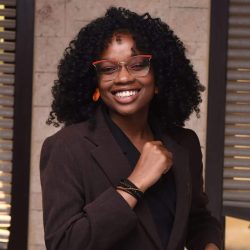

Interview with Alice Jallois
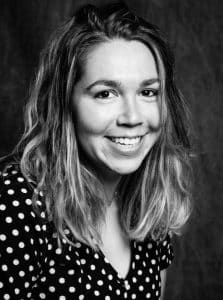
(this interview lasted 42 minutes)
Who do you consider to be your community? The reason I’m asking this is because we want to know the impacts of climate change on your community.
I come from Chile, I grew up in Chile, but I’ve been living in Paris for the past six years. Moving to a different country—I’m half French so it’s also my culture. Moving to Paris has brought me closer to Chile, which is super weird because I don’t even have family in Chile anymore. My parents moved to Madrid—everyone is everywhere—but my main culture is Chilean. In France, I am closer to Chile; but in Chile, I am too French.
So, the Latina community everywhere is super close, is super bonded, which is also the same case in France for the Chilean community. Then, if we talk about climate change, I feel that one of the first things that hit me when I moved to France was realizing that everyone was so involved in this fight.
In Chile, I believe that there’s a part, it’s like when you have your basic needs, right? And those are covered, you can get your fights for other stuff. When I went to France, in the beginning, I went to the Feminist March, the first year I arrived.
What year was that?
2019. It was super small. You go to Chile to a feminist march, it’s gigantic. Everyone is out there because we feel the need, to go and get our rights, you know, there’s no abortion in Chile. But in France, we have that [access to abortion]. I’m not afraid of going out in the street at night alone in France.
I feel super free in comparison to living in Chile. In Chile, you’re always careful when you come back home. You text your friends your location, you know? But when I went to the climate change march that same year in France, everyone was there. Everyone that wasn’t in the feminist march.
In France, we already have like the basic female rights, you have abortion and stuff that people don’t question. They don’t question it because they have it. So it’s not a big deal. Yeah, it’s normal, you know, for us growing up, for me growing up in Chile and then moving into this country. But for me, growing up in Chile, not everyone has the same rights as in France. So, it was interesting to start seeing people doing stuff for climate change, like this being an important subject, an important topic where people talk about it, where there’s much, where people go to demonstrations for, and it’s important.
For climate change, it’s more like groups of people doing stuff and, in France, it was more massive. Everyone does it, but I think it’s also because they have women’s rights and all the rest so now they can move on to this.
Can you think about a time or instance in which you realized that climate change has really affected you?
Growing up in Chile you see it every day. You see the deserts advancing to the south. You’re looking at the consequences. The country has changed a lot in the past years. When I go back, I see it more. Growing up in somewhere where these initiatives come from groups of people (in Chile) and then moving to somewhere where everyone is like looking for this (in France), like the gap between this was like very, very dramatic.
I also was super into “fast fashion” when I was growing up in Chile…I went to Paris in 2014 for a semester abroad and I started doing a lot of research. I guess that’s when I switched. I stopped consuming the way I was consuming because I realized that while I was studying design. If I wasn’t part of the change, then who was going to do it? We are designing the clothes; we are designing the prints for the clothes. If I keep consuming like this…the change doesn’t come from the industry then it will never come. And then I guess that’s the moment when I completely switched my way of seeing everything. I remember I didn’t buy a single piece of clothing for almost two years because I had so much you know.
What do you think the future impacts of climate change will be from your perspective? Maybe looking at Chile or looking in Paris.
It’s super hard. It’s a question I ask myself all the time and I feel like I try to be the change that I want to see but, at the same time, I go into a nihilistic place. For example, I am a vegetarian. I don’t eat meat because I believe that it takes too much water to produce the meat. Do I compensate for people who do eat meat every day? Also, in my decision to dye my fabric with plants because I understand that the process of dying is so horrible I remember looking at these huge tanks with a huge like amount of water that gets wasted. I want to be the change, but at the same time I get into a nihilistic place. You see people consuming…so, it’s based on consumption. France is not like Chile. Chile is closer to the United States. In France, you see people trying to make a change and then you see people like you guys (Americans) and you get nihilistic and you’re like, okay, whatever I’m doing is not enough.
In Chile, we don’t even realize what we’re doing. Everything is consumption. Like we were talking the other day how Parisians dress and how Americans will dress. And for example, you will see a Parisian fashion girl, you know, like we’re talking about these girls that are spending a lot of money in clothes, you know? So here they will use like big taglines, big like brands, brands, you see the brands. I have friends that are wearing very expensive clothing ($20,000). But you don’t see a brand—they’re not showing that they were wearing expensive stuff. In France, you go out, you go to the park, and you take the bus (public transportation).
In the US, it’s so hectic and everything leads you to consumption. The rhythm of the life leads you to consumption. When you buy, you want more and more and more—but everyone is like that. I still go to shops, and I want to buy everything but I just don’t do it because I realize that there’s a void.
Shifting a bit, can you describe the work that you do and how you became involved in it and in the collective?
Now I work with natural dyes, and I work with natural pigments and I became involved in the collective when I met Danny. She was my weaving teacher. When there was a social outburst in Chile in 2019, I was already in France, but I was still involved with the girls (the other weavers) because you must sit down and practice. When you sit down with someone and make something and spend time making something then there’s conversations. You talk about what happened in your day and, at the same time, if there’s something going on in society, you will talk about it. This is what happened in 2019 because we weren’t near where all the demonstrations were. It was so obvious to start making something right because we were already sitting down and talking about these issues.
When did you start weaving and how did you learn to weave? Was Danny the first person?
Yes, so when I was doing my thesis, I was doing a design, like a final project for my studies in Chile. And I was working with a woman who used to make embroideries during the dictatorship. And I wanted a project on the side, you know? I wanted to be in contact with materials. And I was looking, since I was a girl playing with needles, and I think I did a little on the side. Then I found Danny and I started weaving.
Why do you weave?
When I started weaving, I had already experience with dyes and fabric that is a material, and you intervene. You’re creating the material from scratch — in that creation of the material from scratch there’s a lot of repetition. We weave from one side to the other and then again and then again and then again. There’s something that makes me go back to my childhood. With my nan [grandmother]—she was a seamstress so when we weave these pieces with the collective, at the same time you think about what you’re weaving. When we were weaving the dictatorship piece, we talked a little bit about the dictatorship, and we did a lot of research. For a few months, we just did research and the first thing we decided was to make a piece about the dictatorship — 50 years after the coup d’etat. Then we talked about the role of women during Pinochet’s dictatorship and the resistance. Once we set these “ground stones,” right then we started doing research about what women did during the dictatorship.
Since I worked with the arpillaristas for my thesis, I already knew there was a big dimension of feminism and, earlier with uprising. You see, there’s a piece in the tapestry, there was these females, these women who did embroidery with a really naive aesthetic, and they were showing what was going on in Chile at the time, and since the aesthetics were super naive, then they wouldn’t see it in the censorship, and they would export it a lot to France.
So, almost like a hidden symbol, it became a whole communication kind of thing. In the beginning, at one point the military realized this was going to be a protest. For a while it played low so we started making all this research — it was us and also some of the weavers that helped us with the research part, so we were doing it together, you know, we were having meetings, and we were just talking about this thing.
We would do research during the week and then on Sunday we would have a Zoom call, everyone, and talk about what we would do. It’s like a book club. And when we were weaving the pieces, then it’s like all this information that we didn’t know. Or we researched for months because we did the research, then we did the design, and then we did the weaving. There was like a gap of time between when we did the research and when we talked. And it was super interesting.
In the repetition of the weaving, at the same time, you go back into the investigation, the research. You go back into all the time.
So how did you do the research? What kind of research was it?
So we were on Zoom. We tried to get like the big access of the topics that we wanted to, you know. We knew about the torture, for example. We knew we had to talk about the soup kitchens. But then we started looking for more particular stuff. For example, there’s a piece about La Ballena Beach, where they found a body — she was a teacher, and they hid her, they made her disappear, and they found it there. There’s a lot like this, you know, because we grew up knowing the stuff about the dictatorship, we studied it in school, our parents lived it — so I grew up listening to this. But this story, I didn’t know. You know the number of people who suffered, but you don’t know the stories of each one of them.
This was also a bit cathartic because you didn’t want this story to be forgotten. When you’re repeating this action (of weaving) it is almost like meditation and with all this information — it’s just a process and it’s so slow, like nature a bit. When I started using natural dyes, I realized that nature has another time, another place.
Do you ever think about who the audience is for your weavings?
I would do it for myself, I think. I didn’t realize that I was super uncomfortable with everyone being there. I have been shy the whole time and then there were so many people looking at our weaving exhibit and I got very quiet.
When you were doing the weaving though, do you ever think about who is going to see this? It sounds like you did a lot of work with trying to understand these cases. So, who do you want to speak to, essentially, by doing this weaving?
I guess both weavings we did, we did them in a specific context. We weren’t so much thinking on who was the audience, but we knew also there was an audience because of the context. For the first tapestry, for the social outburst, I really wanted to just capture what was going on because we thought this was important. It’s like, there’s something going on, this is important. At the same time, it’s super connected to the other one because when the social outburst happened, we all had, even us — like generations that weren’t alive in the dictatorship — we had the memories of our parents telling us like, it’s super dangerous to go to demonstrations, like be careful, the violence of the cops, you know? So, it was more like a reaction to what was going on. And for the 15 years, it was like, we’ve already done this piece before, this is what we’re gonna do, something important — we want it to register. We want to remember a way of letting our collective memory not die. It’s so important — if these memories, if these stories go, then the story will repeat itself again as it always does.
To what extent do you apply ancestral traditions or maybe even indigenous techniques in your art?
That’s part of memory too, yes. Danny taught us since the beginning of the weaving — the way that the tapestry is based on medieval European techniques, you know, you can see the tapestries in Europe, there’s a lot, but at the same time we had our own practice in the Andes, like in the indigenous people. We’re learning this technique that is super present, so it was always one of our foci.
I studied more than I did in Paris, there’s a lot of people who have studied natural colors in France, which is super interesting and there’s a lot of farms, and plants. I started in Peru — the Peruvian grandmothers would teach me how to make the loom. You have the yarn here, we will put it there, and then we add the plants, and then I don’t know, I remember they would switch the colors with weird stuff. There’s something interesting like this knowledge that is ours, that is from our continent, from our ancestors — this is important. I realized that they go hand in hand with nature.
The process of weaving is very complementary between European and Latina cultures. Because for weavings, you also need color. For weavings, you also need the pace of nature, the pace of weaving — it’s slow. The pace of making dyes with plants is super slow. To dye one fabric takes weeks.
In what ways do you feel that weaving is actually connected to the land?
Everything is connected to the land. Everything is connected to where you’re at — when you weave here, it’s different from what you would make in Chile or what you would make in Peru because the landscapes are different. Because the land is speaking to you. The land is asking you. I don’t know if I’m being clear but it’s a bit like once you live in many places, you know, as I have — the language changes. It is super interesting also to understand the world we’re living in, to be able to connect with people. Weaving or not weaving, we all share this planet, right, and we all take. I think understanding why people do what they do, or how they act, is super important to be able to understand the consequences of everything. You can see how, in different lands, in different places, people are super different, you know, and make community in a different way. Everything is interwoven.
Can you tell me a little bit about your educational background, where you grew up, and whether you are still part of that community where you grew up?
I grew up in Chile. I always grew up in a very niche area because I was always a part of the French community in Chile. I went to French school with all the Frenchies as well. That’s why I was always a bit French in Chile, and I was a bit Chilean in France. I went through this moment where I didn’t belong anywhere. This is too confusing, but it was hard to find my identity, because I was both, you know. My friends from school moved to France and we’re like a family. The other Daniela was born in exile in Italy and when she came back, she found that it took a little time to adjust.
Are your parents French or Chilean?
My dad is French. He moved to Chile when Chile opened the borders after the dictatorship. And he’s now the most Chilean of them all. He’s the only one that still lives in Chile, you know. He’s French looking, super French looking, in Chile where no one looks French, you know? But you see him and he’s so Chilean. And if he goes to France, he’s like a Chilean. But at the same time, in Chile, he’s always the French. He grew up in many places — France, then Ireland, then Africa. They moved a lot. My mom is Chilean. She grew up in Chile and now lives in Spain.
You will find a different community where you go. But at the same time, you will find the people that are like you a bit, you know. That’s why I make a community with the people that are like me.
Regarding your mentors or supporters, I know about Danny. Who do you think helped you along the way? And how did they help you? And then the other side of the question is, what challenges or problems did you encounter along the way as well?
When I was doing my thesis with the artilleristas they opened their families’ houses to me. When I go to Chile, I still visit them. So, I cannot tell you one person — I mean, there’s Danny, but I believe that the people that you encounter in life teach you stuff, and you can teach stuff to them — it’s an exchange. My grandmother was, like, my main mentor in textiles. She made dresses for my dolls, and she was always there with me, every step of the way. At one point, around the same time I met Danny, my nan was ill, and there came a point where she couldn’t teach anymore, because her hands were no good. At that point, I met Danny at the same time, a bit like at the same point where I was ready to be on my own. And so my nan — it shifted; she had been the one teaching me and giving me, coming along the way with me, holding my hand — it began the other way around. And she started having her creation, her relationship with textiles, live within me.
I could say that my biggest mentor was my nan, but at the same time I’ve encountered so many people that have, at some points in life, pushed me to continue.
For example, the Disappearistas. When I was doing my thesis, I was like, oh, I can’t do this anymore. You know, it’s been so long and then they give you the strength and the impulse to carry on. But for example, it’s also the amount of people that collaborated with us. We owe them. We cannot just sit in the house and say, like, okay, we’re done, we’re not going to do anything more, because everyone was so involved, everyone.
It’s like that collectivity, that strength of finding connections of people that will say — and you find people believing the same thing.
How can those outside of your community support the work that you do, which it sounds to me is a combination of weaving your social conscience. I think the most important thing is that you guys weave these pieces in collectivity.
Especially in the moment we’re in right now. In France, or everywhere — a couple months ago in France, there was another election — if we stand and don’t do anything, then this is how it’s going to become. I think it’s important that everyone does something, right.
The voice of the six of us of the collective is not a singular voice. Sometimes we don’t agree. We have a problem, we find a solution that is halfway, and sometimes you renounce.
It’s a conscious act of building a voice of all of us. It’s not something that just happens — there’s a working.
[Additional reflections from Genevieve Tremblay, who coordinated and worked with the Chilean artists/weavers on the 2024 exhibition “Interweaving the Archive” at the SOIL gallery in Seattle:]
That everyone connects — living in this society that is even more individualistic here, but it’s the same everywhere, you know, it’s not just here — but the act of connecting is so important. Even the ethos of the collective — when you all arrived, you see a collective operating in real time with the sort of fluidity and harmony and collaborative spirit, and you see how well that functions to do anything.
When you work as a collective, you do stuff for the rest as well, not just for yourself. And that alone is super important, and I believe it’s super revolutionary. When you come to the U.S. you notice this right away, and even in an art context, what you notice a lot of any kind of art platforms is that it’s focused on the singular voice. It’s “I am an artist. I have seen this. I’m processing something.” It’s now “I’m going to reflect this back because I have this to give to my audience.”
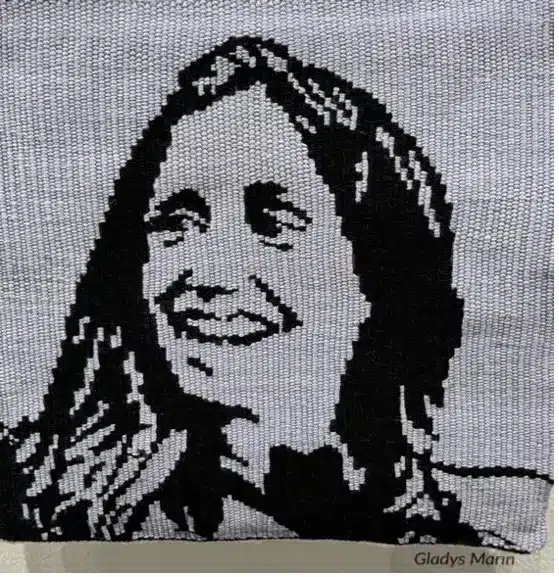
Gladys del Carmen Marín Millie (July 18, 1937 – March 6, 2005) was a Chilean activist and political figure. She was Secretary-General of the Communist Party of Chile (PCCh) (1994–2002) and then president of the PCCh until her death. She was a staunch opponent of General Augusto Pinochet and filed the first lawsuit against him, accusing him of committing human rights violations during his seventeen-year dictatorship. Gladys Marín was the youngest person ever elected to the Chilean Congress, the first woman to run for the country’s presidency, and the only female leader of a Chilean political party.